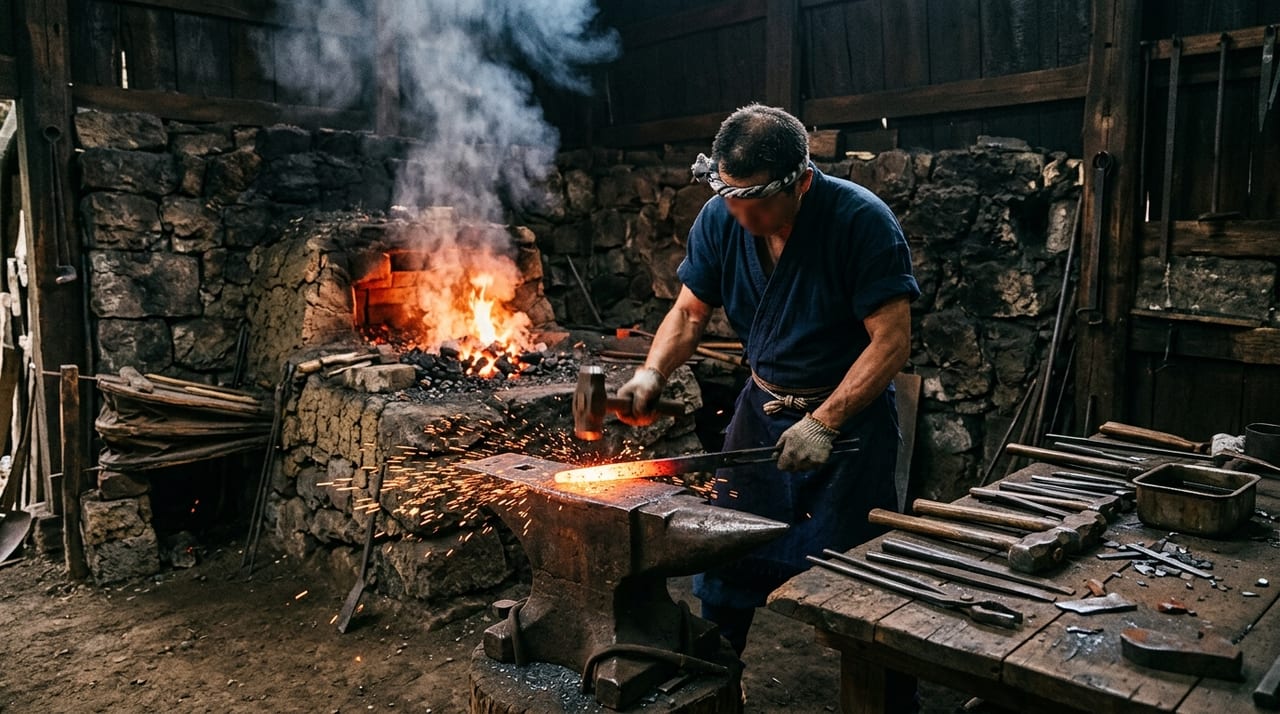
 * Image is for illustrative purposes only.
Osafune Morikage
長船盛景
Description
Morikage and Bizen Osafune in the Nanbokuchō Period
Osafune Morikage is one of the master smiths who represented the Bizen Osafune school in the Nanbokuchō period. Alongside Osafune Kanemitsu and Moromitsu, he carried the core of the era when the Bizen tradition reached its most imposing expression. The Nanbokuchō period, from the mid to late fourteenth century, when Morikage was active, was a time when internal strife created a massive demand for weapons, and the Osafune smith groups established the largest production system in the country. In this era, the Osafune school faced the challenge of balancing mass production with quality, yet it continued to produce distinctive master smiths such as Morikage.
Morikage's tachi have the imposing form characteristic of the Nanbokuchō period, and the splendid chōji-midare and powerful jigane overwhelm the viewer.
Features of the Blade: Imposing Form and the Flower of Chōji
The greatest feature of Morikage's work is first its boldly imposing "sugata." Among the large-scale constructions common to Bizen works of the Nanbokuchō period, Morikage's pieces show a particularly forceful grandeur. The curvature is relatively shallow, and the basic form is the "Nanbokuchō sugata," with a broad mihaba and solid kasane.
The hamon is centered on chōji-midare, with diverse variations such as kataochi-chōji, saka-chōji, and togari-chōji. While inheriting both the splendor of Kanemitsu and the delicacy of Kagemitsu, Morikage develops a hamon of substantial thickness that might be called "chikara no chōji" (chōji of power), a style unique to him. The nie is tightly granulated, the ashi and yō are abundant, and the activity within the hamon is pronounced. The nioiguchi is somewhat subdued, yet nie shines at key points, giving depth to the entire hamon.
The jigane is itame-nagare, with abundant ji-nie, giving it the moist quality characteristic of the Bizen tradition. The utsuri tends to show bō-utsuri, and a whitish utsuri characteristic of Osafune works can be seen.
Ōdachi and the Demand of the Era
The Nanbokuchō period saw an explosive rise in demand for ōdachi and nodachi, and Osafune smiths competed to produce large blades ranging from 2 shaku 7 sun to over 3 shaku. Morikage also produced imposing tachi within this trend of the era. The tachi signed "Bizen-no-kuni-jū Osafune Morikage" in the collection of the Fukuyama Museum of Art is designated as an Important Cultural Property.
Controlling a uniform chōji-midare across a long blade was impossible without advanced skill, and Morikage's achievement in realizing it is regarded as proof of outstanding craftsmanship even within the Osafune school.
Relationship with Kagemitsu and Kanemitsu
Morikage was not in the direct line of the main Osafune lineage (Mitsutada—Nagamitsu—Kagemitsu—Kanemitsu). Traditionally, he is regarded as a smith of the Ōmiya school, who moved from Ōmiya in Yamashiro to Bizen, and he is said to have been a son of Ōmiya Moritsugu. In recent years, some views, based on the way the signature is cut, consider him an Osafune smith descended from the Chikakage line. His style is akin to the imposing Sōden-Bizen manner of Nanbokuchō-period Kanemitsu. In terms of style, the similarity to Kanemitsu's boldness is notable, and he can be seen as a figure who brings together multiple technical lineages within the Nanbokuchō Osafune school. While Kagemitsu stands out for the delicacy of his tantō, Morikage stands out for the grandeur of his large blades, and the two offer contrasting appeals even within the same Osafune school.
TOUKENZA and Osafune Morikage
TOUKENZA presents Osafune Morikage in order to properly evaluate the achievements of the Bizen tradition during the turbulent Nanbokuchō period. Morikage's imposing chōji-midare is an answer to the challenge the age of warfare posed to smiths: the "unity of power and beauty," and that answer retains strong appeal today. Morikage's blades, in which the force of a large blade and the splendor of chōji coexist, are among the finest teaching examples for experiencing the "aesthetics of power" of the Japanese sword.
Famous Works
- Tachi signed Bizen no kuni jū Osafune Morikage (held by Fukuyama Art Museum, Important Cultural Property)