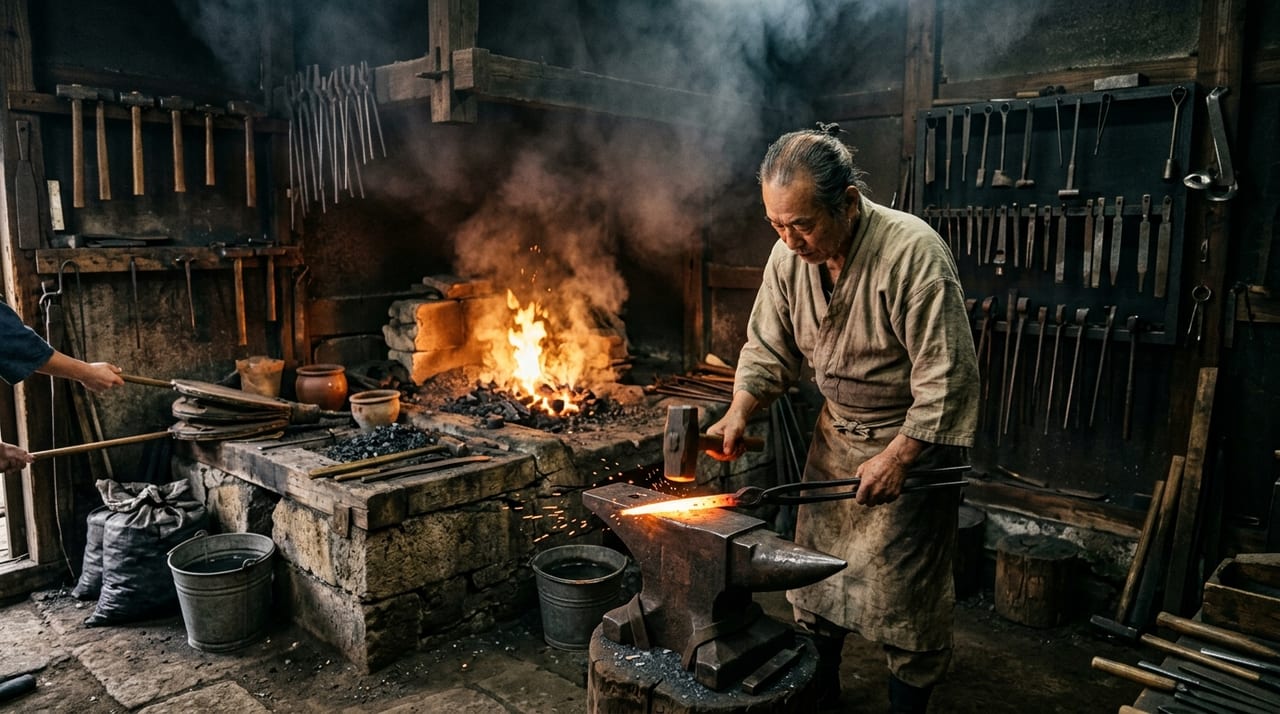
 * Image is for illustrative purposes only.
Ōhara Sanemori
大原真守
Description
Ōhara Sanemori was a swordsmith active in Ōhara in Hōki Province (present-day Tottori Prefecture) in the late Heian period. He is known as a master of the Ko-Hōki school, either the son or the successor of "Hōki Yasutsuna." As a swordsmith who directly inherited the lineage of Hōki Yasutsuna, which is indispensable when discussing the origins of the Japanese sword, and who was deeply involved in forming the technical and aesthetic norms in the earliest period of Japanese sword history, he occupies an important position in the study of Japanese sword history.
Sanemori's swords are characterized by a powerful jigane (base steel) and a gentle yet elegant hamon that are unique to the Ko-Hōki school. The jigane shows prominent ō-itame and nagare-itame, with ji-nie thickly present, and an abundance of the forging character peculiar to old works pervades the whole. This distinctive dark-tinged steel color is a product of ancient iron-making using sand iron from the San'in region, and it gives off an antique elegance not found in later swords. The hamon is often a gentle work in which suguha is combined with ko-midare and ko-chōji. The habuchi has thick, lively nie, and kinsuji and sunagashi appear within the hanaka. Overall, they embody a simple yet sublime beauty from before the kotō era, in which the grand strength of the late Heian period and a sense of calm coexist.
Swordsmiths of the Ko-Hōki school formed the Ko-Hōki lineage, with Hōki Yasutsuna as its founder, followed by Sanemori, Aritsuna, and Sadatsuna. This lineage was the group of swordsmiths that played the most important role in the process from sword-making in the Nara period to the completed form of the "Japanese sword with sori (curvature)" in the late Heian period. Within this lineage, Sanemori was a figure who bore responsibility for the transmission and development of technique as Yasutsuna's direct successor.
Signatures reading "Sanemori" and "Ōhara Sanemori" have been confirmed. However, many Heian-period swords are unsigned or bear unidentified signatures, so certainly signed examples by Sanemori are rare. For that very reason, works bearing Sanemori's signature have extremely high cultural-property value as one of the materials closest to the origins of the Japanese sword. At present, among Sanemori's works, a tachi designated as an Important Cultural Property and transmitted at Tsushima Shrine (Aichi Prefecture) is known. The Tsuchiura City Museum also holds a tachi bearing the signature "Ōhara Sanemori."
Famous Works
- Tachi signed Sanemori (Important Cultural Property, Tsushima Jinja)
- Tachi, obverse signature Ōhara Sanemori (Tsuchiura City Museum)