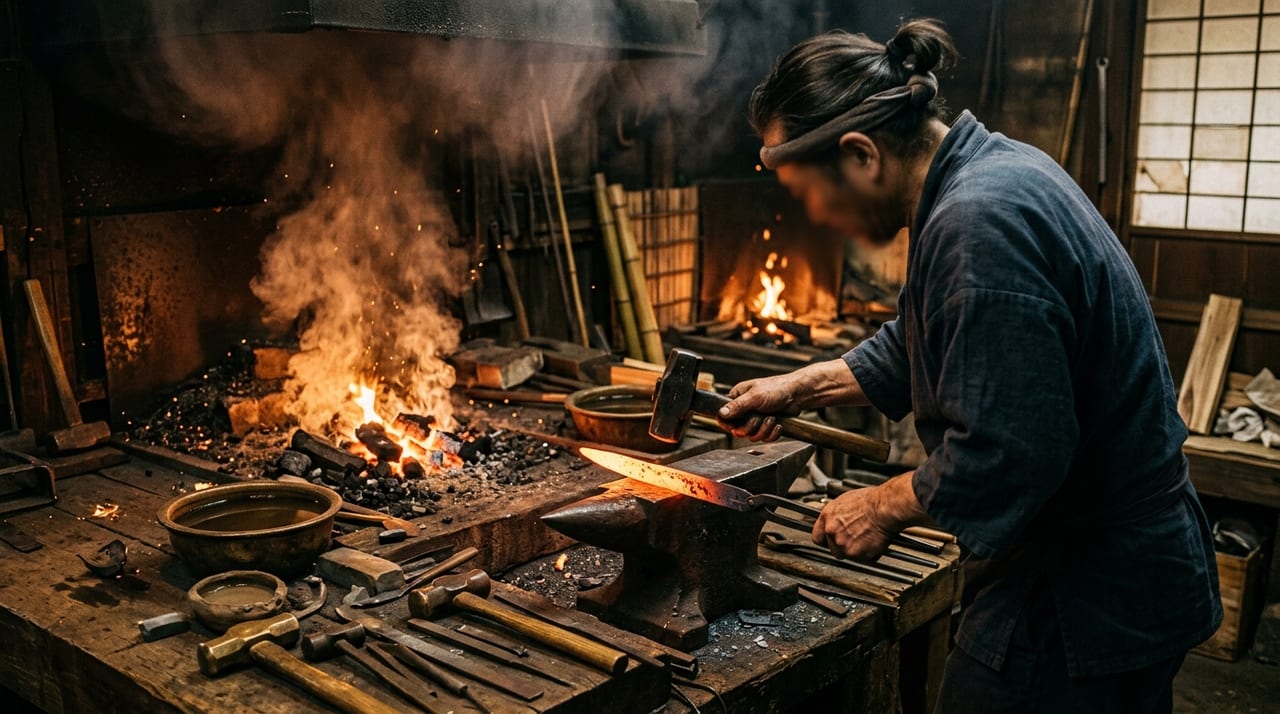
 * Image is for illustrative purposes only.
Ryumon Nobuyoshi
龍門延吉
Description
Positioning of Ryumon Nobuyoshi
Ryumon Nobuyoshi was a swordsmith active in the late Kamakura period at Ryūmon in Yoshino District, Yamato Province (the area of present-day Yoshino Town and Uda City, Nara Prefecture). He is said to have belonged to the Senjuin school, one branch of the Yamato Goha. In this area, Nobuyoshi formed a distinctive body of work while inheriting the technical foundations of the Senjuin school.
Extant signed works are extremely rare. Only a few are known, such as the tachi "Mei Nobuyoshi," which has been designated a National Treasure. Some theories regard "Nobuyoshi" as the work of two or more smiths, based on the character forms of the signature. At present, however, he is often treated as a single craftsman.
Characteristics of Style: The Fusion of Yamato and Bizen
The greatest feature of Nobuyoshi's work lies in its distinctive duality, in which Bizen-den techniques are added to the framework of the Yamato-den.
Works in the Yamato style show a tightly closed nioiguchi and a suguha-chō hamon with fine ji-nie. The jigane is itame with masame mixed in.
Works in the Bizen style display a lively hamon mixing chōji-midare and gunome, and utsuri appears in the jigane.
The National Treasure tachi "Mei Nobuyoshi" has a nagasa of 73.3 cm and a sori of 2.9 cm. Its jigane is ko-itame, with well-developed ji-nie. The hamon is ko-midare with ashiba and well-developed ko-nie. The composition, in which the yakihaba widens in the upper half, is considered a key feature for appraisal. This work is highly regarded as the benchmark among extant works by Nobuyoshi, and as one of the finest in quality. It is said to have been owned by Emperor Go-Mizunoo (1596–1680), and it was designated a National Treasure on March 31, 1953. It is now held by the Japanese Sword Museum.
Evaluation and Influence
As a swordsmith who lived at Ryumon in Yoshino and belonged to the Senjuin lineage, Nobuyoshi is indispensable to any consideration of the development of the Yamato Goha in the history of Japanese swords. His distinction lies in showing Bizen-like brilliance while maintaining the dignity of the Yamato-den. The rarity of his signed works further enhances the cultural property value of his pieces, and it is officially recognized through designation as a National Treasure.
Famous Works
- Tachi, signed Nobuyoshi (National Treasure, Japanese Sword Museum)