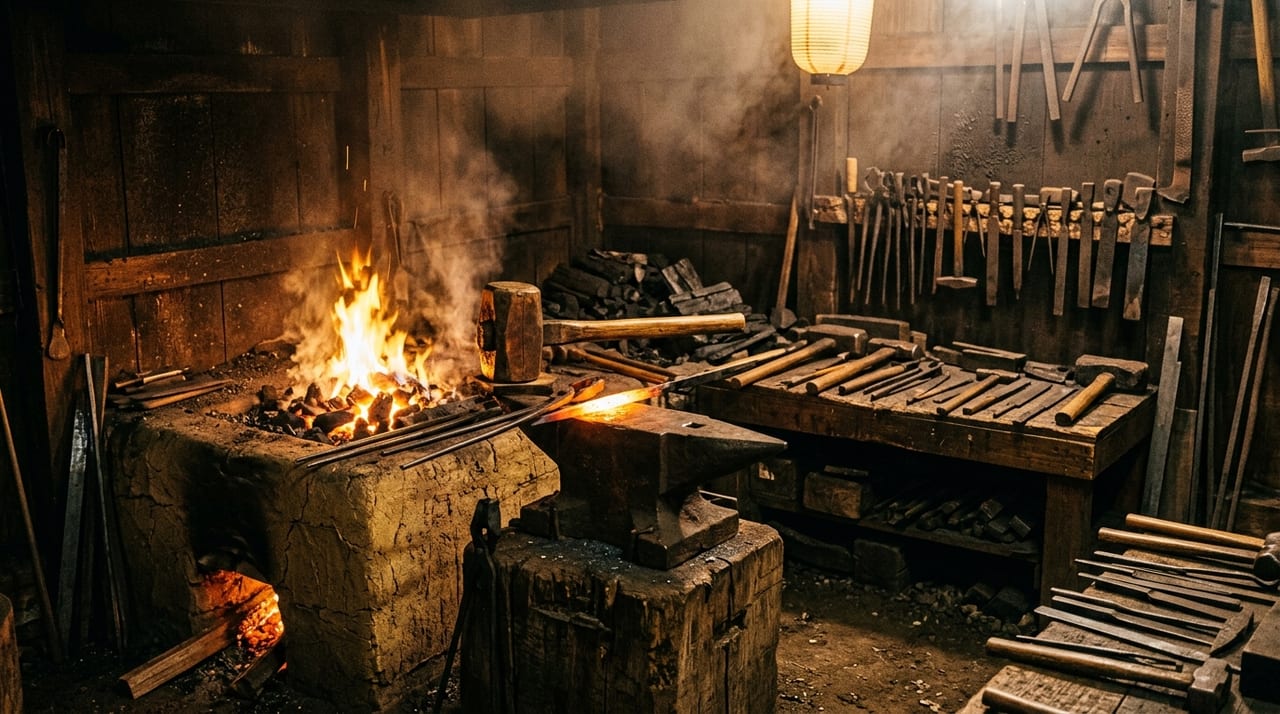
 * Image is for illustrative purposes only.
Nankai Tarō Chōson
南海太郎朝尊
Description
Nankai Tarō Chōson was a smith of the late Edo period and the bakumatsu era, active in Kyoto, Edo and elsewhere. He was a native of Tosa Province (present-day Kochi Prefecture) and worked in the shinshintō period. His real name was Morioka Tomonosuke, and "Nankai Tarō Chōson" was an art-name-like signature he used on his blades. In Kyoto he studied under Iga-no-kami Kinmichi, and in Edo under Suishinshi Masahide. During the Tenpō era he made swords near Yushima Tenjin in Edo.
The most distinctive feature of Chōson's work lies in the combination of a forging method that strongly reflects an awareness of reviving kotō (old swords) with original hamon. His jigane shows fine, dense ko-itame, with a depth and moisture reminiscent of old work. His hamon are varied, including gunome, chōji and ō-midare.
Takechi Hanpeita, who led the Tosa Loyalist Party (Tosa Kinnōtō), purchased a sword by Chōson on his return from a warrior's training journey in 1860 and kept it in his possession.
Known signatures include "Nankai Tarō Chōson," "Chōson," "Morioka Chōson saku" and "Yamashiro no kuni Hataeda gū Chōson." His taihai ranges from the standard naka-kissaki of the late bakumatsu period to bold forms with a broad-tipped kissaki, and his skill in flexibly meeting customers' requests can be seen.
The Kyoto National Museum holds a tantō signed "Yamashiro no kuni Hataeda gū Chōson." His writings include the Tōken Gogyōron. He is known as an accomplished theorist, yet his works are also said not to follow his theories. He died in Kyoto in Keiō 1 (1865).
Famous Works
- Tantō, signed Yamashiro-no-kuni Hatae ni yosu Chōson (Kyoto National Museum)