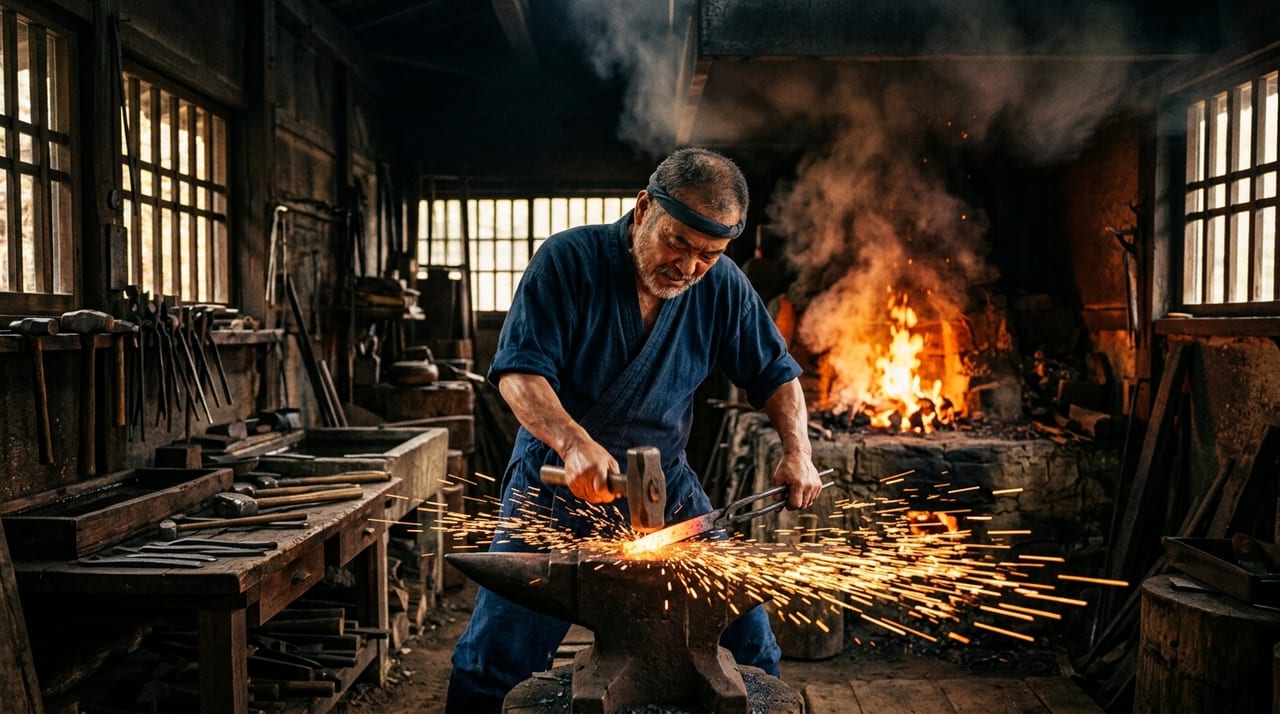
 * Image is for illustrative purposes only.
Naminohira Yukitaka
波平行高
Description
Naminohira Yukitaka—Master Craftsman of the Kamakura Period Bearing the Foundational Lineage of Satsuma Swords
Naminohira Yukitaka was a sword smith active in Satsuma Province (present-day Kagoshima Prefecture) in the late Kamakura period, spanning the Kagenʼen to Genkyō eras (ca. 1303–1324), and is recorded in Japanese sword history as one of the master craftsmen representative of the Naminohira school. The Naminohira school was a major sword-smith community based at Naminohira in Satsuma Province at Japan's southern tip, and it is said that its origins trace back to the late Heian period. Yukitaka lived as a craftsman of the late Kamakura period within this long lineage and stands as a representative figure of the era when the technical and artistic standards of the Naminohira school were high.
Satsuma Province was located at the southern tip of Kyushu and developed in a geographically and culturally distinctive manner. Under the powerful rule of the Shimazu clan, the samurai culture of Satsuma nurtured a unique spirit, and from it emerged the Satsuma sword. The Naminohira school formed the core of Satsuma's sword-smith culture and, from the late Heian period through the early Meiji era, continued to forge swords in Satsuma for nearly a thousand years—one of the longest-lived sword-smith lineages in the history of Japanese swords. The sword work of Yukitaka, as relatively early work within the history of the Naminohira school, serves as precious material demonstrating the level of Satsuma swords during the Kamakura period.
Technical Characteristics of the Naminohira Tradition and Yukitaka's Style
The sword work of the Naminohira school possessed distinctive techniques arising from its geographical position at the southern tip of Kyushu. The raw iron—sand iron and tamahagane—was sourced from Satsuma and various regions of Kyushu, and this iron quality, different from that of the Yamashiro, Bizen, and Sōshū materials of the mainland, created the distinctive ground-steel atmosphere unique to Naminohira swords. The ground steel frequently exhibited a rough texture ranging from itamehada to masame grain, possessing a rustic and vigorous quality distinct from the refined, tightly-packed surface of the mainland's renowned production centers.
The blade pattern was primarily straight temper, with coarse granulation appearing prominently being a characteristic feature of the Naminohira school. This abundant granulation brought granular white lustre to the blade edge, forming a rugged yet magnificent appearance. Gold lines and stream-pattern activity frequently worked richly within the blade, and the combination of the coarse-granule intensity with the activity within the blade became the distinctive point of interest of Naminohira swords. Yukitaka's work exhibits these typical characteristics of the Naminohira sword while also possessing the dignified proportioning of the Kamakura period, in which a sense of period refinement is felt.
Body Proportions and Sword Form—The Elegance of the Late Kamakura Period
The extant work of Yukitaka is primarily in tachi form and exhibits the typical proportions of the late Kamakura period. There is little difference between the width at the base and width at the point, with a moderate curve and well-balanced form showing the transitional character from late Kamakura into the Nanbokuchō period. Though geographically distant from the central court culture due to being located at the southern tip of Kyushu, the craftsmen of Naminohira received influence from the mainland while establishing their own distinctive style. The tachi form of Yukitaka's blades is solid in form, reflecting Satsuma's practical martial spirit, yet loses none of the dignity that Kamakura-period samurai culture possessed.
The tang exhibits distinctive forms particular to the Naminohira school, with the signature cut as "Yukitaka" or "Naminohira Yukitaka." The study of Naminohira signatures forms an important field within Satsuma sword research, and research continues today in identifying individual craftsmen through the calligraphy and form of signatures and the manner of tang construction.
Satsuma Swords and the Sword Culture of the Ryūkyū and Kyushu Regions
The Satsuma swords of the Naminohira school possessed a distinctive distribution network unlike that of mainland swords. The principal clientele of Naminohira swords were the island communities of the southwestern archipelago extending from Satsuma through Ryūkyū (present-day Okinawa) and the Amami Islands, as well as samurai society throughout Kyushu. Even in the Ryūkyū Kingdom, Naminohira swords were highly prized, and it is believed that some of the swords worn by Ryūkyūan samurai were Naminohira swords.
This broad distribution demonstrates that Naminohira swords transcended being a product of Satsuma alone and represented a core presence in the sword culture of southwestern Japan as a whole. It is inferred that Yukitaka's sword work similarly circulated through these distribution networks and was widely used, being deeply connected to the daily lives of samurai in Kyushu and the southwestern archipelago.
Present-Day Evaluation of Naminohira Yukitaka
In modern Japanese sword research, Naminohira Yukitaka holds an important position as a craftsman representative of the Kamakura period of the Satsuma and Naminohira schools. Though limited in number, his extant works are each regarded as precious material demonstrating the technical level of the Naminohira school during the Kamakura period, drawing attention from researchers and enthusiasts. Among the works of the Naminohira school designated as Important Cultural Property or Important Art Object are blades by Yukitaka or contemporary Naminohira craftsmen, with works of high appreciation value having been transmitted to the present day.
Naminohira Yukitaka is presented as a master craftsman representative of the Kamakura period of the Satsuma Naminohira school, occupying a distinctive position in the history of Japanese swords. The appeal of Satsuma swords, possessing distinctive aesthetics and techniques distinct from those of the mainland's major production centers, is a testament to the diversity and regional richness of Japanese swords, with the aim of conveying to present-day enthusiasts the unique sword beauty created by the samurai culture of southwestern Japan.
Famous Works
- 太刀(重要美術品)
- 太刀(神社所蔵)