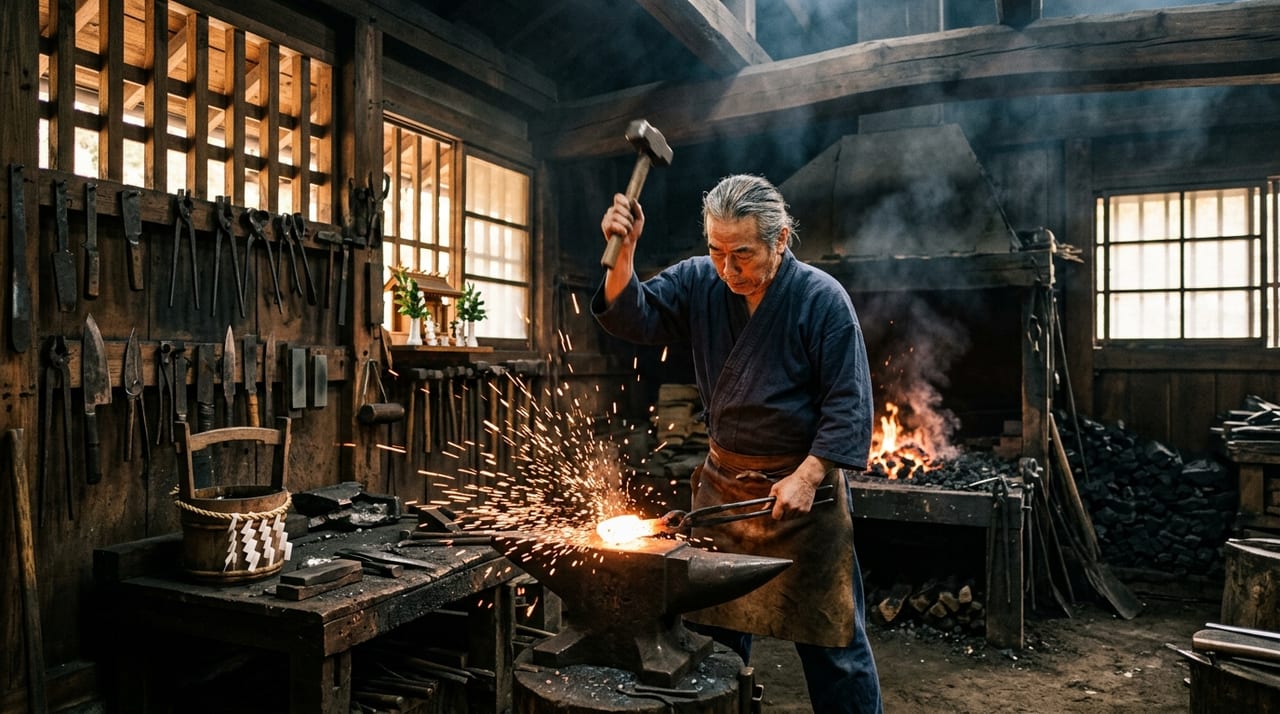
 * Image is for illustrative purposes only.
Naminohira Yasukuni
波平安国
Description
Historical Background of the Naminohira School and Characteristics of Satsuma Blades
The Naminohira School is one of the longest-established traditions in Japanese sword history, with an active period spanning approximately 700 years from the late Heian period through the end of the Edo period. Based in Naminohira, Yatsuyama District, Satsuma Province (in present-day Kagoshima Prefecture, near Kagoshima City's East Yatsuyama area), successive smiths maintained the school's continuity by consistently using the character yasu (安) in their signatures. These signature characters—appearing in names such as Yasutsune, Yasukuni, Yasuyoshi, Yasuitie, Yasutsugi, and Yasunori—serve as the most important distinguishing mark of the Naminohira School from other traditions and are recognized as a symbol of Satsuma blades.
Naminohira Yasukuni was a principal smith of the Naminohira School active during the Kamakura period and is positioned in sword history as a craftsman representing the standard of Satsuma blades in this era. While multiple generations of Naminohira smiths may have borne the name Yasukuni, the works of the Kamakura-period Yasukuni consist primarily of long tachi forms, reflecting the practical weapon needs of the warrior society of the time.
The Work Style of Naminohira Yasukuni
A technical characteristic shared across the entire Naminohira School is a work style strongly influenced by the Yamato tradition. This aligns with the tradition that the school's founder migrated from Yamato to Satsuma, and the characteristic texture of Naminohira steel is typified by masame-hada or itame-hada with masame elements mixed throughout.
Yasukuni's steel likewise features itame-hada with a masame bias, with a calm grain pattern and uniform forging. Satsuma steel is said to possess unique qualities, notably the characteristic shirake (white radiance) that appears in the jigane, and this distinctive Satsuma whiteness is evident throughout the steel of Yasukuni's works.
The hamon features straight-edge (suguha) as its primary form, often interspersed with subtle ko-midare and ko-gunome patterns, resulting in a calm hamon composition. Influenced by the Yamato tradition, the work style is characterized by suguha-dominated, restrained hamon; however, as time progressed toward the Nanboku-chō period, the pattern became more turbulent. The works of Kamakura-period Yasukuni typically display relatively orderly suguha-style hamon. The ha-edge nié is fine and uniform, with a tight, restrained nioi-guchi.
The hamon point (bōshi) features a straight form with a subtle round turn, a typical style reflecting Yamato tradition influence. The tang (nakago) typically bears a two-character signature reading 'Yasukuni,' though some examples carry a longer signature including the school name 'Naminohira Yasukuni.' Kamakura-period Yasukuni's signatures are generally cut in straightforward kaisho script and serve as an important reference standard for dating when compared with signatures of later Naminohira smiths.
The Social Role of Naminohira Yasukuni in Satsuma
Satsuma has long served as a frontier defense region prepared for external conflict, and its geographic position at the southern tip of Kyushu fostered a unique martial culture. As the Kamakura shogunate was established and local warrior groups in Satsuma became organized, Naminohira smiths functioned as important suppliers meeting the weapon needs of Satsuma warriors.
The prevalence of long tachi among Yasukuni's works reflects the weapon demands of Kamakura-period mounted cavalry tactics and use from horseback, demonstrating close ties to the warrior society of the era. Satsuma's local warriors (gokenin) participated in the Bunei and Kōan campaigns (Mongol Invasions) as bakufu gokenin, and Satsuma blades are believed to have played an important role in these conflicts.
Sword-Historical Evaluation of Naminohira Yasukuni
In modern sword research, Naminohira Yasukuni occupies an important position as a benchmark work exemplifying the standard style of the Naminohira School during the Kamakura period. Works by Yasukuni are held in institutions such as the Kyushu National Museum and the Kagoshima Prefectural History and Heritage Center (Reimei-kan), where they are utilized as essential materials in historical research on Satsuma blades.
TOUKENZA presents Naminohira Yasukuni as a principal figure of the Kamakura period in the Naminohira School's 700-year history, positioning him as an embodiment of the rich development of Japanese sword culture in the frontier region of Satsuma.
Famous Works
- 太刀(九州国立博物館所蔵)
- 太刀(黎明館所蔵・薩摩伝来)