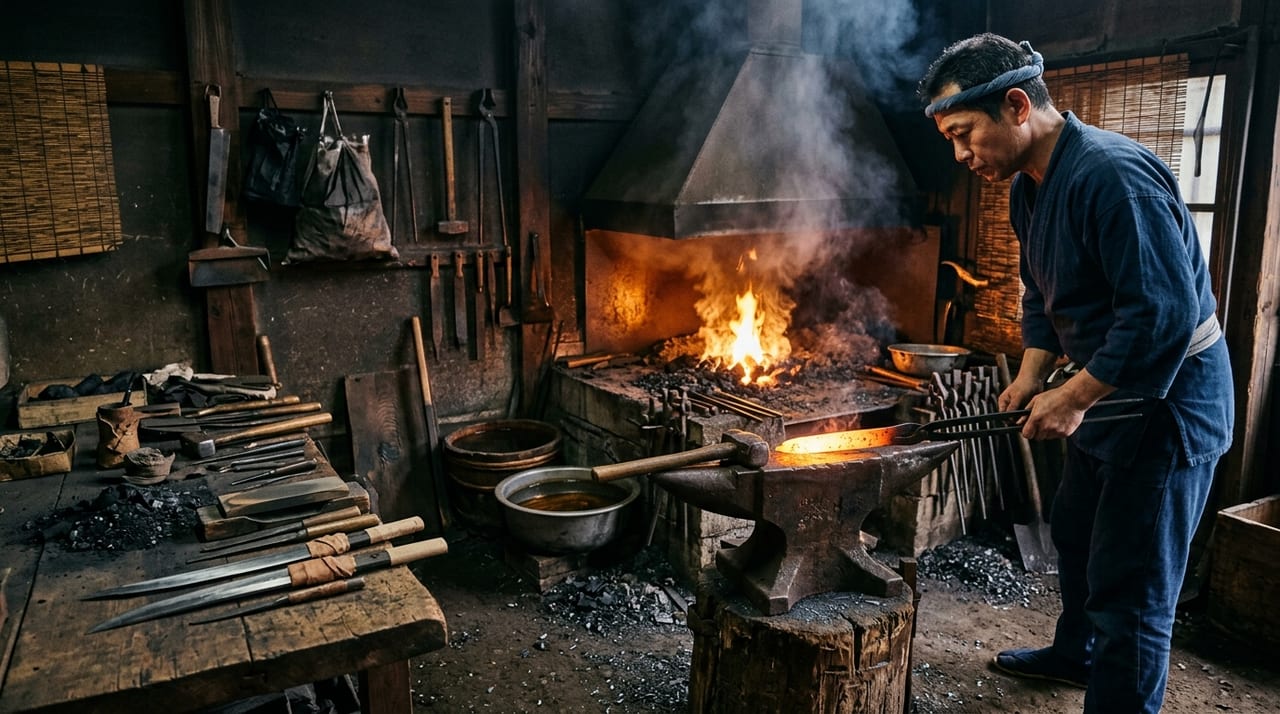
 * Image is for illustrative purposes only.
Mokusa
舞草
Description
Overview
Mokusa was a group of swordsmiths based in Mokusa, Iwai District, Mutsu Province (present-day Maikawa, Ichinoseki City, Iwate Prefecture). Active in the late Heian period, it is considered one of the oldest swordsmith groups in Japan. It is credited with producing blades with a curve suited to actual combat, which gives it a founding place in the history of the Japanese sword. Its blades are known as Mokusa-tō, and the Ichinoseki City Museum holds surviving works such as a tachi signed "Mokusa."
Lineage from the Warabite-tō
Whereas earlier swords were straight blades without curve, the defining feature of Mokusa blades is their curve. One view holds that this curve arose under the influence of the slight curvature of the warabite-tō, swords used since the Kofun period by the Emishi of the Tōhoku region. Mokusa blades are therefore positioned as a lineal presence connected with the establishment of the curve in the Japanese sword.
Patronage of the Ōshū Fujiwara
The Mokusa school flourished under the patronage of the Ōshū Fujiwara, who built their wealth on gold and horses from Ōshū, with their base at Hiraizumi. Mokusa blades were called Ōshū-tō, and are reportedly favored by Minamoto no Yoshiie and by warriors in Kyoto.
Decline
In Bunji 5 (1189), when Minamoto no Yoritomo's Ōshū campaign destroyed the Ōshū Fujiwara, the Mokusa school lost its patrons. Some smiths reportedly moved to Kamakura on Yoritomo's order, but most are said to have scattered across the country. However, the name of the Mokusa smiths remains in the sword records until the Muromachi period.
Present-day Standing
The Ichinoseki City Museum houses and exhibits Mokusa blades and related materials. As a group of smiths who bridged the transition from the warabite-tō to the Japanese sword, Mokusa is positioned as one of the wellsprings of Japanese sword history.
Famous Works
- Tachi, signed Mokusa (Ichinoseki City Museum)