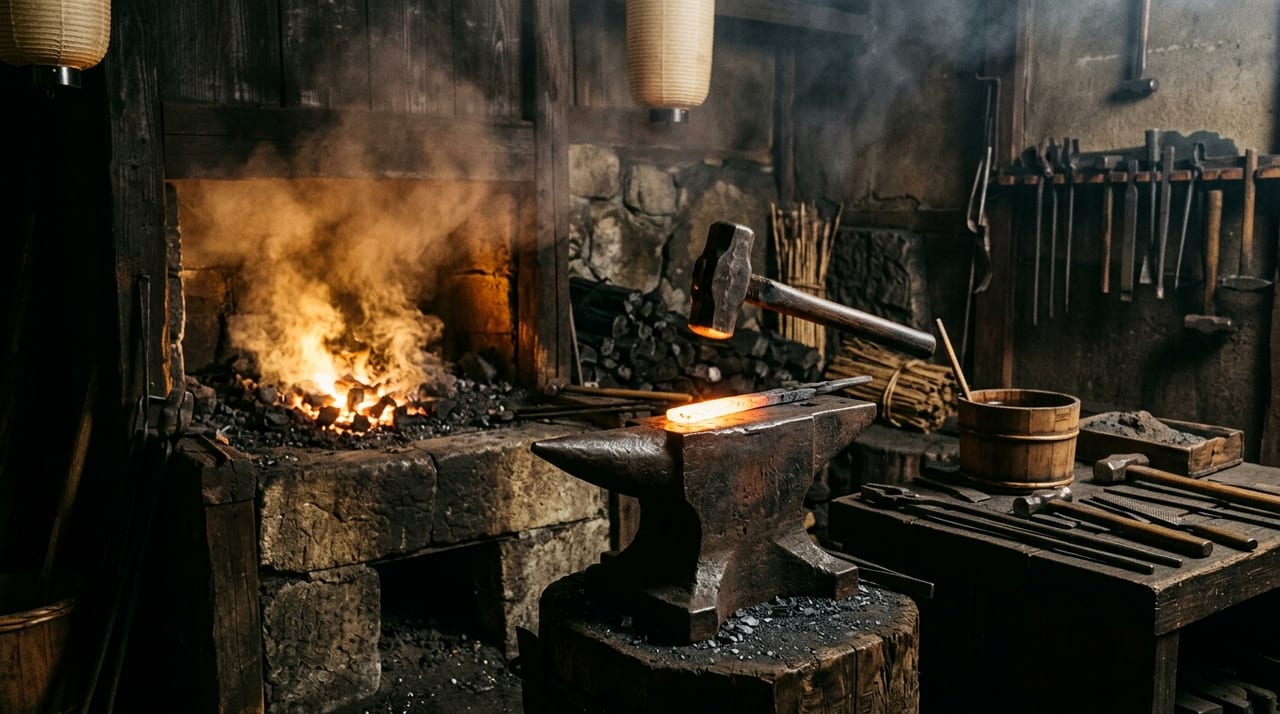
 * Image is for illustrative purposes only.
Miyamoto Kanenori
宮本包則
Description
Origins and Apprenticeship under Yokoyama Sukekane
Miyamoto Kanenori (1830-1926) was a swordsmith born in the thirteenth year of the Bunsei era (1830), the second son of a brewer in Hōki Province (in present-day Misasa Town, Tōhaku District, Tottori Prefecture). His real name was Shigahiko and his childhood name was Sawajirō. It is said that he aspired to become a swordsmith in admiration of the legendary master of his home region, Yasutsuna (Hōki Yasutsuna). In the fourth year of the Kaei era (1851), at the age of 22, he visited Osafune in Bizen Province (present-day Setouchi City, Okayama Prefecture) and became a disciple of Yokoyama Sukekane. It is said that he was initially refused entry by Yokoyama Sukenaga, also of Osafune, and under Sukekane he thoroughly mastered the Bizen-den forging techniques over seven years. Within this master–disciple relationship, he is said to have received the "Kane" element of his master's name and begun calling himself Kanenori.
Activities in the Bakumatsu Period and the Boshin War
In the fourth year of the Ansei era (1857) he returned home and became a retainer smith of Arao Naonari, karō of the Tottori Domain and lord of Kurayoshi. In the third year of the Bunkyū era (1863), he established his own forge at Sanjō Horikawa in Kyoto and made swords to order for samurai of various domains who took part in the sonnō jōi movement. He received the patronage of Prince Arisugawa Taruhito, and in the third year of the Keiō era (1867) was granted the honorary title Noto-no-kami. During the turmoil of the Boshin War, he forged swords for samurai from a position of supporting the imperial forces, and he retreated to Fushimi Inari Taisha to make votive swords, thereby firmly establishing his standing as a swordsmith amid the upheavals of the late Edo period.
Style Based on the Bizen Tradition
Miyamoto Kanenori's style is founded on the Bizen tradition, modeled on the nioi-deki, gunome-chōji, and kaen-kissaki of Bizen Osafune Kanemitsu, and he also explored the Sōshū-den and Yamashiro-den as research. Compared with the splendid works of Gassan Sadakazu, a fellow Teishitsu Gigeiin (Imperial Household Artist), his works are often sober and classical; his jigane is refined, and at times he also left majestic works that evoke the Sōshū-den Masamune. This style, while responding to changes in demand for swords from the late Edo to the Meiji period, played a role in transmitting the classical technical foundation of the Bizen tradition into the modern era.
Appointment as Teishitsu Gigeiin and Service to the Imperial Household
In April 1906, Miyamoto Kanenori, together with Gassan Sadakazu, became the first swordsmiths to be appointed Teishitsu Gigeiin. The Teishitsu Gigeiin title was established in a modernizing Japan for the purpose of preserving traditional craft techniques, and it is the highest honor, said to be the forerunner of the later system of Living National Treasures (Important Intangible Cultural Property Holders). In 1915, on the occasion of the accession ceremony of Emperor Taishō, he was ordered to make a daigensuitō, and he also forged the mamori-gatana of the Prince Regent (later Emperor Shōwa) and Prince Chichibu, as well as the shinpō tōken for the shikinen sengū of Ise Grand Shrine and for Heian Jingū and Meiji Jingū. He is positioned as the last goyō-kaji who served the imperial household across four reigns: Emperor Kōmei, Emperor Meiji, Emperor Taishō, and Emperor Shōwa.
Longevity and Historical Significance
Miyamoto Kanenori continued making swords into his nineties, and died on October 24, 1926, at the age of 97. A long career as a swordsmith spanning 75 years, counted from his apprenticeship at age 22, is a rare example of activity that spanned the major turning points in the history of Japanese swords, from the turmoil of the late Edo period through the Meiji modernization to the imperial ceremonies of the Taishō and early Shōwa periods. His style, based on the Bizen tradition while also exploring the Sōshū-den and Yamashiro-den, and his attainment of the highest honor of Teishitsu Gigeiin, convey today the great importance of Miyamoto Kanenori in the history of modern Japanese swords. His grave is at Somei Cemetery in Tokyo.
Famous Works
- Daigensuitō (Supreme Commander's sword) for the Enthronement Ceremony of Emperor Taishō (1915)
- Tachi, sacred treasure for the Shikinen Sengū of Ise Shrine (1886)