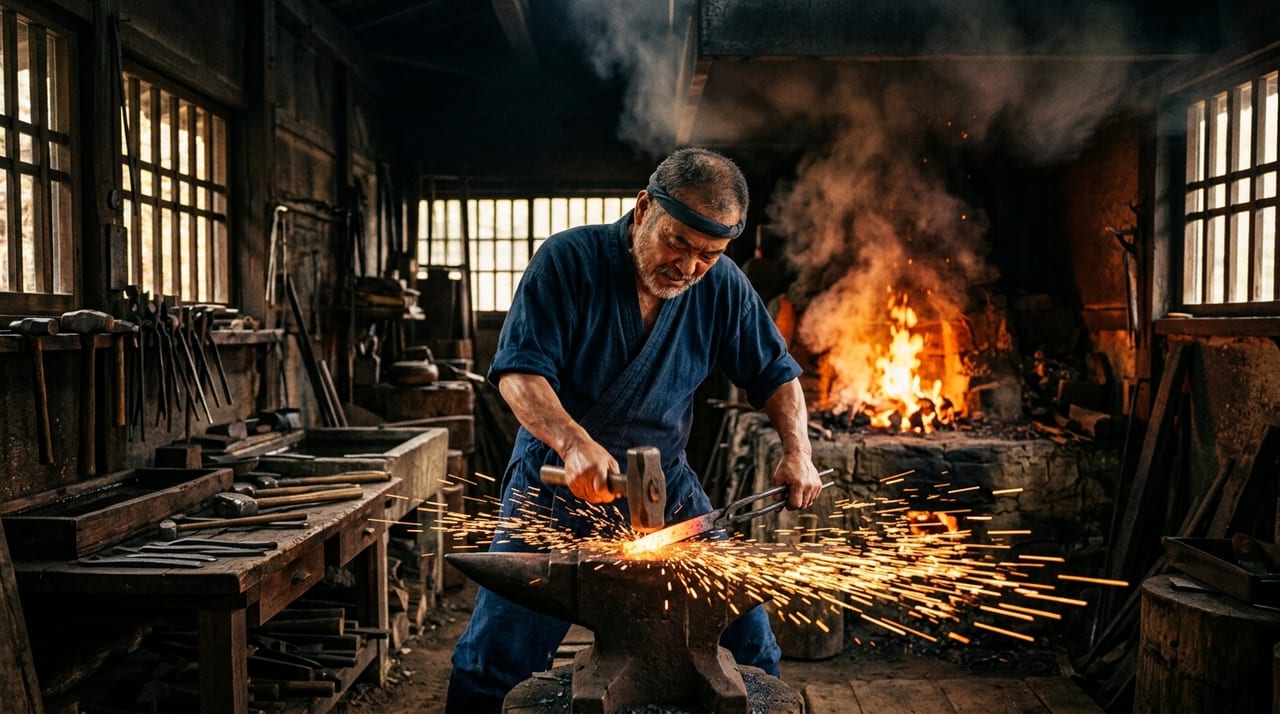
 * Image is for illustrative purposes only.
Mino Senjuin (Akasaka Senjuin)
美濃千手院(赤坂千手院)
Description
Lineage and School
Mino Senjuin traces its origins to the Senjuin school, one of the Yamato Five Schools. The Senjuin school was a group of swordsmiths of priestly status affiliated with Tōdai-ji in Nara. They lived in the Senjudani valley at the foot of Mt. Wakakusa, and the school is said to have taken its name from the Senjuin hall there, whose principal image was Senju Kannon. It is regarded as the oldest of the Yamato Five Schools; its founders are traditionally given as Yukinobu and Shigehiro, though no securely attributable extant signed works survive. During the Nanbokuchō period, part of this Yamato Senjuin school moved to Akasaka in Fuwa District, Mino Province (present-day Akasaka, Ōgaki City, Gifu Prefecture), founding a branch also known as the Akasaka Senjuin. It flourished in Mino until the late Muromachi period.
Style
The jigane is generally characterized by well-forged itame grain that is comparatively refined; on finer examples, ko-itame is densely packed, with masame prominent along the shinogi-ji, and this is said to be characteristic. The hamon is not uniform, ranging from pieces with a suguha hamon to those with a nie-based gunome-midare in which sunagashi and kinsuji are vigorously active within the blade. Unlike typical Mino work, Mino Senjuin is distinguished by its strong retention of the coloring of the Yamato Senjuin style.
Assessment
The school is evaluated as one that carried Yamato-tradition techniques into the Mino region, positioned as a bridge between the Yamato and Mino traditions. Within the group of Mino smiths, it is said to stand apart from other Mino work in that it strongly retains the stylistic character of the Yamato Senjuin.