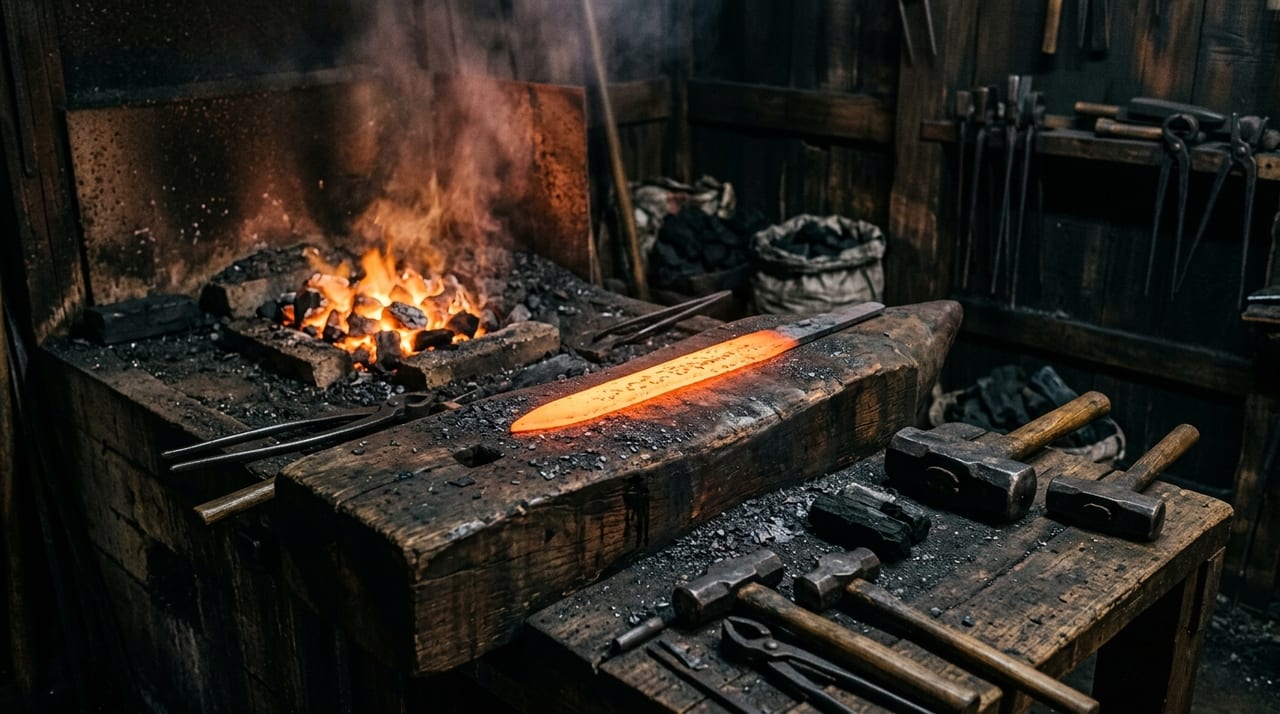
 * Image is for illustrative purposes only.
Mino Kaneshige
美濃金重
Description
Mino Kaneshige was a swordsmith active during the late Kamakura period through the Nanbokuchō period, counted among the "Ten Great Disciples of Masamune" (Masamune Jittetsu) as a master smith and close disciple of Masamune, the great master of the Sōshū tradition. According to tradition, he originally dwelled in Tsuruga in Echizen Province, and later relocated to Seki in Mino Province (present-day Seki City, Gifu Prefecture), where he trained disciples. Because of his instruction there, he is regarded as the de facto founder of the later Seki swordsmithing community, and particularly of the Mino tradition—one of the Five Great Traditions (Gokaden).
The blades crafted by Kaneshige are distinguished by the vigorous nie-based activity characteristic of the Sōshū tradition, and by the jigane rich with chikei inherited from his master Masamune. The jigane exhibits flowing itame with abundant chikei and thick jinie, displaying a bright and keen finish in nie-based character. The hamon is composed primarily of gunome and notare, with prominent display of kinsuji, sunagashi, inazuma, and kuichigaiha patterns. In particular, the intense activity of kinsuji and sunagashi is typical of the Sōshū tradition in the lineages of Masamune and Sadamuné, and attests that Kaneshige was among the Ten Great Disciples of Masamune who most faithfully embodied his master's style.
At the same time, Kaneshige's blades clearly show elements that foreshadow the later Mino tradition. The pointed gunome and the strongly flowing masame jigane are the source of the aesthetic direction of Seki swordsmithing of the Muromachi and Sengoku periods, exemplified by smiths such as Seki Kanemoto and Seki Kanesada. This attests the path by which Sōshū technique, mediated through Kaneshige, was transplanted and became established in the Mino region—a major episode of regional diffusion in Japanese sword history. In this sense, Kaneshige is a rare figure who, while continuing in the lineage of those who perfected the Sōshū tradition, simultaneously became the founder of a new regional tradition.
His signature is the two-character mei "Kaneshige," and signed works such as tantō survive. The forms range broadly—from those displaying the robust, splendid appearance with large kissaki characteristic of the Nanbokuchō period, to those with relatively restrained medium-kissaki form—revealing Kaneshige as a craftsman working during a period of transition both stylistically and chronologically. The number of surviving signed works is small.
Mino Kaneshige is highly esteemed as a figure whose name is simultaneously inscribed in two important contexts of Japanese sword history—as one of the Ten Great Disciples of Masamune and as the founder of the Mino tradition. Kaneshige's existence, linking the robustness of the Sōshū tradition with the rationality of the Mino tradition, stands as an indispensable point of reference for understanding the regional development of the Gokaden.