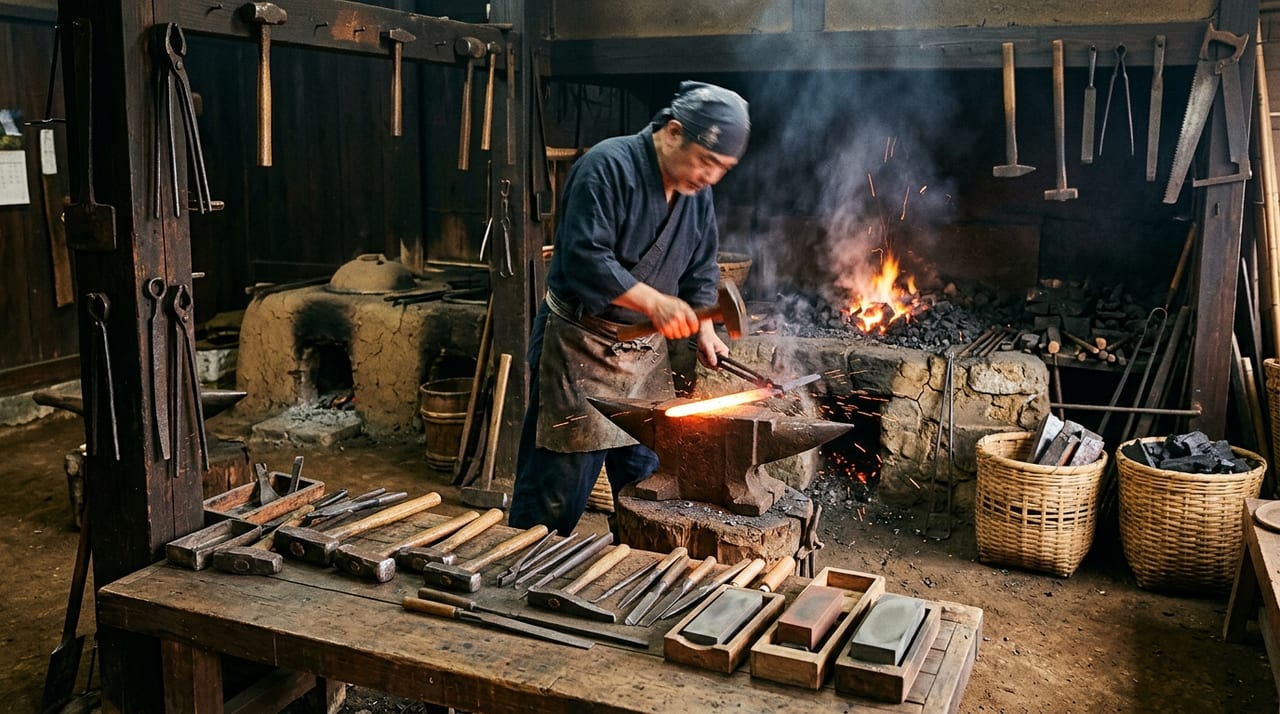
 * Image is for illustrative purposes only.
Ko-Ichimonji Sukemune
古一文字助宗
Description
Ko-Ichimonji Sukemune: A Master of the Dawn of Bizen Blades
Ko-Ichimonji Sukemune was a smith active in Bizen Province (present-day Okayama Prefecture) in the early Kamakura period, from the Kenkyū to the Jōkyū eras (around 1190 to 1220). He is one of the most important craftsmen in the founding period of the Ichimonji school (Ichimonji-ha), and he holds a brilliant place in the history of Japanese swords. The Ichimonji school is a collective term for groups of smiths who inscribed the single character 一 (ichi) as their mei. It was the leading school of Bizen in the Kamakura period and included smiths who were selected as goban-kaji (smiths on duty) for Retired Emperor Go-Toba. Sukemune is said to have been a son of Norimune, who is regarded as the founder of the Ichimonji school. It is also recorded that he was among the smiths listed for the ninth-month duty in Go-Toba's goban-kaji. As a smith of the Ko-Ichimonji group, the oldest layer of the Ichimonji school, he laid the foundations for the school's later flourishing.
Retired Emperor Go-Toba is known as an emperor who deeply loved swords. He summoned skilled smiths from across the country to the palace and had them forge blades on a monthly rotation (tsukiban). Through this goban-kaji system, the smiths of Bizen Ichimonji were exposed to the most refined connoisseurship, and they had the opportunity to absorb the influence of court culture into their work. Sukemune's period coincided with the height of the goban-kaji system, and many masterpieces born from this happy exchange between the court and the smiths have been handed down to the present day.
The Jigane and Hamon of Ko-Ichimonji: The Pinnacle of Japanese Sword Beauty
In the world of Japanese sword appreciation, the blades of the Ko-Ichimonji smiths are ranked among the highest achievements, and Sukemune's work is no exception. The jigane (steel surface) shows tight ko-itame (small burl-like grain), is very fine, and carries a vivid utsuri (reflection). This is a typical feature of Ko-Bizen and Ko-Ichimonji blades. The utsuri appears as a pale, band-like light running across the blade, a dreamlike optical effect. It is an aesthetic phenomenon unique to the Bizen-den tradition, produced by high-quality Bizen steel combined with precise forging technique.
The hamon is basically a suguha-style pattern of small midare mixed with ko-chōji (small clove-shaped patterns). The jūka-chōji (double-flowered chōji), in which one chōji rests on top of another, is a splendid form seen at the height of the Fukuoka Ichimonji in the mid-Kamakura period. The ashi (leg-like lines) and yō (leaf-like forms) are active, and the view within the hamon changes richly. The nie (crystalline particles) are fine and even, and across the whole surface the nioiguchi (the edge boundary) shows a vivid, tightly defined beauty.
Tachi Form and Proportions: Kamakura-Period Elegance
Sukemune's tachi show the typical taihai (proportions) of the early Kamakura period. They have a high koshi-zori (curvature near the hilt) and a graceful form that tapers finely toward the tip. Tachi of the early Kamakura period combine the elegance of the Heian era with the practicality of the warrior society of Kamakura, and Sukemune's tachi form can be called a crystallization of the aesthetics of its time. The kasane (blade thickness) is moderate, and the sori (curvature) is deep in the way typical of the early Kamakura period.
On blades that retain their ubu-nakago (original, unaltered tang), a form peculiar to Ko-Ichimonji can be seen. The mei is cut in two characters, "Sukemune." The name Ichimonji school derives from the fact that the smiths of this lineage cut the character 一 (ichi) on their tangs.
Extant Works and Cultural Property Designations
Few of Ko-Ichimonji Sukemune's extant works survive, but they are known for their high quality. A tachi bearing the mei Sukemune, which was held by Uesugi Kagekatsu as a favorite blade and is kept at Matsugasaki Shrine in Yonezawa, Yamagata Prefecture, with its kawazutsumi tachi-goshirae (rawhide-wrapped tachi mounting), is designated an Important Cultural Property.
Some oshigata (paper rubbings of blade surfaces) are recorded in renowned sword literature since the Edo period, and the blades have long been objects of appreciation and study. Even today, in the world of sword appraisal, Ko-Ichimonji is firmly established as the "pinnacle of kotō (old swords)," and Sukemune's standing within that tradition is unshaken.
The Cultural and Historical Significance of Ko-Ichimonji
The early Kamakura period, when the Ko-Ichimonji blades were made, was the time when the Japanese sword was established as the spiritual symbol of warrior culture. After Minamoto no Yoritomo established the Kamakura shogunate (1192) and warriors became the leading class of society, the cultural value of swords rose markedly. The Ko-Ichimonji smiths answered these demands of their era and opened new heights for the Japanese sword, both technically and aesthetically.
TOUKENZA presents Ko-Ichimonji Sukemune as a master smith who embodies the golden age of the Kamakura sword. Its aim is to convey to contemporary enthusiasts the world of Sukemune's blades, in which the three beauties of the Bizen-den tradition, chōji-midare, the utsuri, and the fine, tight jigane, crystallize. To hold a blade by Sukemune is to return to the origins of Japanese sword art, and it is an experience of facing directly the summit of sword art that the warrior culture of the Kamakura period offers to the world.
Famous Works
- tachi (Important Cultural Property)