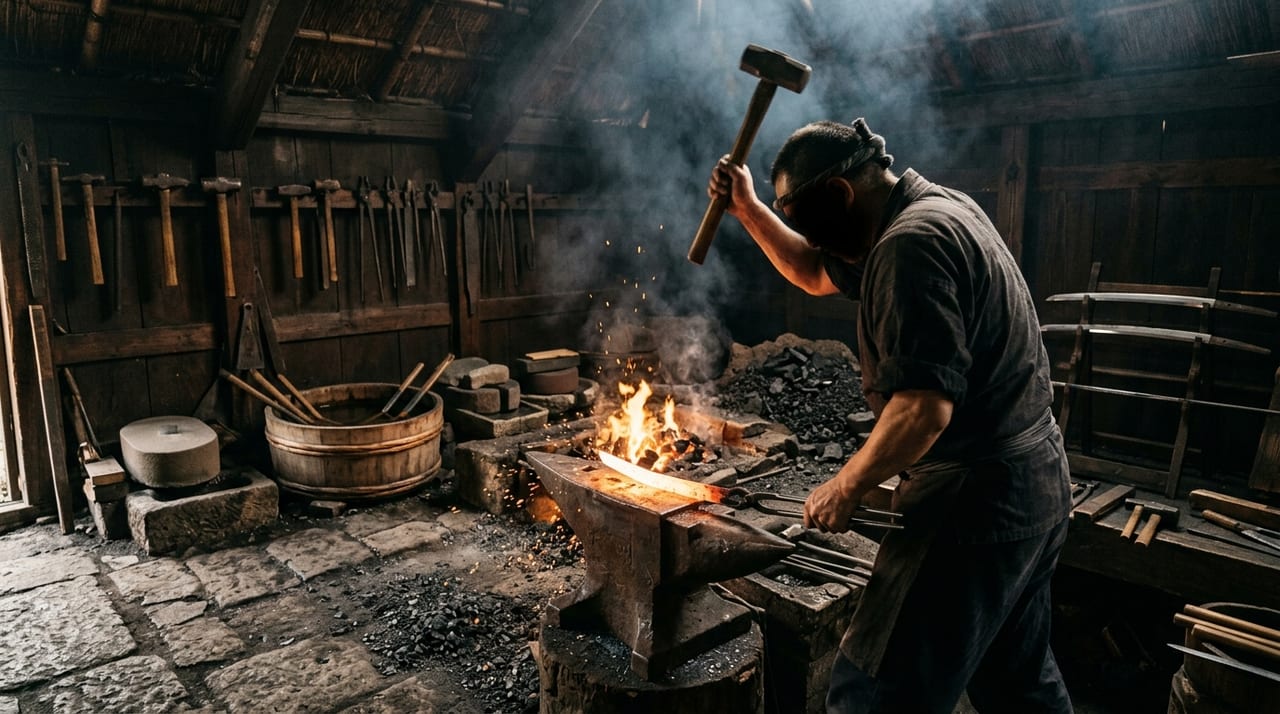
 * Image is for illustrative purposes only.
Ko-Gassan
古月山
Description
Overview
The Gassan smiths were a lineage based at the sacred peak of Mount Gassan, one of the Dewa Sanzan in Dewa Province (present-day Yamagata Prefecture). Tradition holds that the founder was the legendary Oniōmaru, who is said to have begun making swords on the sacred grounds of Mount Gassan. The school flourished from the Kamakura period through the Nanboku-chō and Muromachi periods, alongside the development of Shugendō on the Dewa Sanzan. To distinguish this koto-period lineage from the later Gassan school revived in Osaka during the Edo period (Gassan Sadakazu, Gassan Sadakatsu, and others), this early line is called “Ko-Gassan” for convenience.
Ayasugi Hada
The defining feature of Gassan work is the ayasugi hada (also called Gassan hada), a distinctive forging texture in which the grain of the steel appears in large, undulating waves resembling cedar boarding. It is regarded as the hallmark technique of the Gassan school.
Peak and Decline
The Gassan smiths are said to have reached their peak during the Nanboku-chō period, and sword-making continued until the late Muromachi period alongside the prosperity of Dewa Sanzan Shugendō. However, once the Edo period began and the Dewa Sanzan became purely religious communities without military force, the Gassan school as a community of swordsmiths declined rapidly.
Revival by Gassan Sadayoshi
The koto-period Gassan lineage lapsed during the Edo period, but in the final years of the Edo period, Yahachirō Sadayoshi, a member of the Gassan line, moved from Yamagata through Edo to Yariyachō in Osaka. There he revived the ancestral ayasugi forging technique and established the Osaka Gassan school. From Sadayoshi’s adopted son, Gassan Sadakazu I, onward, the Gassan school continued unbroken into the modern and contemporary eras.
Significance
The koto-period Gassan smiths (Ko-Gassan), as the Dewa lineage that originated the distinctive ayasugi forging technique, hold an important place in discussions of regional character in Japanese swords. Their technique was carried forward through the Edo-period revival into today’s Gassan school.