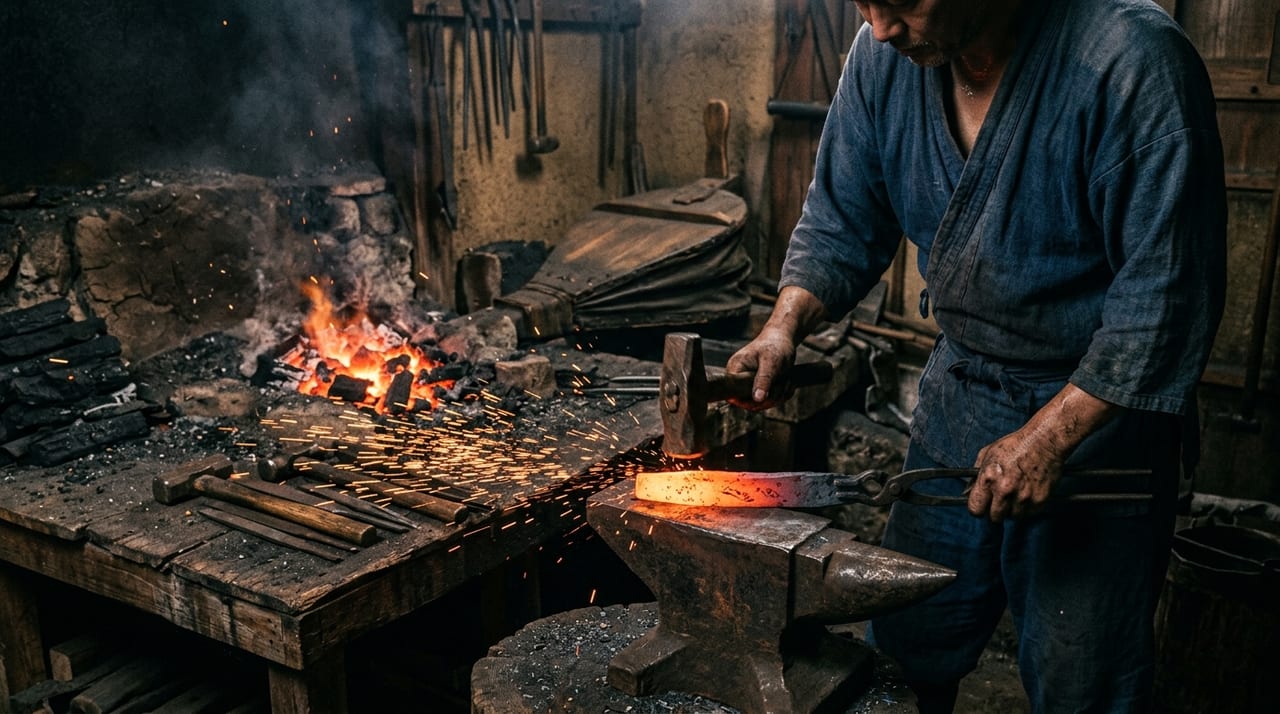
 * Image is for illustrative purposes only.
Ko-Bizen Masatsune
古備前正恒
Description
Masatsune, Representative Smith of Ko-Bizen, and His Historical Background
Masatsune was a smith of the Ko-Bizen school who was active in the late Heian period, roughly in the 12th century, and is one of the most important figures in establishing the Bizen tradition. The Ko-Bizen school is the collective name for the smiths who worked in Bizen Province (present-day southeastern Okayama Prefecture) before the Kamakura period. Masatsune is cited together with Tomonari as a representative smith of this school, and he has the largest number of extant signed works within the Ko-Bizen school. As the source of the later Osafune school and other Bizen schools, he holds an extremely important position in the history of the Japanese sword.
In the late Heian period, Japan saw the rise of the warrior class, including the Minamoto and Taira clans, and demand for arms expanded rapidly. In particular, demand for the tachi (a long, curved sword worn at the waist by mounted warriors) grew, and production centers for swordsmiths took shape across the country. Bizen Province advanced dramatically as a production center during this period. By making the most of its geographical advantages of abundant high-quality iron sand and charcoal, it grew into one of Japan's leading sword-producing regions. Masatsune was a master smith who met the needs of his age, continuing to forge outstanding blades in Bizen.
Ko-Bizen Beauty Embodied in the Jigane and Hamon
Masatsune's blades concentrate the technical features distinctive to the Ko-Bizen school. The jigane shows densely packed ko-itame-hada with well-developed ji-nie, and within the ground, changes resembling nashiji are seen. Whitish utsuri often appears in the ground. This is considered the prototype of the midare-utsuri seen in later Bizen blades, and it is an important element inherited by later generations as a symbolic feature of the Bizen tradition. This utsuri stems from the composition of the jigane and the forging method, and its appearance is none other than the artistic effect produced by the iron sand and forging techniques unique to Bizen.
The hamon is mainly suguha, mixed with ko-midare and ko-chōji, and has an antique, dignified character. Ko-Bizen hamon is so-called archaic style, and it differs from the bold and splendid midare-ba seen in the later Osafune and Ichimonji schools. It is a hamon whose beauty could be described as tranquil and introspective, and though it appears simple, it has deep flavor. The nioiguchi is deep, with fine, uniform nie spread over the whole blade, showing a harmonious beauty in which the ground and the edge form a single unity. The nie grains are small and dense, and they show a variety of expressions depending on how the light strikes them, which is also one of the charms of Ko-Bizen.
As for the shape (sugata), the kissaki is ko-kissaki, the koshi-zori is high with funbari, and the mihaba is often narrow, giving an overall elegant and dignified form. These formal features show the typical style of the tachi from the late Heian to early Kamakura period, and embody the ideal form of weapon that combined the practicality and beauty that warriors of the time demanded.
Masterpieces by Masatsune That Survive Today
Several works by Masatsune designated as National Treasures or Important Cultural Properties survive, and they continue to confirm the high artistic value of his work to this day. Five tachi are counted as National Treasures. One of them, held by the Fukuyama Museum of Art, passed through the Hachisuka family of Awa, shows Masatsune's typical style, and is said to be in good condition. Others are held by the Agency for Cultural Affairs, the Tokugawa Art Museum, and others.
Among the Important Cultural Properties there are also tachi held by Kunōzan Tōshō-gū, the Hayashibara Museum of Art, and others. What all these works share is the refined Ko-Bizen jigane and a hamon that is restrained yet deep in flavor. Their quality was such that later master smiths took them as models.
Influence on the Later Bizen Tradition
The impact of Masatsune's achievements on the history of the Japanese sword is immeasurable. Bizen Province was one of Japan's leading sources of iron sand and tamahagane. With high-quality iron sand collected from the basins of the Asahi River and the Yoshii River, and good charcoal produced from the abundant forest resources of the Chūgoku Mountains, it had an environment in which good swords could be produced stably. Masatsune made the fullest use of Bizen's material advantages and raised the techniques of the Ko-Bizen school to the highest standard of its time.
The Osafune school that rose afterward (including Mitsutada, Nagamitsu, Kagemitsu, Kanemitsu, and others) is founded on the technical and aesthetic heritage of the Bizen tradition that the Ko-Bizen school built. Ko-Bizen techniques also influenced the Ichimonji school, playing an important role as a bridge to the bold Ichimonji blades of the Kamakura period. It would be no exaggeration to say that the outstanding technical foundation established by Masatsune and his contemporaries is why Bizen remained Japan's largest sword-producing region throughout the medieval period.
Ko-Bizen Masatsune on TOUKENZA
TOUKENZA introduces Masatsune as a representative smith of the Ko-Bizen school alongside Tomonari. Masatsune's tachi comes from the late Heian period, when the Japanese sword was taking shape, yet it had already achieved a high level of artistry. It demonstrates how early the Japanese sword as a weapon reached the level of art. The beauty of the jigane and hamon, with their antique elegance and dignity, continues to overwhelm viewers today, more than 800 years later, without fading at all. Knowing Masatsune's swords is an indispensable first step toward understanding the depth and profundity of the Japanese sword as cultural heritage.
Famous Works
- tachi (National Treasure, Fukuyama Art Museum, Hachisuka family provenance)
- tachi (Important Cultural Property, Kunōzan Tōshō-gū)
- tachi (Important Cultural Property)