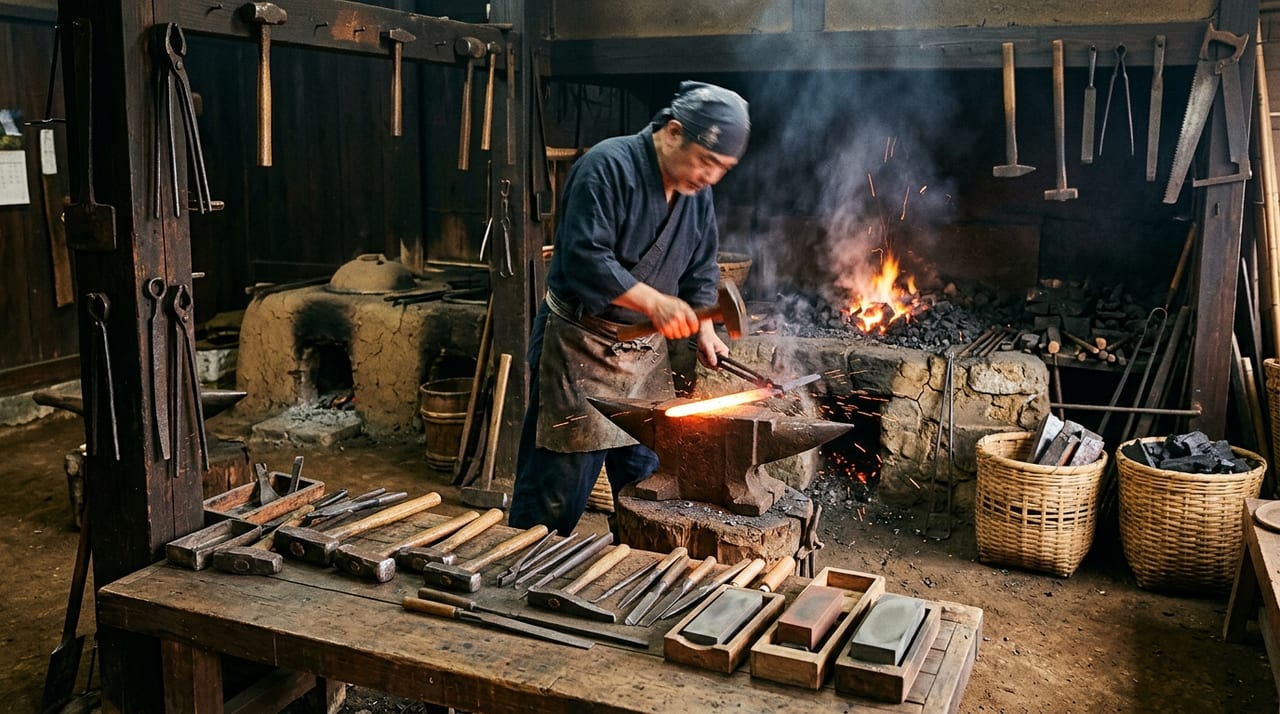
 * Image is for illustrative purposes only.
Katayama-Ichimonji
片山一文字
Description
Katayama Ichimonji was a group of swordsmiths active in Bizen Province from the mid-to-late Kamakura period. As one of the principal branch lines of the Bizen Ichimonji school (Fukuoka Ichimonji, Yoshioka Ichimonji, and Katayama Ichimonji), it holds an important place in the history of Japanese swords. Norifusa, known as the representative swordsmith of the Katayama Ichimonji school, was a master who produced swords of the highest standard of his era, using the bold ō-chōji-midare hamon and finely wrought jigane distinctive of Kamakura Ichimonji. Some works of the Ichimonji school bear the character "ichi" carved on the tang, but Katayama Ichimonji's Norifusa left works bearing the personal signature "Norifusa." Among the Bizen Ichimonji schools, Katayama Ichimonji is said to have excelled at hamon with relatively strong jigane and a powerful impression, and it is described as having a rustic boldness that contrasts with the elegance of Fukuoka Ichimonji. The jigane is composed of finely packed ko-itame, with ji-nie and chikei, and utsuri stands out, showing the typical jihada of Bizen in the Kamakura period. The hamon richly develops ō-chōji and ō-busa-chōji, with ashi and yō extending vigorously. The habuchi, with bright nioi-deki enriched with nie, shows the typical workmanship of Kamakura Ichimonji. Within the blade, sunagashi and kinsuji are at work, and overall it embodies the essence of Kamakura Bizen chōji. The shape is the elegant form of a Kamakura tachi with a deep koshi-zori, and it boasts a refined finish that met the highest standards of the imperial court and warrior society. Examples designated as National Treasures, Important Cultural Properties, and Jūyō Tōken survive in museums and shrines across the country, and they remain an indispensable point of reference in the study of Kamakura Bizen swords.
Famous Works
- Tachi, signed Norifusa (National Treasure, Fukuyama Art Museum)
- Katana, unsigned (mumei) Norifusa (National Treasure, Kyushu National Museum)