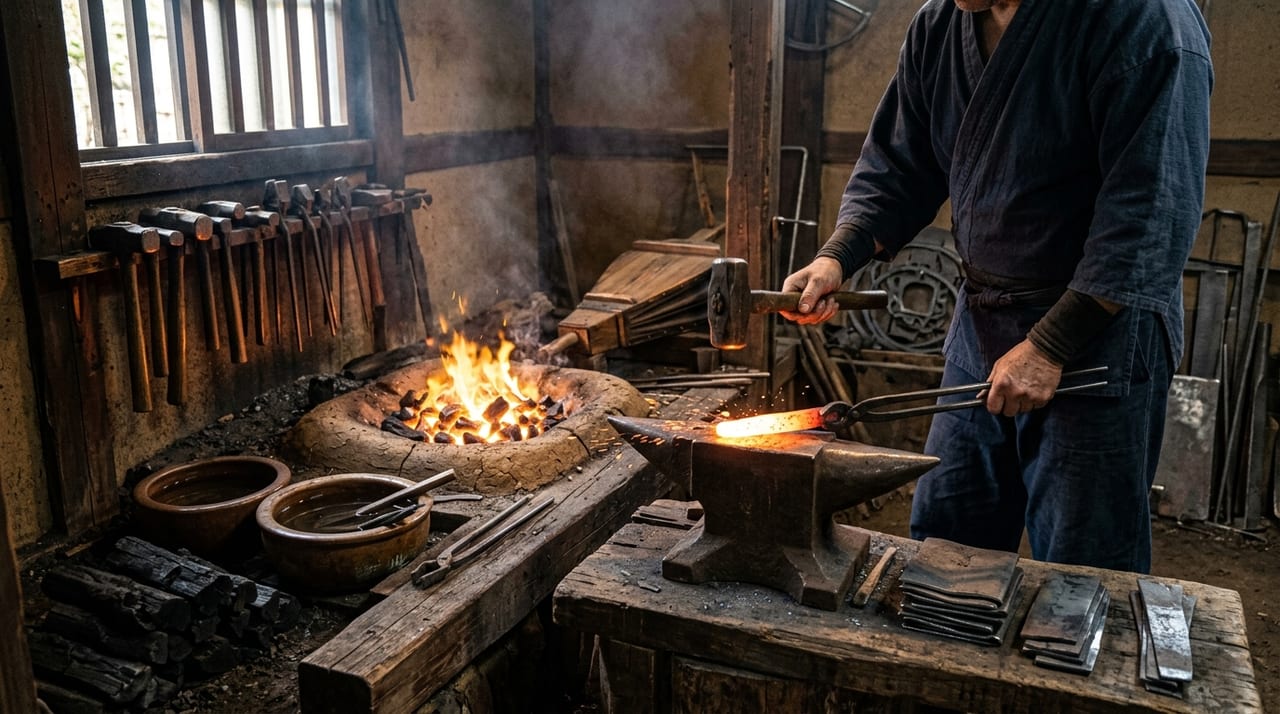
 * Image is for illustrative purposes only.
Kaneshige (Bizen)
兼重(備前)
Description
Bizen Kaneshige and Nanbokuchō-Period Swords
Bizen Kaneshige is a swordsmith said to have been active in Osafune, Bizen Province, during the Nanbokuchō period. The Nanbokuchō period was an era of turmoil in Japanese history, when the Southern and Northern Courts stood side by side. Swords of this age are known for their large, bold forms that responded to the intensifying of warfare, and “Nanbokuchō-period swords” hold a distinct place in the history of the sword as a genre of their own. Kaneshige is counted among the Bizen smiths of this era.
Bizen blades of the Nanbokuchō period, transforming from the refined chōji-midare of the Kamakura period, more often feature a larger, more widely undulating hamon called “ō-midare” (large midare) or “ō-chōji-midare.” In blade form as well, they departed from the graceful koshi-zori of Kamakura, with increasing chū-zori and saki-zori, and bold forms with wide mihaba and wide sakihaba were favored. Kaneshige is recorded in the history of Bizen smiths as one who embodied the sword style of this era.
Kaneshige's Style and Technical Features
The greatest feature seen in Bizen Kaneshige's works is the fusion of the bold form typical of Bizen blades of the Nanbokuchō period with the refined hamon technique of the traditional Osafune school. The jigane is based on itame-hada, mixed with nagare-hada, and ji-utsuri appears. This utsuri, peculiar to the Bizen tradition, gives the entire jigane a dreamlike scenery like a mist, and it is valued as evidence that even among Nanbokuchō-period swords, the orthodoxy of the Bizen tradition was maintained.
The hamon is mainly gunome-midare and chōji-midare, and the width of the undulations shows a size peculiar to the Nanbokuchō period. Nie of large grains are mixed into the hamon edge, and kinsuji and suna-nagashi appear abundantly, visually expressing the “intensity” of Nanbokuchō-period swords. The reliable hamon composition, based on the technical accumulation of the Osafune school, presses upon the viewer not as mere ruggedness but as calculated aesthetic power.
Many tachi of the Nanbokuchō period survive in a state of ō-suriage (heavily shortened), and many of Kaneshige's works are said to have lost their signatures through suriage. Among his signed works is a tachi inscribed “Bishū-jū Kaneshige saku” (made by Kaneshige, resident of Bishū), and one blade transmitted at Nikkō Futarasan Jinja has been designated an Important Cultural Property.
Bizen Smiths of the Nanbokuchō Period and Kaneshige's Place
In Bizen and Osafune of the Nanbokuchō period, first-rate smiths such as Kagemitsu, Kanemitsu, Chikakage, and Motoshige were active. Although Kaneshige lacks the international renown of these masters, he receives solid recognition as a Bizen smith of the Nanbokuchō period, and his skill is acknowledged particularly in bold tachi. The Osafune school was Japan's largest sword-producing center from the Kamakura through the Muromachi period, and Kaneshige has made his name in history as one of the many craftsmen who supported that prosperity.
When the turmoil of the Nanbokuchō period ended and the Muromachi period began, sword form changed again, and the more practical uchigatana form spread. The Nanbokuchō period, when Kaneshige was active, was also an age when long swords such as ō-tachi and nodachi were in vogue, and as works embodying the spirit of that age, Kaneshige's blades are also important historical witnesses.
The Bizen Sword Tradition and the History of Osafune
Osafune in Bizen Province flourished throughout the medieval period as Japan's largest sword-producing center. From the late Heian period through the Kamakura, Nanbokuchō, Muromachi, and Sengoku periods, Osafune smiths continued to produce swords at the forefront of their times, and their fame resounded throughout the country. Osafune during the Nanbokuchō period, when Kaneshige was active, was one of its peak periods, with many famous and capable smiths working under the great masters Kagemitsu and Kanemitsu at the top. Many works from this era survive today and serve as important primary sources for the study of Japanese sword history.
TOUKENZA introduces Bizen Kaneshige as one of the Bizen smiths who pursued bold beauty in the age of Nanbokuchō turmoil, and its mission is to convey to modern enthusiasts the spirit of medieval Japanese warriors dwelling in his works and the technical richness of the Bizen tradition.
Famous Works
- Tachi, signed Kaneshige of Bishū (Important Cultural Property, Nikkō Futarasan Shrine)