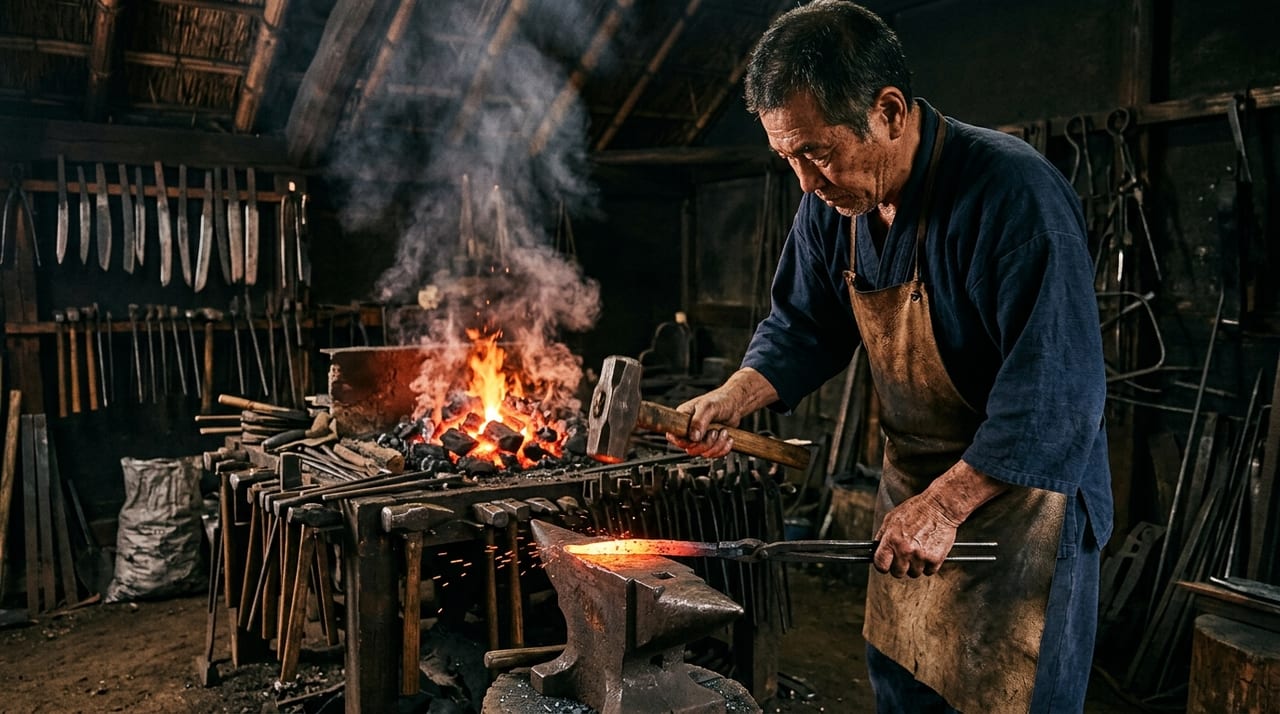
 * Image is for illustrative purposes only.
Horii Taneaki
堀井胤明
Description
Horii Taneaki was a swordsmith of Ōmi Province (present-day Shiga Prefecture) who was active from the late Edo period into the Meiji period. He was the second head of the Horii family, succeeding the Ōmi swordsmith Horii Taneyoshi, who had studied under Taikei Naotane and others, and he belongs to the lineage of Taikei Naotane.
After the Meiji Restoration, Taneaki continued making swords despite the effects of the Haitōrei (Sword Abolishment Edict, 1876). In Meiji 39 (1906), he made swords together with his disciple Horii Toshihide at the Zuisenji forge in Kamakura. In Meiji 40 (1907), he was invited to serve as an instructor at the Nihontō Tanren Denshūjo (Japanese Sword Forging Institute), which Kurihara Hikosaburō had inherited. He later made Toshihide his adopted son and son-in-law, and Toshihide succeeded as the third head of the Horii family. He was a swordsmith who devoted himself to preserving traditional techniques during the decline of sword culture.
As an important witness who recorded the transformation of sword culture from the shinshintō period into the Meiji period, Taneaki's name is still passed down today.