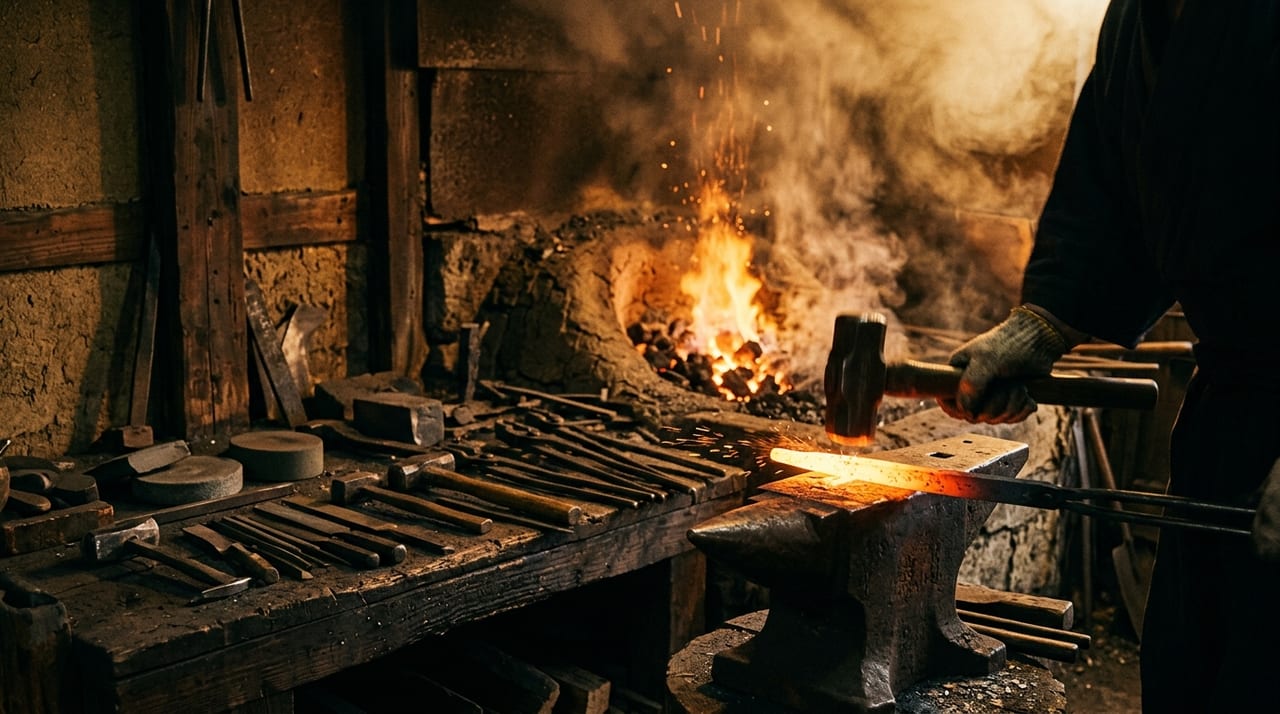
 * Image is for illustrative purposes only.
Hokke Saburō Nobufusa
法華三郎信房
Description
Hokke Saburō Nobufusa is the hereditary name of a line of swordsmiths based in Matsuyama, Ōsaki City, Miyagi Prefecture. The eighth-generation Hokke Saburō Nobufusa (personal name Takahashi Noboru) is particularly well known as the modern smith who reconstructed the forging method of the Hōshō school of the Yamato tradition, a technique that had nearly been lost.
Lineage
The Hokke Saburō house descends from the swordsmiths of the Sendai domain and has maintained its forge for generations in Matsuyama in northern Miyagi Prefecture. Through the seventh generation the family style was the Bizen tradition, and the eighth generation initially inherited and worked in that style.
Reconstructing the Hōshō Tradition
The eighth-generation Nobufusa made it his life's work to recreate the masame (straight-grain) forging of the Hōshō school, one of the five Yamato schools of the Kamakura period. Because masame steel is prone to splitting during forging and the technique itself had not been transmitted, the reconstruction proved extremely difficult. He is said to have devoted eight years of repeated trials before succeeding in 1963.
Recognition
For this achievement he was designated in November 1966 as the first holder of Miyagi Prefecture's Important Intangible Cultural Property status for Japanese sword forging technique. In 1981 he was further certified as mukansa, the highest rank attainable by a contemporary swordsmith. He died in 2000.
The name Hokke Saburō Nobufusa has continued to be passed down in later generations, and the house holds a firmly established place in the world of contemporary Japanese swords as the Tōhoku lineage that preserves masame forging of the Yamato tradition.
Famous Works
- 刀 銘 法華三郎信房