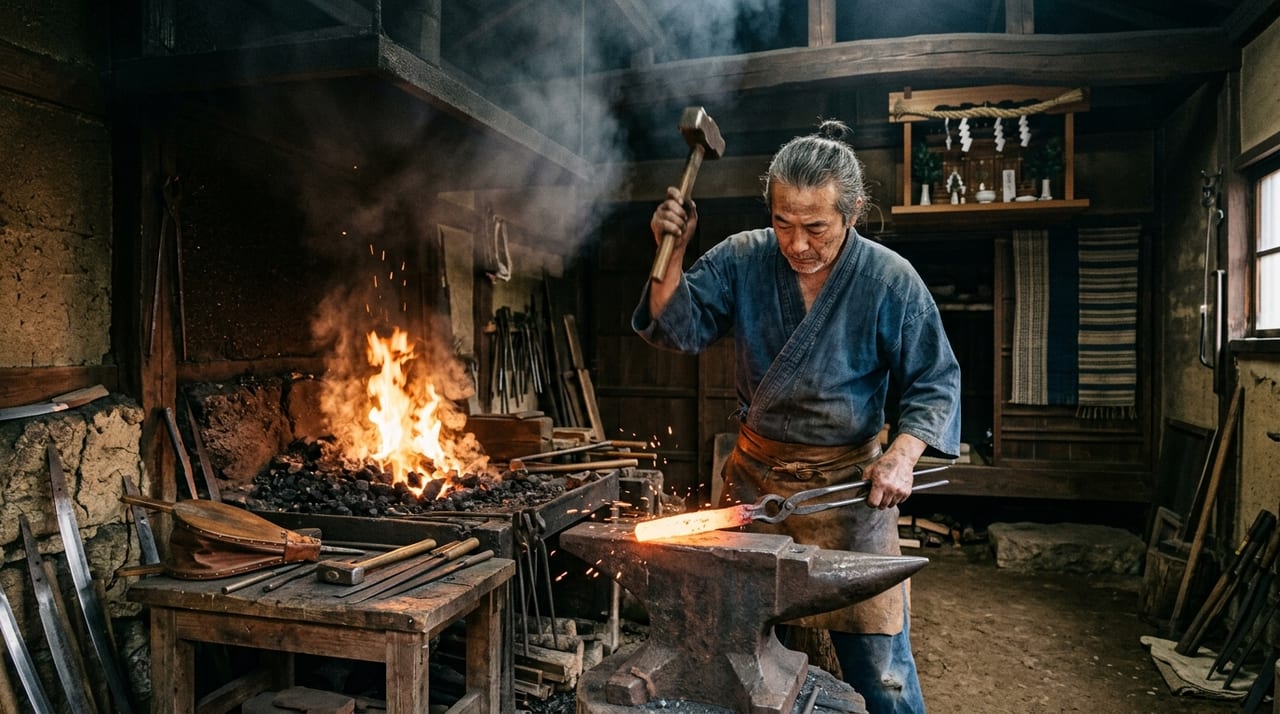
 * Image is for illustrative purposes only.
Hōju
宝寿
Description
Hōju is a group of swordsmiths representing the Ōshū smiths, based in Mutsu Province (present-day Aomori, Iwate, Miyagi and Fukushima prefectures) from the late Heian period to the early Muromachi period. It belongs to the Mokusa school and is known as the only line among the names of Mokusa smiths that continued over a long period, from the Heian period through the Muromachi period.
Origins and the Mokusa School
Hōju is a group of smiths of the Mokusa school, which forms the core of the Ōshū smiths. It is considered a faction that was deeply involved in the early development of the Japanese sword. The Mokusa smiths are regarded as one of the sources of the Japanese sword, and Hōju is positioned as an important line that carries on that tradition.
Historical Background
After the Ōshū campaign led by Minamoto no Yoritomo, the smiths of Hōju moved to various parts of the country, and the home base in Mutsu Province itself declined. However, this dispersal spread the reputation of the Mokusa smiths across the country, and their techniques and names were handed down to later generations.
Surviving Works
Signed works by Hōju are rare. A Kamakura-period tachi inscribed “Hōju” (held by Seikadō) is designated an Important Cultural Property. In Ichinoseki City, Iwate Prefecture, a Kamakura-period tachi and a Nanboku-chō-period wakizashi inscribed “Hōju” are also preserved, and these are designated Tangible Cultural Properties of Ichinoseki City. They are works of high documentary value that convey the reality of sword production in medieval Ōshū.
Reputation and Tradition
The Gikeiki records that Satō Tadanobu, a retainer of Minamoto no Yoshitsune, had a sword made by a smith (舞房) and, at the scene of his suicide, praised it with the words “It cut into my belly without the slightest catch.” This is said to show that the cutting quality of Mokusa smiths’ swords was well known.