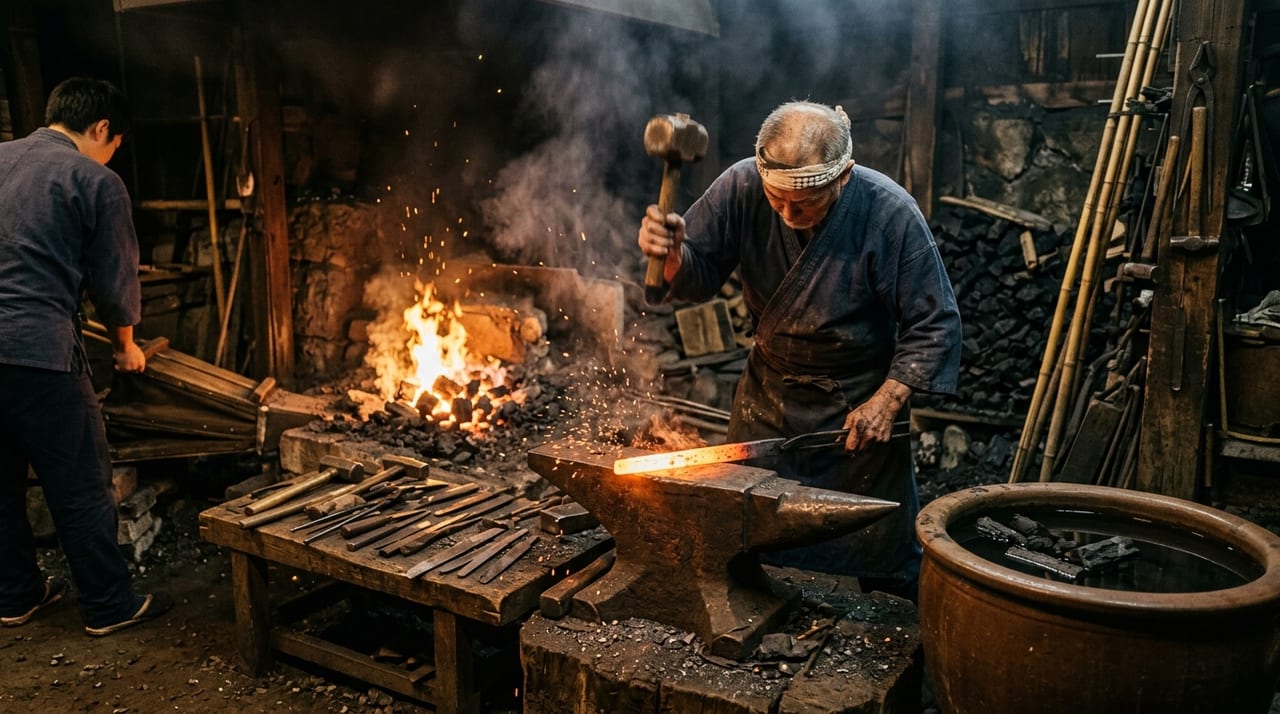
 * Image is for illustrative purposes only.
Furukawa Kiyoyuki
古川清行
Description
Furukawa Kiyoyuki's Path to Becoming a Swordsmith
Furukawa Kiyoyuki is a contemporary swordsmith born in Nagano Prefecture in Shōwa 23 (1948); his real name was Nobuo. Kiyoyuki majored in applied physics at Tokyo University of Science, but while still a student he was captivated by the beauty of Japanese swords at a meitō exhibition at the Shinano Art Museum, and he aspired to become a swordsmith. After graduating from university, he entered the Miyairi school, where he trained in sword-making, and in Shōwa 53 (1978) he received approval from the Agency for Cultural Affairs to make swords.
Style and the Sōshū Tradition
Kiyoyuki studied under Miyairi Kiyohira, the younger brother of Living National Treasure Miyairi Akihira (Yukihira) of Sakaki town in Nagano Prefecture, and learned the Sōshū tradition. His specialty was Japanese swords of the Sōshū tradition, which stand out for their beautiful notare-ba, undulating like waves rolling in. The Sōshū tradition was brought to maturity in the Kamakura period by Masamune and others, and is characterized by a bold and dazzling style with vigorously active nie. For many years, Kiyoyuki worked on researching and reproducing Japanese swords of the Kamakura period, and applied the spirit of old works to contemporary sword-making.
Awards and Mukansa Certification
In Shōwa 62 (1987), he won the Kanzan Prize at the New Sword Exhibition (Shinsaku Meitō-ten), and after that he won many other awards, including special prizes and excellence awards, establishing his standing as a swordsmith. In Heisei 19 (2007), he was designated an intangible cultural property of Suzaka City in Nagano Prefecture, and in Heisei 21 (2009), at the New Sword Exhibition, he received the NBTHK Honorary Chairman's Prize and was certified as mukansa, an honor considered second only to Living National Treasure. Kiyoyuki died in Heisei 27 (2015) at the age of 67. As a contemporary swordsmith who pursued the Sōshū tradition in Shinano, his name is inscribed in history.