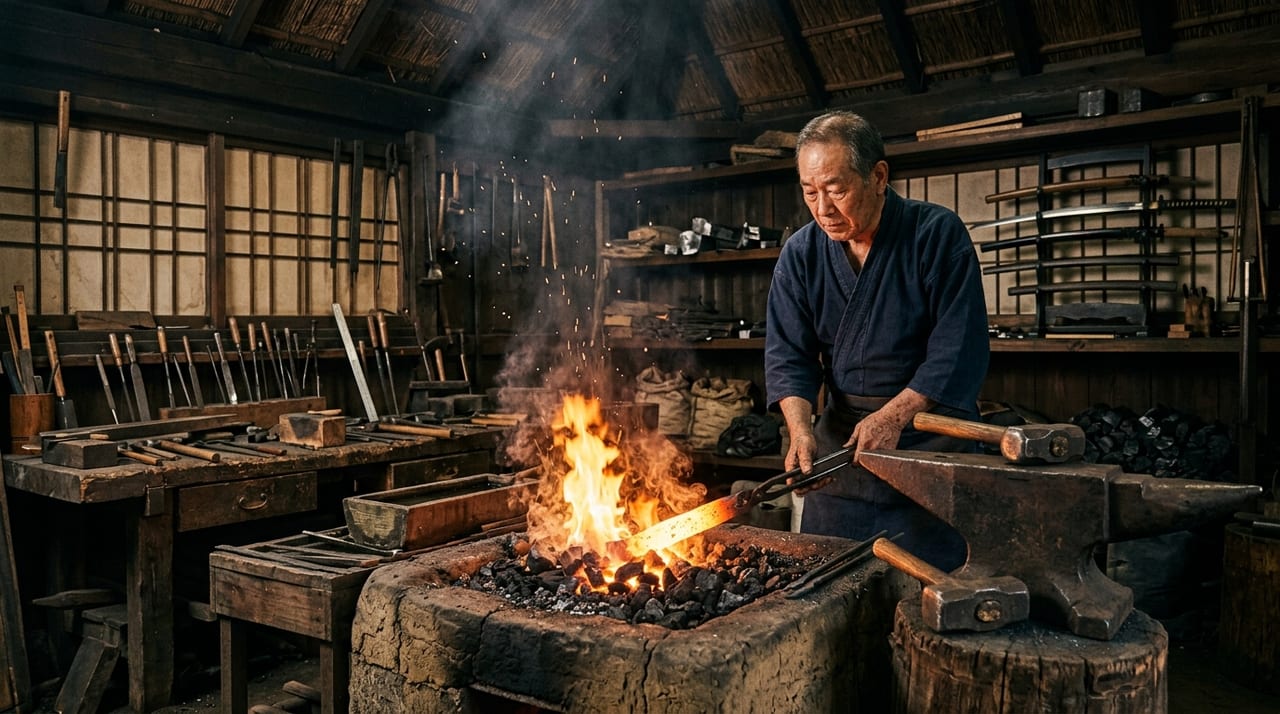
 * Image is for illustrative purposes only.
Enju Kuninobu
延寿国信
Description
Enju Kuninobu's Background and the Enju School
Enju Kuninobu was a swordsmith active in Kikuchi in Higo Province (present-day Kikuchi City, Kumamoto Prefecture) from the late Kamakura period through the Nanboku-chō period, and he is counted among the principal smiths of the Enju school. The Kagawa Museum holds the tachi signed (Enju) Kuninobu, a work bearing his signature. Among the smiths of the Enju school, Kunitomo, Kunisuke, Kunitoki and Kuninobu are renowned.
The Enju school takes as its founder Kunimura, a maternal grandson of Rai Kuniyuki (said to be a son of Senjuin Hiromura of Yamato and a child of Rai Kuniyuki's daughter). It is a branch that moved from Yamashiro to Kyūshū at the request of the Kikuchi clan of Higo Province. It is closely tied to the standing of the Kikuchi clan's warriors on the Southern Court side, and for this reason the smiths who served the Kikuchi clan as kinnō-kaji (loyalist smiths) were especially prized. The Enju line carried its renowned lineage from the late Kamakura period into the Sengoku period. Works of the Kamakura period are generally called Ko-Enju, works of the Nanboku-chō period Chū-Enju, and works from the Ōei era onward Sue-Enju. Kuninobu is considered to have been active in the era of Ko-Enju and Chū-Enju.
Style and Characteristics of the Enju School
The blades of Enju Kuninobu embody the Ko-Enju style, which retains a strong influence of the Yamashiro tradition. Ko-Enju tachi have a refined form, tapering to a narrower width toward the point, with funbari in the Yamashiro-den (Rai lineage) manner, and they carry an elegant bearing akin to that of Rai Kunitoshi and Rai Kunimitsu.
The jigane is mainly well-forged ko-itame-hada, and on a nashiji-like ground small dark itetsu characteristic of Kyūshū steel are scattered. Shirake-utsuri appearing is also one of the important appraisal criteria for Enju blades. The hamon is a suguha on a nie-based pattern, narrow in width, with a few nie-ashi, giving a calm style. Gunome, ashi and yō may appear, and the result is a dignified finish that reproduces the refinement of the Rai school with Higo steel. The Kagawa Museum's blade by Kuninobu has high koshi-zori and strong funbari, and presents the imposing form of a tachi with a blade of 94.5 cm.
Representative Work
The tachi signed (Enju) Kuninobu held by the Kagawa Museum passed down to the Takamatsu Matsudaira family, who governed eastern Sanuki Province (120,000 koku), and it comes with a tōmaki-nuri uchigatana koshirae (rattan-wrapped lacquered mounting). That a signed tachi by Kuninobu has been preserved to the present as a daimyo house heirloom confirms the high standing of the work and its important position within the Enju school.
Historical Significance
Enju Kuninobu is an indispensable smith in the process by which the techniques of the Yamashiro-tradition school took root in Kyūshū and formed the tradition of the Higo swordsmiths. The character of the Enju school as kinnō-kaji, deeply bound to the Kikuchi clan, laid the basis on which Enju blades were especially prized among imperial loyalists. That a signed tachi passed into the hands of a daimyo house conveys to the present that Kuninobu was recognized as a smith of standing within the Enju school.
Famous Works
- Tachi, “signed (Enju) Kuninobu” (Kagawa Prefectural Museum collection)