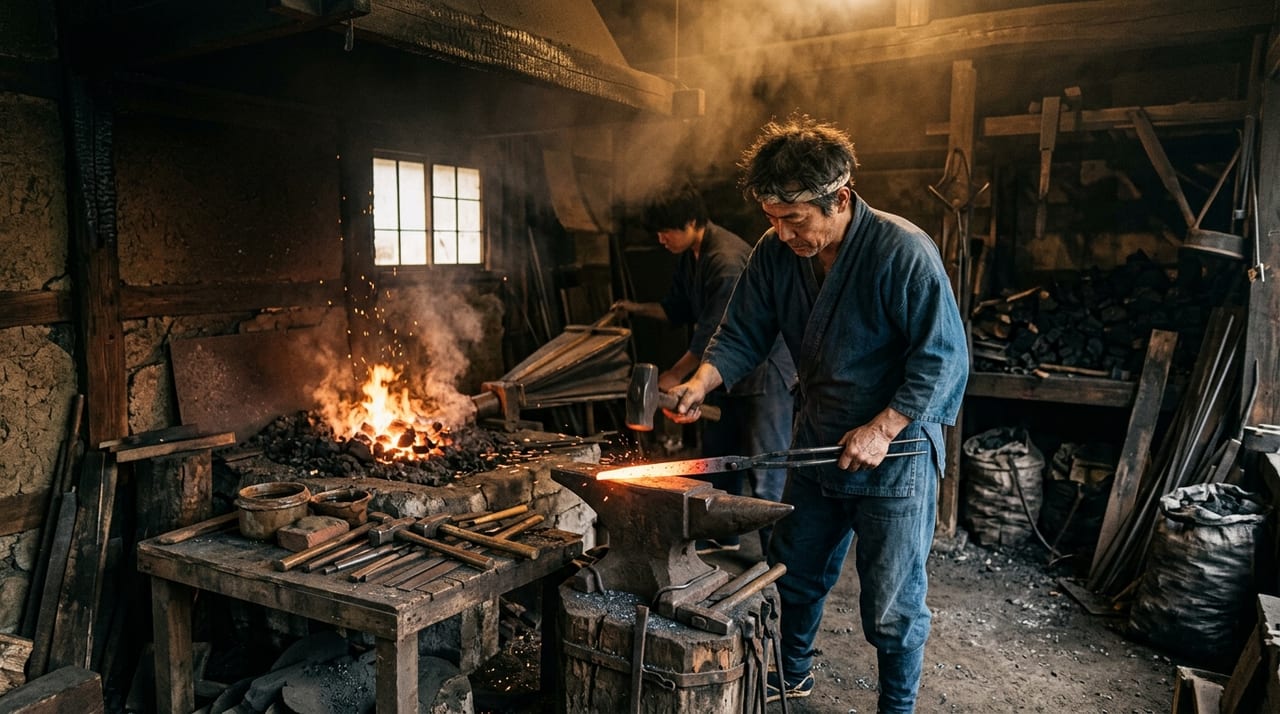
 * Image is for illustrative purposes only.
Enju Kunimura
延寿国村
Description
Enju Kunimura and His Era
Enju Kunimura was a swordsmith who worked in Kikuchi District, Higo Province (around present-day Kikuchi City, Kumamoto Prefecture), from the late Kamakura period into the early Nanboku-chō period. As the founder of the Enju school, he is a master smith who shines brilliantly in the sword history of Higo. The name "Enju" derives from Kunimura's use of the name Enju Tarō. Later smiths inherited the techniques and spirit of the school, starting from Kunimura.
In the late Kamakura period, demand for swords remained high as the warrior government became stable, and independent smith groups formed in the provinces as well. Higo Province (present-day Kumamoto Prefecture) lies in central Kyushu, where powerful warrior groups such as the Kikuchi clan existed. Sword making developed to meet their demand. Against this background, Kunimura is valued as a pioneer who nurtured a distinctly Higo sword culture while drawing on the lineage of the Rai school of Yamashiro.
The technical roots of the Enju school lie in the Rai school of Yamashiro. Kunimura is traditionally said to have been the child of Rai Kuniyuki's son-in-law, or a disciple of Rai Kunitoshi. His achievement lies in developing the clear suguha lineage of the Rai school (Yamashiro tradition) independently in Kyushu, and this deserves special mention in the history of regional swords.
Kunimura's Techniques and Style
The greatest feature of Kunimura's works is the dignified hamon of the Rai school (Yamashiro tradition), combined with a masame-like quality from the Yamato tradition, creating a distinctive harmony woven by the Higo jigane.
The jigane is primarily ko-itame hada, and some areas show a masame-like quality influenced by the Yamato tradition. The ji-nie appears evenly, and the jigane as a whole conveys rugged strength and unpretentious sincerity. Unlike the splendor of Bizen or Yamashiro, the spirit of the Yamato tradition, which values substance over flashy appearance, is directly reflected in the texture of the jigane.
The hamon is centered on suguha and ko-midare, with fine nie along the edge of the hamon. A characteristic feature of the Yamato tradition is the nijūba, in which a second hamon line appears to run within the same edge. The bōshi mostly turns back straight, keeping the composed impression of the Yamato tradition.
The tachi's form follows the standard shape of the late Kamakura period, but it gives a somewhat more rugged and forceful impression than Bizen or Yamashiro pieces. Its sturdy construction reflects an awareness of actual battlefield use. This suggests that for the warriors of Kyushu, who used these swords in practice, reliable function took priority over decorative beauty.
Lineage and Development of the Enju School
Starting with Kunimura, the Enju school produced many excellent smiths, including Kunisuke, Kuniyasu, Kuniyoshi and Kunitoki. From the late Kamakura period through the Nanboku-chō and Muromachi periods, it flourished as one of the representative smith groups of Kyushu. Because the Enju school belonged to the Kikuchi clan during the Nanboku-chō period, its swords were especially prized among imperial loyalists (kinnō-ka).
The Enju school flourished from the late Kamakura period through the Muromachi period, and its descendants are said to have continued into the Taishō era. It is recorded in the history of Japanese swords as a long-lived school. The influence the Enju school had on later Kyushu smiths was significant, and it played an indispensable role in establishing a sword culture in Higo.
Technical Lineage of the Rai School and the Enju School
The Rai school was a distinguished line based in Yamashiro Province (Kyoto), founded by Rai Kuniyuki and producing Rai Kunitoshi, Rai Kunimitsu and others. It is characterized by clear ko-itame jigane and dignified suguha. The suguha and ko-midare lineage of the Enju school inherited the techniques of this Rai school, and the addition of a masame-like quality to the jigane is also noted as an influence of the Yamato tradition.
The background to the spread of Rai school techniques to Kyushu lay in the expansion of warrior power from the late Heian period through the Kamakura period, and the accompanying migration and kinship ties of swordsmiths. Enju Kunimura went down from the Rai lineage to Higo and established the essence of the Yamashiro tradition in the Kikuchi region. In this respect, he holds an important place in the technical history of how Japanese swordmaking spread.
Kunimura's Legacy and Touken-za
What Enju Kunimura left behind is not merely individual sword works. He established a smith group in Higo and laid the foundation of Kyushu's sword culture by passing on its techniques and spirit to later generations. Enju school swords, which combine the dignity of the Rai school with the spirit of Kyushu, may be less well known than the famous schools of the capital region, but they are a valuable example of the regional diversity of Japanese swords.
Touken-za values shedding light not only on master smiths of the five traditions and Gokinai, but also on regional smiths like these. The simple strength of Enju Kunimura's tachi and the dignity derived from the Yamashiro Rai school embody the diversity of Japanese sword beauty, and their historical significance deserves reappraisal even today.
Famous Works
- Tachi (Important Cultural Property)
- Tachi (Important Art Object)