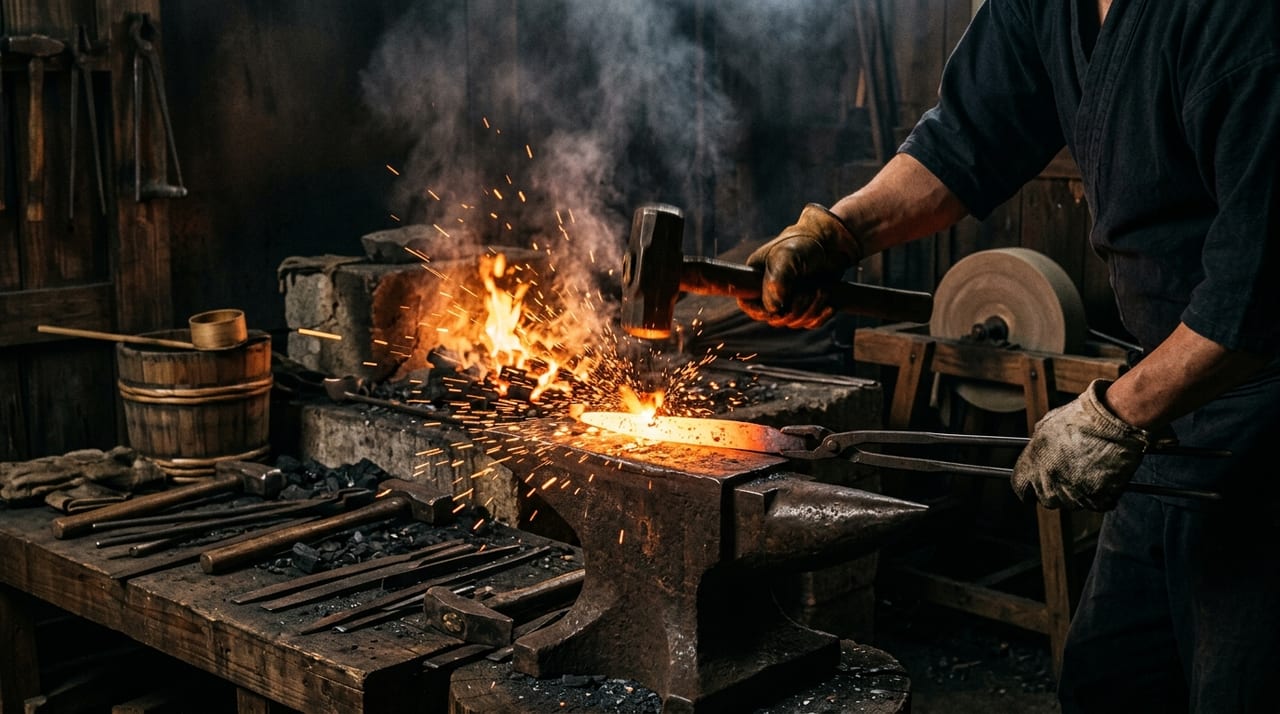
 * Image is for illustrative purposes only.
Enju Kuniaki
延寿国晶
Description
Master Bladesmith Enju Kuniaki of Higo
Enju Kuniaki was a master bladesmith from Higo Province (present-day Kumamoto Prefecture) who flourished from the late Kamakura period into the early Nanboku-chō (Northern and Southern Courts) period, and stands as one of the core master craftsmen of the Enju school. The Enju school was a group of bladesmiths centered in Kikuchi in the Kikuchigawa River basin (present-day Kikuchi City, Kumamoto Prefecture), known for incorporating Yamashiro tradition techniques while developing a distinctive regional character unique to Higo Province. Kuniaki is recognized as an Enju school bladesmith, belonging to a lineage descended from Kunimura as patriarch, a line including Kuniyoshi, Kuniji, Kunitai, and Kunishiro among others.
While there are various theories about the origin of the Enju school's name, the prevailing view holds that the group of bladesmiths working under the patronage of the Kikuchi clan adopted the name 'Enju.' The Kikuchi clan were renowned as powerful generals of the Southern Court during the Nanboku-chō period, supporting Emperor Go-Daigo's Kemmu Restoration and continuing their struggle against the Northern Court and the Ashikaga clan. The Enju school bladesmiths flourished under such patronage from the Kikuchi clan and cultivated a distinctive sword culture in Kyushu.
Kuniaki's Artistic Style — Yamashiro Tradition Influence and Distinctive Character
A hallmark of the Enju school generally is the influence of the Yamashiro tradition (particularly the Rai school), and Kuniaki's style exhibits this tendency strongly. The jigane (base metal) is primarily composed of ko-itame (small wood-grain pattern) with densely packed, refined grain featuring jikage (grain patterns) and jibukki (fine sediment-like patterns). The nie (crystalline patterns) are fine and uniform, approaching the quality of forging by master craftsmen of the Yamashiro tradition. The color of the base metal is bright and pure, imparting an overall refined appearance.
The hamon (tempering pattern) is principally composed of suguha (straight blade), with small clusters and ko-gunome (small interlocking patterns) interspersed. The hamon composition is refined, approaching that of the Rai school, with fine nie densely creating a deep nioi-kuchi (sweet scent outline) throughout. Fine kinsuji (fine lines) and sunagarashi (sand flow pattern) appear as details within the blade, revealing varied and dynamic activity within the temper line. Some works employ yaki-otoshi (stopping the temper before the habaki base, a technique not tempering to the base fitting), another characteristic influenced by the Yamashiro tradition.
The nakago (tang) is rather slender, with file marks typically showing suji-kai (diagonal files) or kesho-yasuri (cosmetic finish files). The mei (signature) is engraved as either 'Kuniaki' or 'Enju Kuniaki.' Most signatures of Enju school blades remain relatively clear, with authentication based on a combination of signature calligraphy and artistic style.
The Kikuchi Clan Connection and the Nanboku-chō Turmoil
The Nanboku-chō period in which Enju Kuniaki flourished was an age of turmoil when Japan was divided between two rival imperial courts—the Southern and Northern courts—in bitter conflict. In Kyushu, Kikuchi Taketeru and others maintained crucial strongholds for the Southern Court, and through countless battles preserved their loyalty to the South. As official bladesmiths to the Kikuchi clan, the Enju school craftsmen continuously supplied practical tachi and wakizashi swords for combat.
The swords of the Enju school, designed for practical warfare, combined solid construction emphasizing utility with the refined beauty learned from the Yamashiro tradition, exemplifying at a high level the Japanese sword ideal of 'strength combined with beauty.' Even in the turbulent Nanboku-chō period, the Enju school maintained its artistic integrity as master craftsmen—therein lies their dignity.
The Position of the Enju School in Kyushu Sword Culture
The Enju school played a crucial role in shaping sword culture in Kyushu. While earlier Kyushu had indigenous sword-making groups like the Namihira school, the Enju school introduced the advanced techniques of the Yamashiro tradition to the region, significantly elevating the level of local sword culture. The influence of the Enju school extended to Higo sword production through the Edo and Meiji periods, becoming one of the spiritual foundations of Kyushu bladesmithing.
As a bearer of the historical mission of the Enju school, Kuniaki occupies an important place in Kyushu sword history. Kuniaki's works, exemplifying the technical diversity and high quality of the Enju lineage, constitute crucial proof that even regional bladesmiths could achieve forging rivaling that of the master craftsmen of Kyoto. For enthusiasts seeking to understand the diverse regional development of ancient swords, Enju Kuniaki is an essential figure not to be overlooked.
Enju Kuniaki in Sword Collections
Sword collections introduce Enju Kuniaki as an important bladesmith representing the sword culture of Higo. The tachi and wakizashi of the Enju school, embodying the fusion of Yamashiro refinement with Kyushu warrior culture, manifest the diversity and richness of regional sword culture. Kuniaki's works constitute precious evidence of the highest standard. For connoisseurs wishing to understand the diverse regional development of ancient swords, Enju Kuniaki is an indispensable figure not to be overlooked.
Distinctive Techniques and Sugata (Blade Shape) of the Enju School
The swords of the Enju school exhibit several distinctive technical characteristics reflecting their geographic and cultural context. Regarding sugata (blade profile) first: the tachi of the Enju school typically display a somewhat narrower edge width with thicker spine, conveying a shape of practical robustness. The curvature varies from koshi-zori (hip curve) to saki-zori (point curve), yet overall the emphasis on practical balance is more prominent than grandeur. Works closer to the Nanboku-chō period show a tendency toward greater edge width under period influence.
Technical similarities with the Rai school are marked in both jigane and hamon. The 'Rai-hada' (Rai-skin) characterized by small ko-itame dense grain established by Rai school craftsmen was likewise pursued in the Enju school, with Kuniaki's works realizing equally meticulous forging of no inferior quality to the Rai school. While there are various theories regarding the pathway of this technical transmission, one account suggests that Kunimura, patriarch of the Enju school, was the son-in-law (or descendant thereof) of Rai Kunitoki, and established his school after moving to Kyushu—suggesting continuity of technical lineage from Yamashiro to Higo.
Regarding hamon, while gentle suguha-type compositions predominate, later works by Kuniaki show a tendency toward larger gunome patterns, reflecting temporal evolution toward the Nanboku-chō period. Such stylistic evolution testifies that the Enju school did not merely imitate the Yamashiro tradition but continuously refined their own aesthetics in response to period demands. That Kuniaki's body of work, observed chronologically, allows concrete tracing of sword style evolution from the late Kamakura through the Nanboku-chō period further establishes him as an important figure in Japanese sword history research.
Famous Works
- 太刀(重要美術品)
- 脇差(重要美術品)