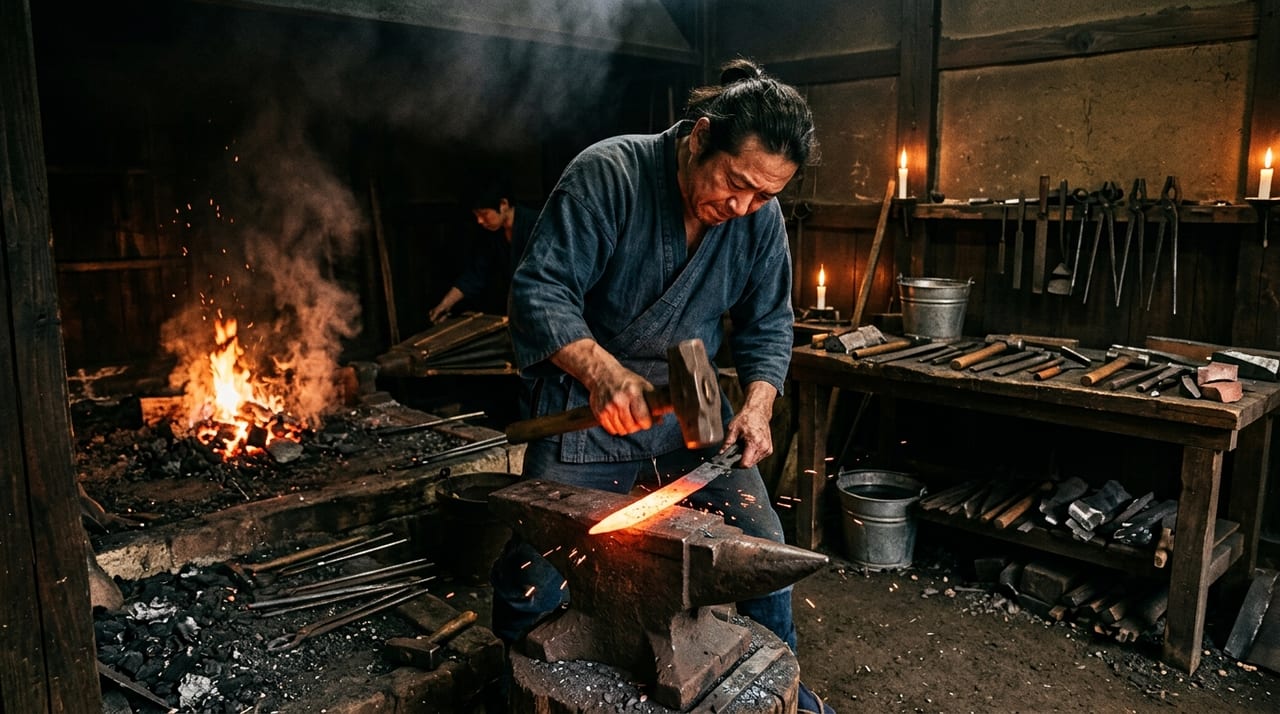
 * Image is for illustrative purposes only.
Chiyozuru Kuniyasu
千代鶴国安
Description
Chiyozuru Kuniyasu was a swordsmith traditionally said to have been active in the mid-14th century, during the Nanboku-chō period, who relocated to Echizen Province (present-day Echizen City, Fukui Prefecture) and became the founder of the Chiyozuru school.
Lineage and School
Kuniyasu was originally a swordsmith in Kyoto and is said to have studied under Rai Kuniyasu. Around 1337 (Engen 2 / Kenmu 4), he moved from Kyoto to Fuchū in Echizen Province (present-day Echizen City) in search of a suitable location — with clear water and good iron sand — for forging fine blades. He is regarded as the figure who transmitted the Yamashiro Rai-school techniques to the Hokuriku region.
Legend and Lore
Alongside his sword-forging, Kuniyasu is said to have made sickles (kama) for local farmers, with the sickle's curved shape reportedly inspired by a crescent moon reflected in a pond — traditionally cited as the origin of the "Echizen sickle." Legend also holds that each time he completed a fine sword, he carved a komainu (guardian lion-dog) statue from a whetstone and sank it into a pond as a prayer for military fortune and that swords serve as symbols of the warrior rather than mere killing tools. When the pond was dredged in 1932, more than ten such komainu statues and one sword blade were reportedly recovered.
Legacy
Traced back to Kuniyasu's settlement, the blade-forging industry of present-day Echizen City developed into "Echizen Uchihamono," which in 1979 became the first cutlery-producing region in Japan to receive the national Traditional Craft designation. A shrine (Chiyozuru Jinja) and a museum (Echizen Chiyozuru no Yakata) dedicated to him remain in the area, where he continues to be honored as the founder of Echizen blade-forging.
Reputation
Little of Kuniyasu's own swordwork survives to be individually appraised, but he is highly regarded — more in the context of industrial and craft history than pure sword connoisseurship — as the figure who transplanted Kyoto Rai-school technique to a provincial region and laid the foundation for a major blade-making industry that continues today.