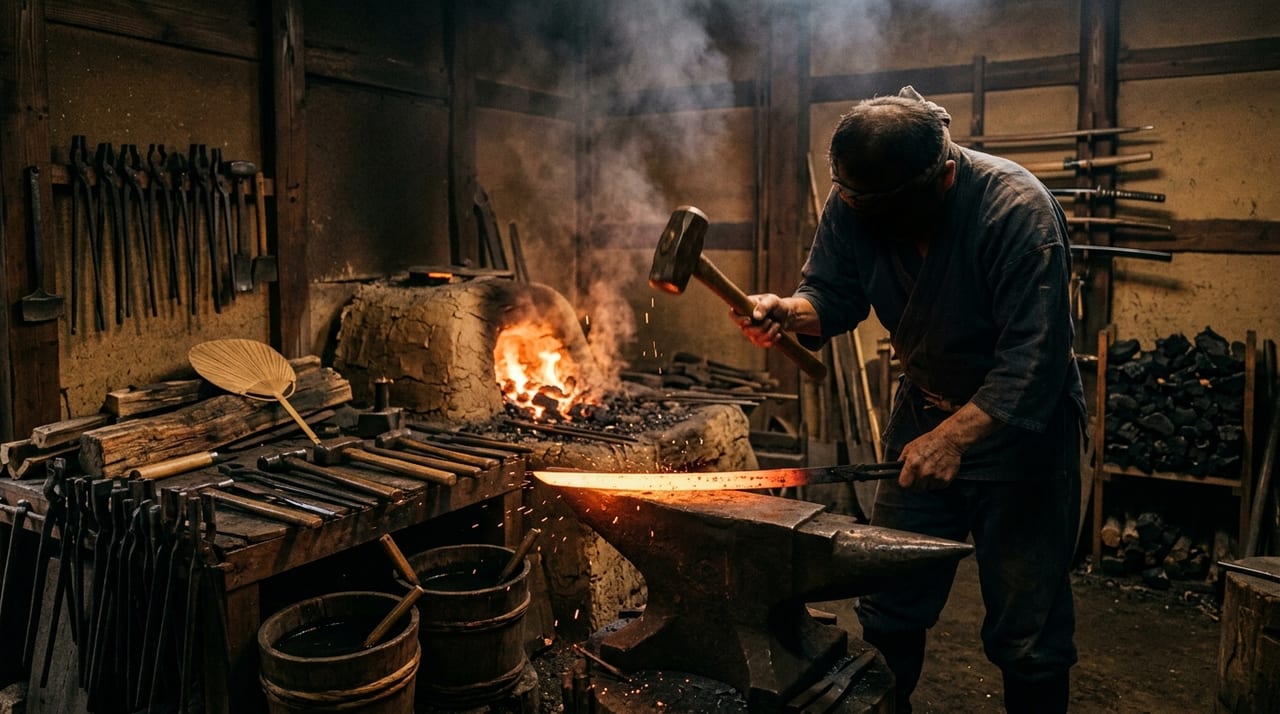
 * Image is for illustrative purposes only.
Chiyozuru Korehide
千代鶴是秀
Description
Lineage
Chiyozuru Korehide (1874–1957), whose real name was Katō Hiroshi, was born into a swordsmithing family that had served the Yonezawa domain in Yamagata for generations. His grandfather was the late-Edo swordsmith, seventh-generation Katō Chōunsai Tsunatoshi. At age 11 he was placed in the care of his uncle, Ishidō Korekazu (Juei), eighth head of the Ishidō family of hereditary swordsmiths in Azabu, Tokyo, and entered the craft as his apprentice.
Career
As sword demand collapsed following the 1876 Haitōrei edict banning the wearing of swords, Korehide trained as a carpentry-tool smith instead. By around age 19 he had already settled on the smithing name "Chiyozuru Korehide," and earned high praise from the carpenters who actually used his tools, becoming renowned as a master craftsman not only throughout the Kantō region but in the Kansai region as well.
Style and Reputation
Korehide's output extended well beyond chisels and planes to include kiridashi knives, hammers, carving knives, scissors, and razors, each judged to surpass the work of specialists in that particular tool. Though functional implements, his pieces were elevated to the status of artistic works embodying "beauty through use" — a quality likened, in sword terms, to that of Masamune.
Significance
Born into a swordsmithing lineage yet turning to tool-smithing amid the social changes following the abolition of sword-wearing, Korehide's career established an unshakeable reputation in that field and stands as a symbolic case of the transmission and transformation of blacksmithing craft in modern Japan.