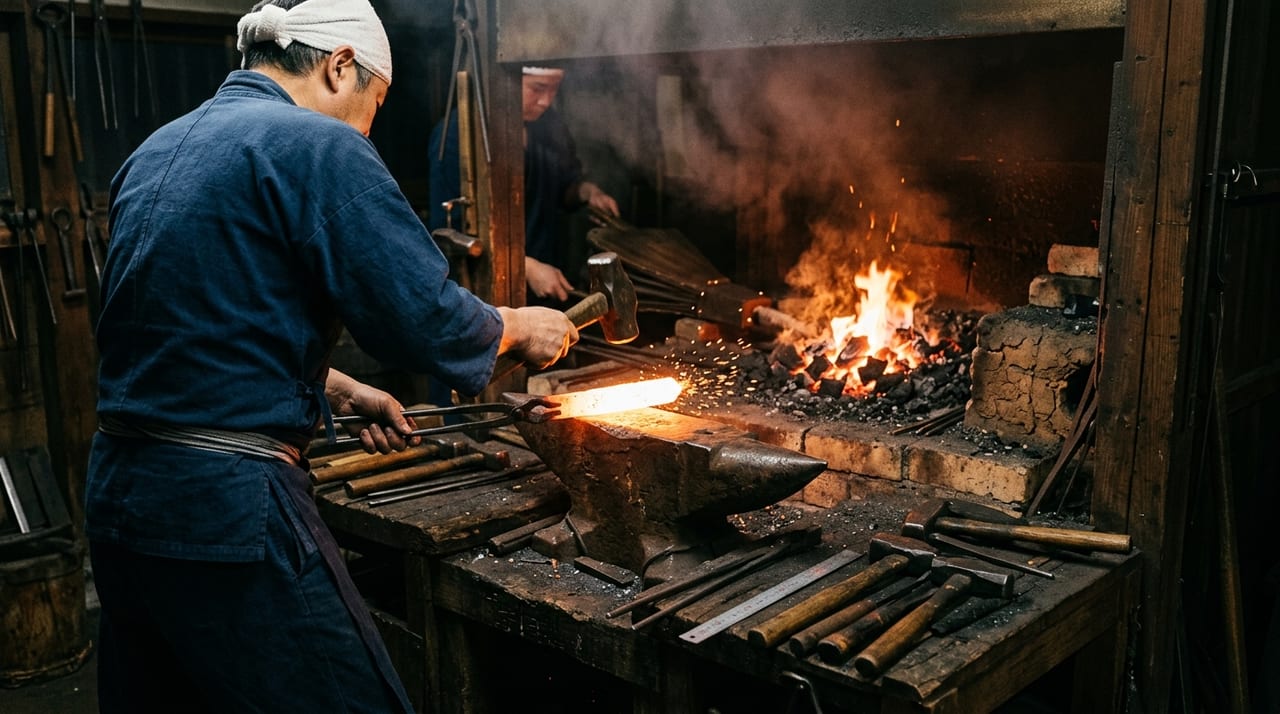
 * Image is for illustrative purposes only.
Chikuzen Jitsua
筑前実阿
Description
Lineage
Jitsua was a swordsmith active in Chikuzen Province from the late Kamakura period into the Nanbokucho period. He belongs to the line of the early Chikuzen smiths Ryosai, Nyusai and Sairen Kuniyoshi, whose work is said to have its roots in the Yamashiro tradition. He was the father of Sa (O-Sa), the leading Chikuzen smith of the Nanbokucho period.
Dated Works
Surviving dated works include pieces from Genko 3 (1333) and Enbun 2 (1357). A tachi signed "Jitsua saku" and dated the first day of the sixth month of Genko 3 is kept at Atsuta Shrine. Signed works are comparatively rare.
Style
The steel is a large itame mixed with flowing masame, with ji-nie and whitish utsuri. The hamon is suguha-based with fine nie, and shows kinsuji, sunagashi and inazuma. The boshi is ko-maru with hakikake. Blades are wide with chu-kissaki and koshizori, and bo-hi or double grooves are common.
Reputation
Two signed Jitsua blades are designated Important Art Objects. An unsigned katana attributed to Jitsua was designated Juyo Token at the 46th shinsa in 2000. His son O-Sa studied under him and later under Masamune, and is regarded as the only smith of the school to surpass Jitsua.