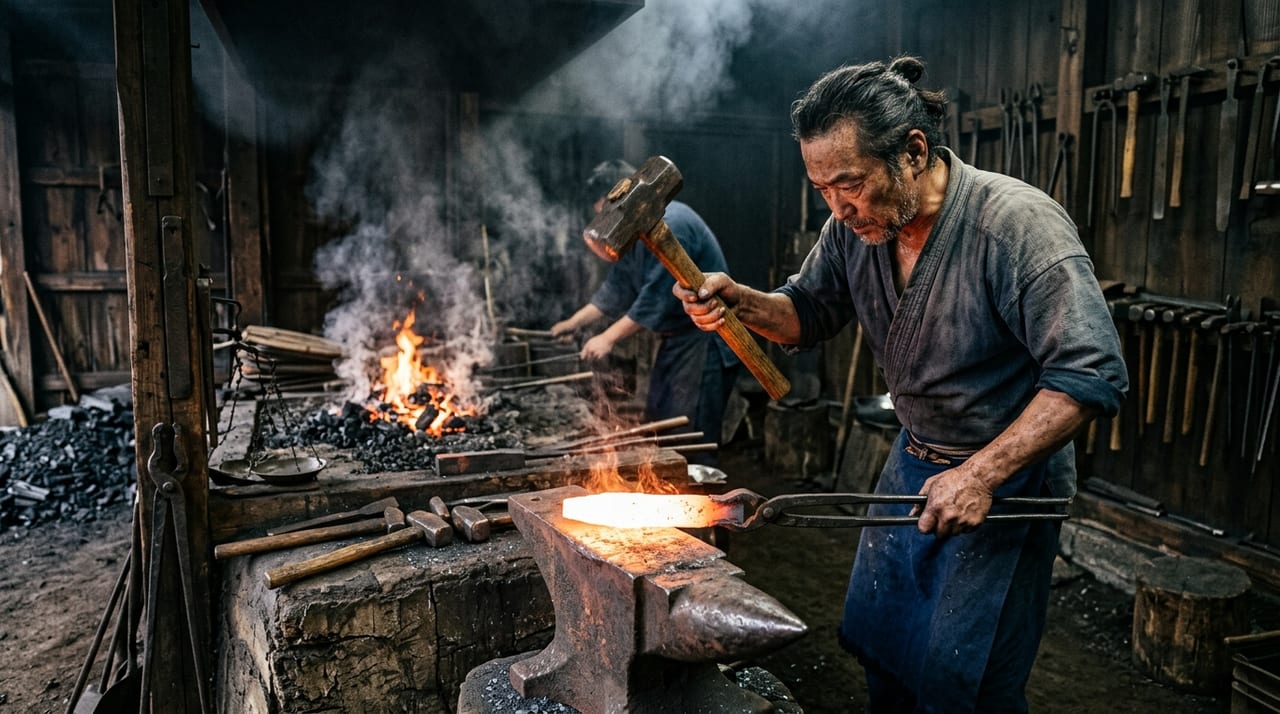
 * Image is for illustrative purposes only.
Awataguchi Kuniyasu
粟田口国安
Description
Awataguchi Kuniyasu was a swordsmith active in Awataguchi, Yamashiro Province (present-day area around Higashiyama Ward, Kyoto City), in the early Kamakura period, and he was one of the central figures of the Awataguchi school. The Awataguchi school is renowned in the history of Japanese swords as the school that embodied the most refined essence of the Yamashiro tradition. Within its lineage, Kuniyasu is known as a swordsmith who, alongside Hisakuni, Kunitsuna, and Yoshimitsu, brightened the golden age of Awataguchi.
The greatest feature of Kuniyasu's swordmaking lies in his realization, with high precision, of the pure Yamashiro-tradition techniques peculiar to the Awataguchi school. The jigane has fine ko-itame densely packed, presenting a uniform surface close to muji, and a fine ji-nie rises across the surface like a mist. The hamon is mainly ko-midare, showing a calm, dignified quench with a slightly moist nioi-guchi. Most of the kissaki are ko-kissaki, the nakago is also finished with care, and the clear spirituality emanating from the entire blade embodies the aesthetic sense of the era in which late Heian court culture shifted to Kamakura warrior culture.
Only a small number of Kuniyasu's signed works survive, but three tachi are designated Important Cultural Properties, and the Tokyo National Museum also holds a signed tachi that retains its appearance from the time it was made. The style of the mei is neatly carved as "Kuniyasu," and the characteristics of the calligraphic style, when compared with those of other Awataguchi smiths of the same lineage, are also regarded as important criteria in sword appraisal. In particular, Kuniyasu's works in the tachi form retain the typical curvature (sori) and length of the early Kamakura period, and they are first-rate sources that convey to the present day the ideal form of swords valued by the nobility and warriors of the time.
The early Kamakura period in which Kuniyasu lived was a turbulent era that moved from the establishment of the Kamakura shogunate by Minamoto no Yoritomo toward the establishment of regency rule by the Hōjō clan. Even as political power shifted to the warrior class, Yamashiro Province and the capital Kyoto remained centers of culture and art. The smiths of Awataguchi, while responding to the demands of the court and of temples and shrines, strove to sustain a swordsmithing culture that elevated swords from mere weapons into works of art. Kuniyasu too devoted himself, in this environment, to making renowned swords that combined practicality with artistry.
Kuniyasu is said to have been the third son of Kuniie of the Awataguchi school, and he is believed to have been selected, together with his elder brothers Kunitomo and Hisakuni, as bankaji (court smiths serving in monthly rotation) for Retired Emperor Go-Toba. Later successor smiths, such as Awataguchi Yoshimitsu (renowned as a master of tantō, including Atsu Tōshirō, and one of the three great masters of meibutsu swords (meibutsu sansaku)), also belong to this lineage, and the outstanding technique of the Awataguchi school was passed down through generations. In modern sword appraisal, Kuniyasu's works are often cited as top-level examples representing the Awataguchi school, and their importance in the study of Japanese sword history is unshakable.
Famous Works
- Tachi signed Kuniyasu (Important Cultural Property)
- Tachi signed Kuniyasu (Tokyo National Museum)