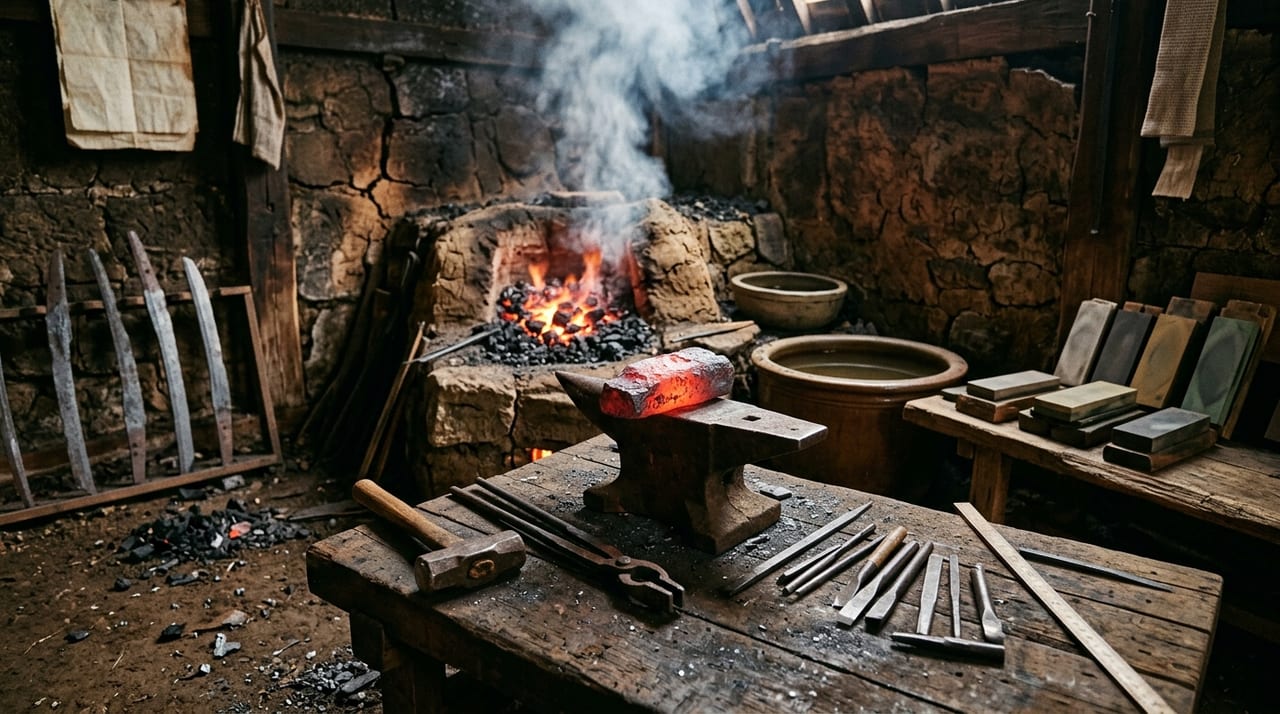
 * Image is for illustrative purposes only.
Awataguchi Arikuni
粟田口有国
Description
Awataguchi Arikuni was a swordsmith active in the Awataguchi district of Yamashiro Province (present-day vicinity of Sanjo Shirakawa Bridge, Higashiyama Ward, Kyoto) during the early Kamakura period and is known as one of the "Six Brothers of Awataguchi," who formed the nucleus of the Awataguchi school. The Six Brothers are transmitted to have been: Kunitomo, Hisakuni, Kuniyasu, Kunikiyo, Arikuni, and Kunitsuna. Among them, it is transmitted that Kunitomo, Hisakuni, Kuniyasu, and others were retained as imperial swordsmiths-in-attendance (Go-ban-kaji) to Retired Emperor Go-Toba, and they were celebrated masters illuminating the dawn of Japanese sword history.
Arikuni's forged blades embody the quintessence of the Yamashiro tradition, realizing both elegant ground steel and gentle hamon at the highest standard. The ground steel shows the beautiful jigane regarded as characteristic of the Awataguchi school, with ko-itame tightly packed with extreme fineness and finely and evenly scattered jinie softly illuminating the whole. The hamon is composed primarily of suguha, ko-midare, and ko-chōji, with a gentle and dignified nioiguchi unfolding evenly throughout. The aesthetic sensibility of court culture from the late Heian through early Kamakura—privileging refinement and quiet dignity over roughness—crystallizes in the blade, emanating a distinguished grace.
In the early Kamakura period when the Six Brothers flourished, Kyoto was an age in which, although the shogunate had shifted its political center to Kamakura, sophisticated artistic and craft culture centered on the imperial court continued to blossom. The Awataguchi smiths were pioneers rooted in this cultural soil who pointed the path of elevating the Japanese sword from "weapon" to "work of art." Behind Yoshimitsu (commonly known as Tōshirō), a later member of the Awataguchi line, being celebrated as the supreme master of the tantō in Japanese sword history, lies the technical and aesthetic foundation established by Arikuni and his brothers.
Works signed "Arikuni" are known, and only a very small number of signed works survive. The body configuration displays the slender form with deep curvature at the hilt characteristic of the early Kamakura period, predominantly featuring ko-kissaki. This elegant blade form, vividly preserving the grace of the late Heian period, eloquently testifies to the cultural context of Kyoto under the reign of Retired Emperor Go-Toba.
Today, a katana with the folded-back signature (orikaeshi-mei) "Arikuni," owned by the Ise Grand Shrine (Jingū), is designated an Important Cultural Property. As a member of the Six Brothers of Awataguchi who contributed to the establishment of the Yamashiro tradition, Arikuni's name remains an indispensable reference point in examining the formation of aesthetic standards in the Japanese sword.
Famous Works
- Katana, folded signature (orikaeshi-mei) Arikuni (Important Cultural Property, Jingū collection)