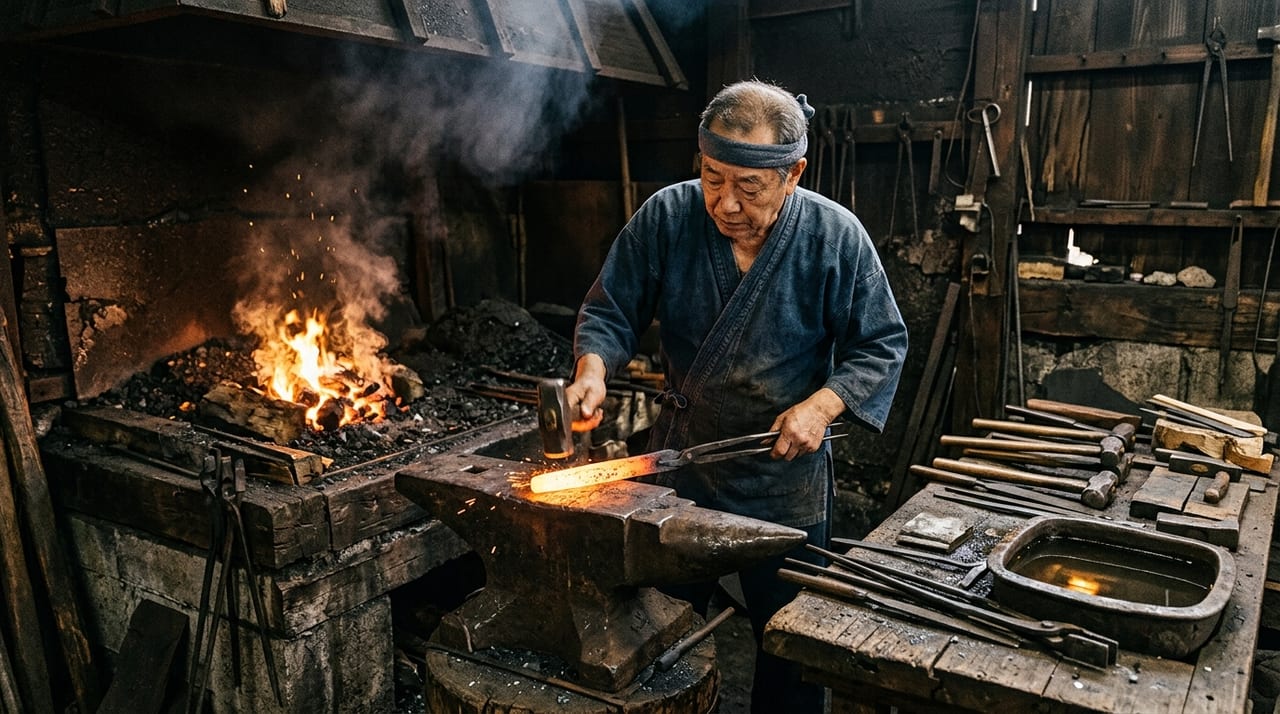
 * Image is for illustrative purposes only.
Aoe Tsugunao
青江次直
Description
Aoe Tsugunao and the Bitchū Aoe School (Sue-Aoe)
Aoe Tsugunao was a swordsmith who was active in the Nanboku-chō period in Aoe in Bitchū Province (around present-day Kurashiki, Okayama Prefecture). His name is recorded in the history of Japanese swords as one of the representative figures of the Bitchū Aoe school (Sue-Aoe). Sue-Aoe refers to the Aoe smiths of the period centered on the Enbun era (1356–1360).
The Aoe school is a regional swordsmith group that arose around Aoe in Bitchū Province at the end of the Heian period and flourished in the Kamakura and Nanboku-chō periods. Although rooted in the same land of Bitchū, it had its own sense of beauty, entirely different from that of the Osafune and Ichimonji schools of neighboring Bizen Province, and it has long been renowned for the unique beauty of its jigane, called sumi-hada.
The land of Kibi, including Bitchū, has been known since ancient times as a source of iron. Against this background, the Aoe school presented to the world of Japanese swords a 'beauty of stillness' that was clearly distinct from Bizen.
Sumi-hada and Tsugunao's Techniques
The most distinctive feature of the Aoe school's works is the beauty of the jigane called sumi-hada. Sumi-hada refers to a jigane that is clear and blue, in which jifu, areas that appear black and changed in color, emerge.
The hamon of Sue-Aoe blades include those in the traditional suguha style and those with large-patterned chōji-midare that slant (saka-gakaru), known as saka-chōji. 'Saka-gakaru' means that the ashi forming the hamon do not meet the edge at a right angle but lean diagonally, and it is considered a characteristic of Aoe works in general.
Works by Tsugunao also show gunome, ko-gunome and other variations, avoiding monotony. The bōshi generally returns in a straight (sugu) manner, maintaining the composed neatness peculiar to the Aoe school. The combination of the bluish jigane and the saka-chōji hamon truly embodies the individuality of the swordsmith Aoe Tsugunao, and it is also a decisive key in sword appraisal for identification.
Master Smiths of the Aoe School Contemporary with Tsugunao
The Aoe school produced many excellent swordsmiths besides Tsugunao, including Moritsugu, Tsunetsugu, Sadatsugu and Tsuguie. Tsunetsugu and others belong to the Kamakura-period Ko-Aoe, while Tsugunao belongs to the Sue-Aoe of the Nanboku-chō period. Among them, Aoe Tsunetsugu of Ko-Aoe is known for the meibutsu 'Juzumaru Tsunetsugu' (one of the Tenka Goken, Important Cultural Property) and is a symbol of the Aoe school. Tsugunao of the Nanboku-chō period is also valued as a swordsmith who left works of no less high standard.
Aoe school smiths use the element 'tsugu' as a tsūji, a character shared across names, as seen in Moritsugu, Sadatsugu and Tsunetsugu. Tsugunao and Tsuguie follow the same practice.
Although the Aoe smiths competed with one another in technique, they bound together under the shared aesthetic of sumi-hada and saka-chōji, forming a large group. It can be said that it was because of this collective technical foundation that individual smiths were able to consistently produce works of high standard.
Bitchū Aoe and Geographical Influence
Aoe is located on the lower reaches of the Takahashi River, in present-day Kurashiki City.
Geographically, Bitchū lies directly west of Bizen. The fact that the Aoe school was able to maintain a distinctive character clearly different from Bizen's chōji-midare is a major feature of the Aoe school.
Tsugunao's Legacy and TOUKENZA
The swords of Aoe Tsugunao embody the latter value in the dualistic beauty of 'stillness against splendor' and 'composure toward ascent'. If Bizen's chōji expresses the vitality of rising, Aoe's saka-chōji expresses the stability and depth that follow gravity. This contrast is not merely a technical difference but reflects the fundamental duality of 'movement and stillness' and 'yang and yin' in the Japanese sense of beauty.
TOUKENZA intends to convey the breadth of the beauty of Japanese swords by introducing not only Aoe Tsunetsugu but also the diverse master smiths of the Aoe school, including Aoe Tsugunao. The clear bluish jigane and the saka-chōji hamon that falls quietly. Knowing this 'beauty of Aoe' leads directly to knowing the depth of the art of Japanese swords.
Famous Works
- Tantō signed Bitchū-no-kuni-jū Tsugunao saku, dated Enbun 3, 11th month (Important Cultural Property, Tokyo National Museum)
- Katana, folded signature (orikaeshi-mei) Bitchū-no-kuni-jū Tsugunao (Important Cultural Property, Tokugawa Art Museum)