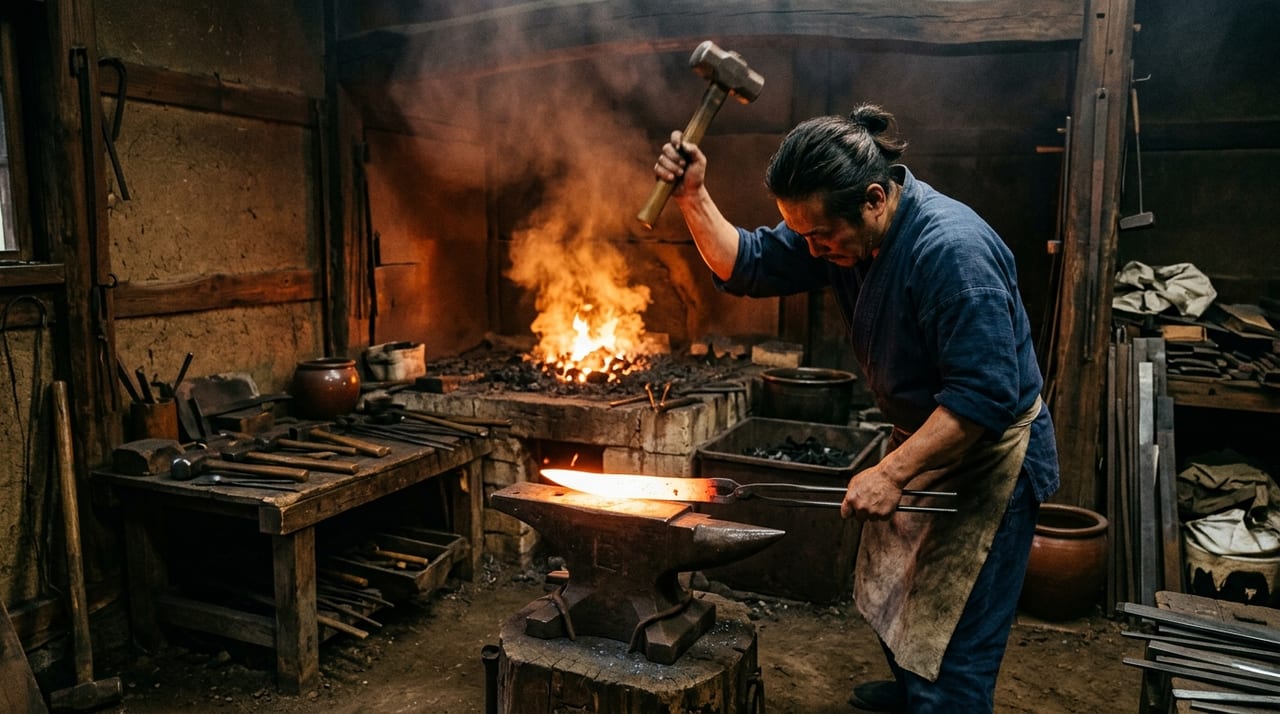
 * Image is for illustrative purposes only.
Aoe Moritsugu
青江守次
Description
Ko-Aoe's Masterpieces and the World of Moritsugu's Works
Aoe Moritsugu was a representative swordsmith of the Aoe school of Bitchū Province (present-day western Okayama Prefecture), active in the mid-13th century, in the middle of the Kamakura period. The Aoe school was a group of swordsmiths centered on Aoe in Bitchū Province (present-day Kurashiki City, Okayama Prefecture), directly west of Bizen. Its history spans a long period from the late Heian period to the Nanboku-chō period. The swordsmiths of the Aoe school up to around the middle of the Kamakura period are called “Ko-Aoe”, and they are known for the beauty of their distinctive jigane and for their hamon with nie-deki. Moritsugu is one of the master smiths who represent the peak of Ko-Aoe, and he is a superb swordsmith rated as saijō-saku.
The mid-Kamakura period, when Moritsugu was active, was a period of stability under Hōjō shikken rule, and it was also an age in which samurai culture matured. Swordsmiths of the Aoe school, including Moritsugu, kept supplying high-quality swords to the warrior society of western Japan, while maintaining a technical system of their own that differed from that of the Bizen smiths.
Jigane Unique to Ko-Aoe: The Mystery of “Sumihada”
The most notable point in Moritsugu's works is the beauty of the jigane unique to Ko-Aoe. The jigane of Ko-Aoe shows what is called “sumihada”: within the clear, blue-tinged jigane, dark patches (jifu) appear that look as if their color has changed to black. It displays a texture with more raised grain and more variation than Bizen work. This characteristic of the jigane is clearly distinct from the other schools of Bizen-den (Osafune and Ichimonji). In the ji, a mysterious utsuri may appear as fine hataraki, like moonlight reflected on the surface of water, and this is one of the greatest pleasures in appreciating Ko-Aoe.
The ji-nie is fine and even, forming an overall crisp and clear beauty. Moritsugu's jigane is especially orderly and beautiful, conveying the impression that a skilled smith has fully mastered the nature of the material. Such high-quality jigane is produced by the combination of the properties of satetsu (iron sand) peculiar to Bitchū Province and the forging techniques handed down through generations of the Aoe school. It is a unique beauty that cannot easily be reproduced in other production regions.
Hamon Characteristics: Fine Suguha and the Depth of Nie-deki
Moritsugu's hamon consists mainly of fine suguha (hososuguha) or gentle ko-midare, with nie-deki at its core. Although this hamon appears plain at first glance, its characteristics contain a rich content when examined closely. The fine nie particles distributed evenly over the entire blade show a glitter as if silver sand had been spread over it, and when the angle of the light changes, a complex expression rises up within the blade. The nioiguchi is somewhat tight and deep, and at the boundary between the blade and the ji, fine kinsuji and sunagashi appear.
The “depth of nie-deki” peculiar to the hamon of Ko-Aoe has a paradoxical richness: it holds a complex internal structure within the serene beauty of a simple suguha. This quality, which excludes showiness yet deeply captivates the viewer, can also be interpreted as embodying the spirit of the warrior, the ideal of being serene on the outside while possessing deep power hidden within.
Moritsugu's Mei and Surviving Works
Moritsugu's mei is inscribed with the two characters of his name, Moritsugu (守次), and its brushwork is a forceful, orderly script befitting a master smith. Among the works of Ko-Aoe Moritsugu there is a tachi designated as an Important Cultural Property (designated 1931; current whereabouts unknown). In addition, a Moritsugu of the same name is found among the Sue-Aoe of the Nanboku-chō period, and his tachi and tantō also include Important Cultural Properties.
Encountering Moritsugu's swords is a precious opportunity to experience the diversity and depth of the sword culture of western Japan, which flourished in Bizen and Bitchū.
Historical Position of the Aoe School and the Significance of Moritsugu
The Aoe school is a group of Bitchū swordsmiths classified under Bizen-den within the Gokaden. While holding its own technical system independent of the Bizen mainstream, it made an important contribution to the nihontō culture of the Kamakura period as a whole. As a bearer of its peak period, Moritsugu played an important role in the sword culture of the Bizen region, alongside Ichimonji and Osafune.
At TOUKENZA, Moritsugu is introduced as a master smith who embodies the distinctive world of beauty woven by the sumihada and deep nie-deki hamon of Ko-Aoe. The beauty of Ko-Aoe is plain at first glance yet deepens the more one looks. It is the very essence of the pleasure of appreciating nihontō, and Moritsugu's works are among its highest peaks.
Materials of the Aoe School and the Natural Environment of Bitchū
Behind the Aoe school's creation of its own jigane beauty lie the natural environment and material conditions peculiar to Bitchū Province. In the basin of the Takahashi River flowing through Bitchū, high-quality satetsu is abundant, and it is considered that the chemical composition of this satetsu greatly affects the color tone and texture of the jigane peculiar to Ko-Aoe. Bitchū satetsu, with components subtly different from those of Bizen satetsu, produces a distinctive texture and utsuri in the forging process. Bitchū charcoal, too, is said to have distinctive burning characteristics, which influence how nie and nioi form during quenching.
Moritsugu fully grasped such material conditions and established forging and quenching techniques that make the fullest use of them. The beauty of sumihada born as a result may be called a miraculous product of a fortunate meeting of material and technique. Moritsugu's works eloquently show that the beauty of the nihontō is not merely a product of craftsmanship, but a comprehensive cultural expression in which land, material, technique, and the spirit of the age are unified. It is said that when standing before Moritsugu's tachi, viewers often forget the passage of time and are drawn into this mysterious world of beauty. Ko-Aoe Moritsugu's swords are among those that most quietly yet most deeply speak to the fact that the nihontō is a “work of art beyond a weapon.”
Famous Works
- Tachi signed Moritsugu (Important Cultural Property, whereabouts unknown)