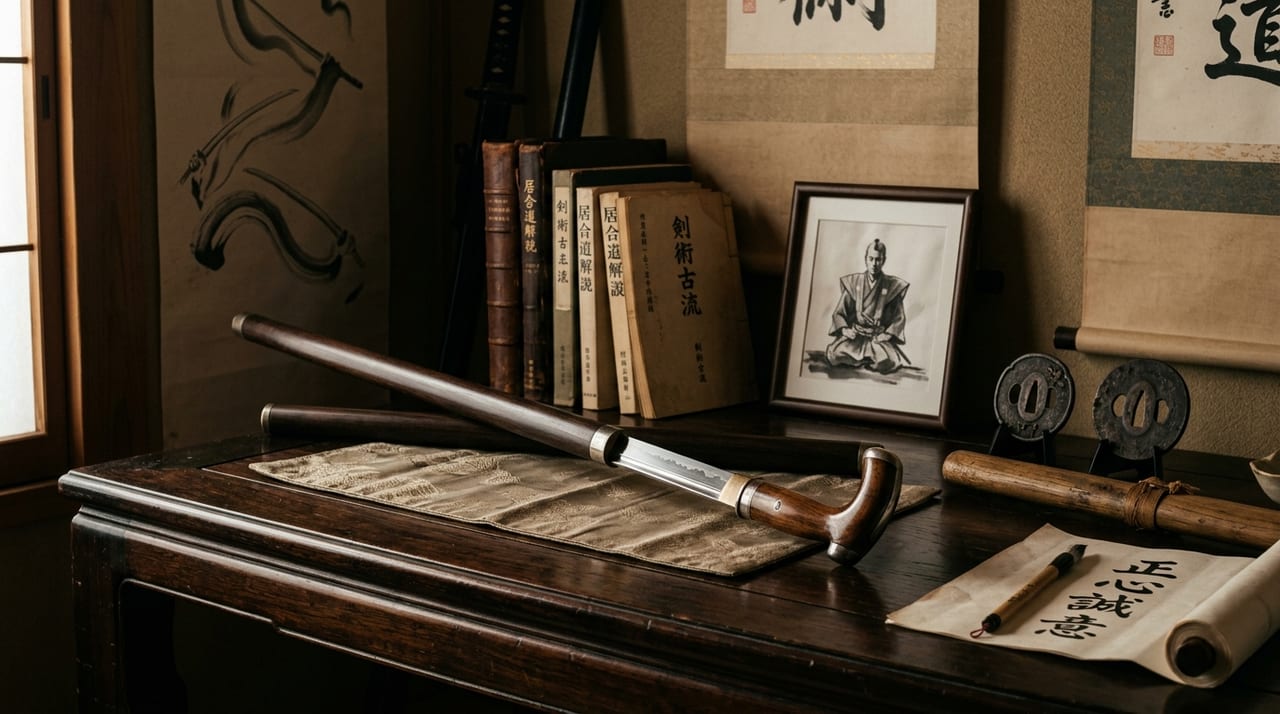
 * Image is for illustrative purposes only.
Zatoichi
座頭市
A story of a blind wandering gambler-swordsman, Zatōichi, played by Shintaro Katsu in 26 films from 1962 and remade by Beat Takeshi (Takeshi Kitano) in 2003. Through its unique swordplay, using a concealed-blade cane (shikomizue) and iai draws from a reverse grip (sakate-mochi), the work established a one-of-a-kind action style in Japanese period drama. Through the concealed-blade (shikomi-gatana) culture, iai techniques, and the social position of the blind, it conveyed many aspects of Edo-period sword culture to the world.
Description
The Blind Wandering Gambler-Swordsman
Zatōichi is a landmark of Japanese period drama in which Ichi, a blind wandering gambler-swordsman (kyōkaku), cuts down evil with a shikomizue (sword cane). Shintaro Katsu played the character in 26 films and a 100-episode television series from 1962. In 2003, Beat Takeshi (Takeshi Kitano) remade it as director and star, and it earned high international acclaim, including the Silver Lion at the Venice International Film Festival. Zatōichi vividly impressed two elements of Japanese sword culture on film fans not only in Japan but around the world: the shikomizue and the iai draw.
The Secret of the Shikomizue
The shikomizue (sword cane) that Zatōichi carries is a hidden weapon with a blade concealed inside a cane. Townspeople who needed to arm themselves were said to have carried it for self-defense, and after the Sword Abolishment Edict (Haitōrei) was issued in the Meiji period, carrying shikomizue became fashionable among the former samurai class (shizoku). Because of structural constraints, the blades of concealed-blade swords (shikomi-gatana) are shorter than ordinary uchigatana, and many are built closer to chokutō (straight swords) with shallow curvature. They have no tsuba (guard) or tsuka (hilt) and are simply constructed so as not to spoil the appearance of a cane.
Reverse-Grip Iai
The true essence of Zatōichi's swordsmanship lies in the iai draw from a reverse grip (sakate-mochi). Whereas ordinary iai draws the sword from the scabbard with a forward grip, Zatōichi holds the sword in reverse and uses a distinctive style of cutting upward from below. This technique is based on the fact that reverse-grip draw forms (sakate-nuki) also exist in actual iaidō, but Shintaro Katsu independently evolved it, establishing a form of swordsmanship expression that does not rely on sight. Because he is blind, he senses his opponent's movements through hearing and presence and cuts instantly. The setting of this 'unseen swordsman' embodies the essence of the martial arts: Japanese swordsmanship is not mere physical technique but an integrated training of mind and body.
The History of Iai
The founder of iai is said to be Hayashizaki Jinsuke Shigenobu, a swordsman from Yamagata Prefecture, and there is a legend that he mastered the technique of drawing and cutting in an instant from the scabbard in order to avenge his father. From Hayashizaki-ryū, many iai schools branched out, including Musō Jikiden Eishin-ryū and Musō Shinden-ryū, and even today training continues under the All Japan Kendo Federation as iaidō. The Zatōichi series is one of the greatest contributors to spreading this iai culture around the world.
Real Swords Featured
Shikomizue (sword cane)
A self-defense weapon that hides a blade inside everyday objects such as canes or umbrellas, said to have been carried for protection by townspeople who needed to arm themselves. Outwardly it is entirely a cane, but pulling out the grip reveals a blade from within. The blade has no tsuba and is often built close to a straight sword with shallow curvature. After the Sword Abolishment Edict in the Meiji period, carrying them became fashionable among the shizoku. In Japan today, possessing a blade sheathed in a cane-like exterior made as a concealed-blade sword is prohibited under the Firearms and Swords Control Law. The shikomizue is also an important testament to the fact that Japan's sword culture was not limited to the warrior class but permeated society as a whole.
Iai
A Japanese swordsmanship in which the sword is drawn from its scabbard, with the drawing motion itself serving as the attack. The founder is said to be Hayashizaki Jinsuke Shigenobu of Yamagata Prefecture, and the art was established in the late Sengoku period. Hayashizaki Jinsuke is said to have mastered the drawing technique in order to avenge his father, and from this lineage many schools arose, including Hayashizaki-ryū, Tamiya-ryū, Musō Jikiden Eishin-ryū, and Musō Shinden-ryū. Training uses a real sword or an iai sword, and repeating forms (kata) against imagined opponents integrates mind, technique, and body. The principle of "winning while the sword is still in the scabbard" expresses the spirit that the outcome is decided before the sword is drawn, showing that iai is training of the mind as well as of technique. Today it has been systematized as the All Japan Kendo Federation standard iai (Zen Ken Ren Iai), and training continues both in Japan and abroad.
Chokutō (straight sword)
A sword with a straight blade lacking curvature, an ancient form that predates the curved shape Japanese swords later acquired. From the Asuka to the Nara period, Japanese swords were chokutō influenced by continental culture, and the swords preserved at the Shōsōin are representative examples. Curvature began to appear in blades around the mid-Heian period, forming the prototype of the modern Japanese sword. The emergence of the curve is said to be related to the efficiency of cutting in mounted combat, and the evolution toward the curved wantō became a decisive feature that sets Japanese swords apart from swords elsewhere in the world. The blade of a shikomizue, due to the structural constraints of the scabbard (cane), is often built close to a straight sword, and in this respect it shares a formal similarity with ancient chokutō. Zatōichi's shikomizue is also depicted with such a straight blade.
This page is intended to introduce Japanese sword culture and is not affiliated with any of the works mentioned.