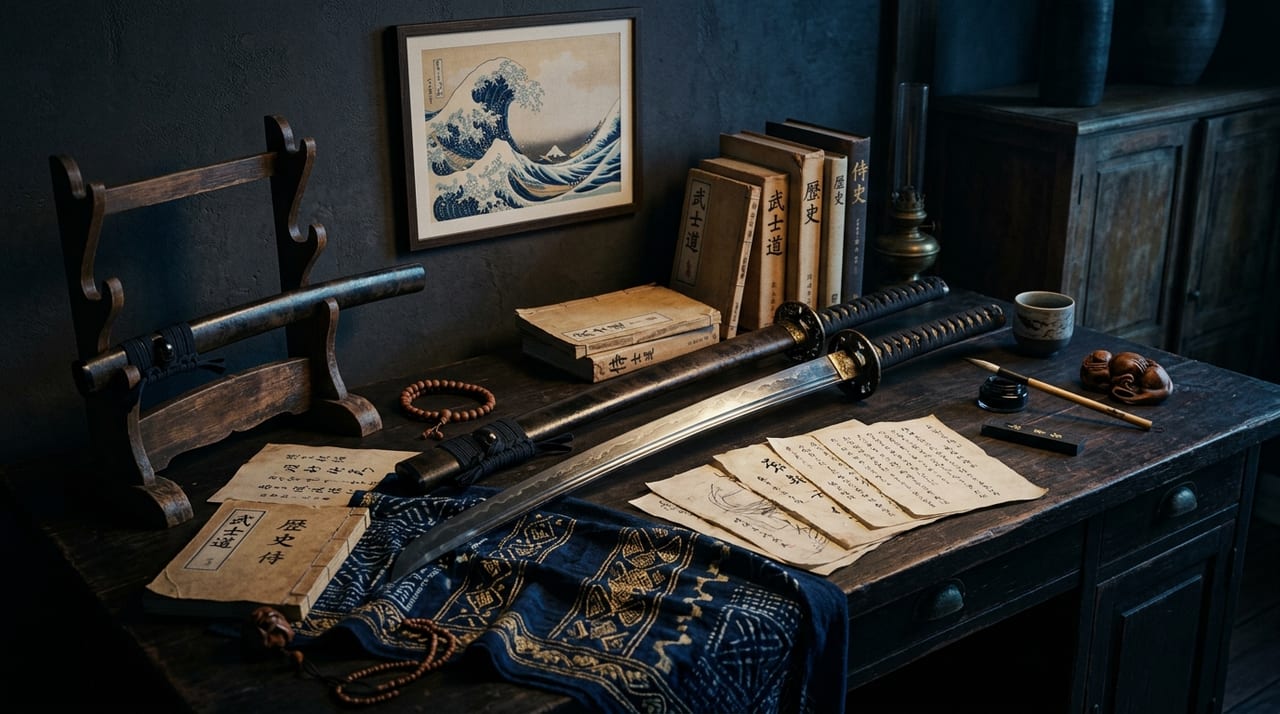
 * Image is for illustrative purposes only.
Yasuke
ヤスケ
A 2021 Netflix anime series based on the historical figure of Yasuke, a man of African origin who served Oda Nobunaga as a samurai. The show blends historical fact with dark fantasy in a supernatural retelling of the Sengoku era.
Description
Historical Background: The Real Yasuke
Yasuke was an African samurai who lived in the late 16th century. He came to Japan accompanied by the Jesuit missionary Alessandro Valignano, and in 1581 he had an audience with Oda Nobunaga. Nobunaga was greatly interested in Yasuke's physique and dark skin, took him into his service, and is said to have later granted him a stipend, a private residence, and a short sword worn at the waist (sayamaki), treating him as a samurai. This was an exceptionally rare case of a foreigner being recognized as a Japanese samurai, and it draws attention from history enthusiasts around the world even today. During the Honnō-ji Incident in 1582, Yasuke was also with Nobunaga, and his whereabouts after surrendering to Akechi Mitsuhide's forces are unknown.
Interpretation in the Anime Series
The 2021 Netflix anime, directed by LeSean Thomas with music supervised by Flying Lotus, is structured as a dark fantasy based on the historical Yasuke. Its premise is that Yasuke, after losing Nobunaga in the Honnō-ji Incident, takes up the sword again to protect a sick girl with mysterious powers. The series unfolds in a distinctive world involving magic, yōkai, and other supernatural elements. The fusion of historical drama and Afrofuturist aesthetics drew international attention.
Swords and Identity as a Samurai
In Yasuke's identity, the sword Nobunaga gave him holds great significance. For Yasuke, a foreigner who was permitted to carry a sword, the sword was a symbol of social status and recognition as a warrior, going beyond a mere weapon. The anime also depicts this carefully, and the act of Yasuke setting down the sword and then taking it back up becomes the emotional axis of the story. Through the case of a foreign samurai, the cultural notion of the Japanese sword that "chooses its wielder" is illuminated from a fresh angle.
Nobunaga's Sword Culture and Its Symbolism
Oda Nobunaga was also known as a connoisseur of swords, and he owned and bestowed many famous blades. Giving a sword to Yasuke was not simply the provision of a tool, but an official declaration that Yasuke was recognized as a member of the warrior class. The famous sword Nobunaga owned, Heshikiri Hasebe, is said to have later been bestowed on Kuroda Kanbei. It was passed down in the Kuroda family through the Edo period as a renowned sword of the realm, demonstrating Nobunaga's deep involvement with sword culture and his discerning eye. The sword given to Yasuke is recorded only as a "sayamaki" (a short sword worn at the waist) in a manuscript copy of the Shinchō Kōki, and no maker or other details have been transmitted. Still, the cultural weight of that act is indispensable in telling Yasuke's story.
International Reception and Significance
Yasuke's story has been reassessed around the world in recent years. It has been taken up across many media, including films, manga, and games such as Assassin's Creed Shadows, and it is widely discussed as a symbol of the diversity inherent in the historical fact of the "Black samurai." In the context of conveying Japanese sword culture internationally, Yasuke's existence also provides a valuable case that reexamines the meaning of the sword from universal perspectives, through the question of who may wield a sword.
Real Swords Featured
Heshikiri Hasebe (National Treasure)
Heshikiri Hasebe is a work by the swordsmith Hasebe Kunishige of the Nanbokuchō period, and one of the renowned named swords that Oda Nobunaga treasured. According to legend, Nobunaga cut down a tea-ceremony attendant (chabōzu) who was hiding beneath a serving shelf by oshikiri (cutting by pressing the blade), and the name "Heshikiri" is said to derive from this episode. It later passed to Toyotomi Hideyoshi and the Kuroda family, and it is now held by the Fukuoka City Museum as a National Treasure. It is a sword from the same period in which Nobunaga gave a sword to Yasuke, and a relic that shows what Nobunaga regarded as the value of a sword.
Tenshō-period uchigatana (swords of Nobunaga's era)
The Tenshō era (1573–1592), when Yasuke was active, was a period of practical uchigatana that reflected the intense demand for combat weapons in the late Sengoku period. With a blade length of roughly 2 shaku 2 to 3 sun (67–70 cm), the uchigatana style, worn at the waist for fighting on foot, became widespread. Swords used by formidable armed forces such as Nobunaga's army were often valued more for cutting performance and durability in actual combat than for their character as works of art.
See authentic Japanese swords
See authentic Japanese swordsThis page is intended to introduce Japanese sword culture and is not affiliated with any of the works mentioned.