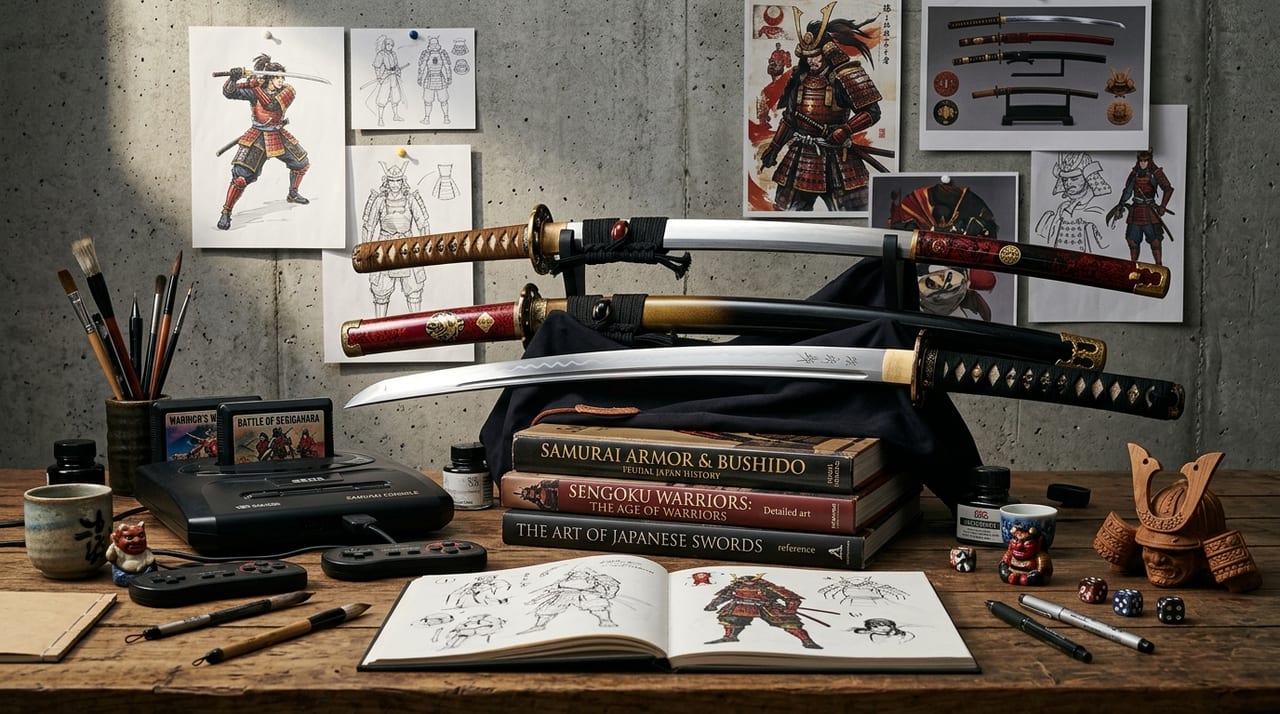
 * Image is for illustrative purposes only.
Throne of Blood
蜘蛛巣城
A 1957 Japanese film directed by Akira Kurosawa that transposes Shakespeare's Macbeth to Japan's Sengoku (Warring States) period. Toshiro Mifune plays the ambitious general Washizu, who betrays his lord and is ultimately killed by a hail of arrows from his own men. Swords appear throughout as symbols of samurai loyalty and rank, notably when Washizu and his ally receive katana from their lord.
Description
Overview
Throne of Blood (Japanese title: Kumonosu-jō, "Spider Web Castle") is a 1957 Japanese film directed by Akira Kurosawa, adapting Shakespeare's Macbeth to an unspecified time and place within Japan's Sengoku (Warring States) period. It stars Toshiro Mifune with Isuzu Yamada. Rather than translating Shakespeare's dialogue directly, Kurosawa restaged the tragedy through the visual and performative conventions of Noh theater.
The Story and the Granting of Swords
The general Washizu (Mifune, the Macbeth figure) and his ally Miki (the Banquo figure) receive a prophecy from a forest spirit in Spider Web Forest. Early in the film, Washizu and Miki are shown pompously receiving new katana and territory from their lord — the sword functioning as a mark of samurai rank and loyalty. Spurred on by his wife Asaji (Yamada, the Lady Macbeth figure), Washizu assassinates his lord and seizes power.
Armor, Arrows, and the Final Scene
Washizu's armor is styled after the o-yoroi, an older form of Japanese armor, with lacquered plates and colored silk lacing prominent on screen. In the film's climax, Washizu's own mutinous soldiers fire volleys of arrows at the castle where he is trapped, and he is killed by a barrage of arrows striking his body — not by a blade. The sequence is famous for having used real arrows shot at close range toward the actor, and it is regarded as one of the most harrowing scenes in film history.
Fusion with Noh Theater
Kurosawa sought to fuse Western tragedy with the formal beauty of Noh. Isuzu Yamada's restrained, mask-like expressions and stylized gestures as Asaji are widely noted as deliberately echoing Noh masks and movement patterns. Noh-influenced elements also appear in the film's line delivery and score, elevating the adaptation into a distinct visual poem.
Reception and Legacy
The film was neither a major box-office hit nor a critical favorite in Japan on release, but it came to be regarded abroad as one of Kurosawa's masterworks and among the finest cinematic adaptations of Shakespeare, later entering the Criterion Collection. Its depiction of swords ceremonially granted to samurai and its rendering of o-yoroi armor are cited as influential visualizations of the rank-bound meaning of swords and arms in the Sengoku period, shaping later jidaigeki films.
Real Swords Featured
See authentic Japanese swords
See authentic Japanese swordsRelated Content
Nobunaga's Ambition
Game信長の野望
Japan's longest-running historical simulation game series by Koei Tecmo (1983–). Players control Sengoku warlords including Oda Nobunaga in a quest for national unification. The series systematically parameterizes warriors' swords and equipment, providing one of the most comprehensive frameworks for learning about Japanese sword history, distribution, and connections to historical figures.
Seven Samurai
Film七人の侍
Akira Kurosawa's timeless masterpiece that introduced the world to Sengoku-era warriors and swords, influencing all subsequent action cinema.
Legend & Butterfly (Film, 2023)
Filmレジェンド&バタフライ(映画・2023年)
Toei 70th Anniversary commemorative work (directed by Otomo Keishi, screenplay Furusawa Yoshita, released January 2023). Kimura Takuya portrays Oda Nobunaga and Ayase Haruka portrays his primary consort Nōhime (Kicho), depicting the unknown bond between Nobunaga and Nōhime. A large-scale historical film with a total production cost of 2 billion yen and cumulative attendance exceeding 1.8 million. Rooted in the historically documented famous swords of Nobunaga — Sozan Samonji (Yoshimoto Samonji) and Heshikiri Hasebe — this is an important work from the perspective of sword culture, in which Nobunaga's sword aesthetics under the banner of 'Tenka Fubu' (Rule the Realm Through Arms) intersect with Nōhime's strength.
Blue Exorcist
Anime and Manga青の祓魔師
A shonen manga where exorcists who banish demons battle with swords. The protagonist's holy sword is central to the story.
This page is intended to introduce Japanese sword culture and is not affiliated with any of the works mentioned.