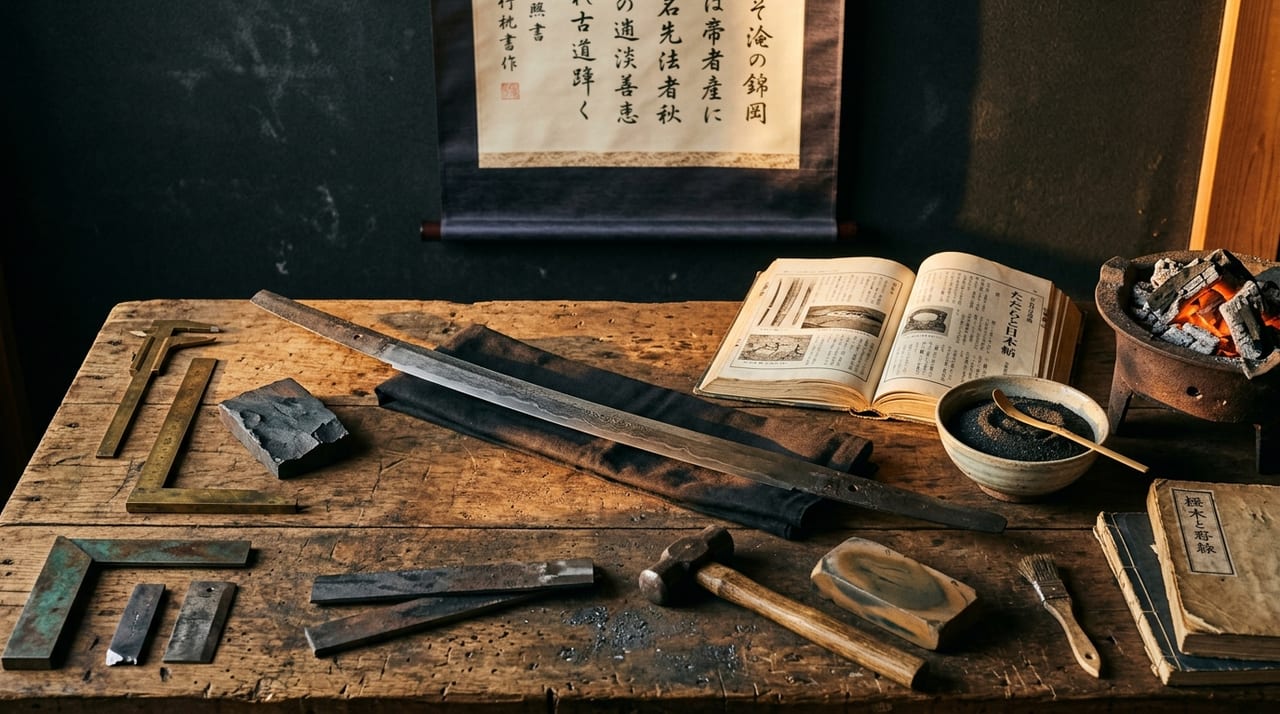
 * Image is for illustrative purposes only.
TATARA SAMURAI
たたら侍 / TATARA SAMURAI
A 2017 film directed by Yoshinari Nishikiori. Set in Izumo Province during the Sengoku period, it follows a young man from a village that works in tatara iron-making as he struggles between becoming a samurai and living as a maker of iron. Built around the production of tamahagane, the raw steel for Japanese swords, it is an exceptionally rare feature film. It shows the long manufacturing process of the Japanese sword, which begins with iron sand, and the tatara iron-making tradition that has continued in Okuizumo for more than a thousand years.
Description
The Conflict Between Blade and Iron
TATARA SAMURAI (2017, directed by Yoshinari Nishikiori) is set in Izumo Province during the Sengoku period. It depicts Gosuke, a young man from a village engaged in tatara iron-making, as he wavers between becoming a samurai and living as a maker of iron. Few works in Japanese cinema place the production of tamahagane, the raw steel for Japanese swords, at the core of the story, and TATARA SAMURAI is a representative example.
The Tatara Iron-Making Process
Tatara iron-making is an ancient Japanese smelting method in which sand iron and charcoal are fired for three days and three nights in a clay furnace inside a building called a takadono, producing a steel mass called kera. The process includes gathering sand iron, building the furnace, operating the bellows (fuigo) with craftsmen called banko, and continuing until the kera is removed from the furnace after three days and nights of smelting. A single smelting yields about 2.5 tons of kera, but only a portion of it is selected as tamahagane for swords, and a swordsmith must then make a rigorous selection of the iron before forging a single blade. No other work conveys as persuasively the fact that the Japanese sword is born from iron sand.
History of Okuizumo
Okuizumo, the center of tatara iron-making (present-day Okuizumo Town, Nita District, Shimane Prefecture), is a "land of iron" that has carried on tatara operations for more than a thousand years, blessed with high-quality masa iron sand and abundant forest resources. In the Edo period, large-scale tatara operators called tetsushi (ironmasters) supported the regional economy, and iron from Okuizumo circulated throughout the country, sustaining Japan's industrial base not only through swords but also through farm tools and architectural hardware. Today, the only facility operating traditional tatara iron-making is Nittōho Tatara, run in Okuizumo Town, Shimane Prefecture by the Society for the Preservation of Japanese Art Swords (NBTHK). It supplies tamahagane to swordsmiths across Japan through a few limited operations each year. The murage (the chief of a tatara operation) at Nittōho Tatara has advanced skill in judging the state of the furnace from the color and sound of the flame, and that skill has been passed from master to apprentice by oral transmission.
The Time and Labor Behind Production
The most important message the film conveys is how many people's hands, how much time and how much passion are spent before a Japanese sword appears as a finished product. Those who collect iron sand, those who burn charcoal, those who run the tatara, those who select tamahagane, and the swordsmiths who forge the blade all contribute. A single Japanese sword is born at the end of this vast chain of processes.
Real Swords Featured
Tatara seitetsu
An ancient Japanese iron-making method in which sand iron and charcoal are burned for three days and three nights in a clay furnace inside a building called a takadono, producing a steel mass called kera. "Tatara" originally referred to the bellows (fuigo) that send air into the furnace, and the name of the method derives from it. During operations, craftsmen called banko take turns working the bellows to send air into the furnace. Iron oxide in the sand iron is reduced by the carbon in the charcoal and becomes steel. A single smelting consumes about 10 tons of sand iron and 12 tons of charcoal and yields about 2.5 tons of kera, of which only a portion is selected as tamahagane for swords. Steel of the same quality could in theory be produced with modern iron-making technology, but the distinctive internal structure that arises only from tatara iron-making supports the beauty of the Japanese sword.
Tamahagane
The highest-quality steel selected from the kera produced by tatara iron-making, and the principal material for forging Japanese swords. Its carbon content is uniform at about 1 to 1.5 percent, and it has a fine, non-uniform internal structure that is fundamentally different from industrial steel. This heterogeneity gives rise, through folding forging, to the steel surface patterns (itame, mokume and masame), and through hardening it produces the diverse temper patterns (hamon). Currently, Nittōho Tatara is the only facility supplying tamahagane for swords through traditional tatara iron-making.
Nittōho Tatara
A tatara iron-making facility in Okuizumo Town, Nita District, Shimane Prefecture, operated by the Society for the Preservation of Japanese Art Swords (NBTHK), a public interest incorporated foundation. It is the only tatara iron-making facility in modern Japan. It revived tatara iron-making in 1977, after the practice had been interrupted in the postwar period, and since then it has run several operations each winter, supplying tamahagane to swordsmiths across Japan. The person in charge of an entire operation is called the murage. Based on advanced practical knowledge, the murage judges the temperature inside the furnace and the state of steel formation from the color and sound of the flame and the condition of the smoke. Akira Kihara (died 2024), who served as murage for many years, was certified as a holder of the Selected Conservation Technique "tamahagane production" by the national government. That skill is transmitted through oral tradition and hands-on experience. It is no exaggeration to say that without Nittōho Tatara, modern swordsmiths could not forge swords, and that the survival of Japanese sword culture rests on this single facility.
Okuizumo's iron-making culture
Okuizumo in Shimane Prefecture is a "land of iron" with more than a thousand years of tatara iron-making history, and a sacred place that has underpinned Japanese sword culture. Blessed with high-quality masa iron sand produced by the weathering of granite in the Chugoku Mountains, and with abundant forest resources supplying charcoal for iron-making, it was one of Japan's leading iron-producing regions from ancient times to the modern era. In the Edo period, large-scale tatara operators called tetsushi were at the center of the regional economy, and the three great tetsushi families, the Tanabe, Itohara and Sakurai, accumulated enormous wealth. Tatara iron-making also involved a distinctive reshaping of the land called kanna-nagashi, in which mountainsides were cut away to collect sand iron. The terraced rice fields of Okuizumo's landscape are the former kanna-nagashi sites converted into paddies. In this way, tatara iron-making was not merely an industry. It shaped the very terrain, culture and social structure of Okuizumo.
This page is intended to introduce Japanese sword culture and is not affiliated with any of the works mentioned.