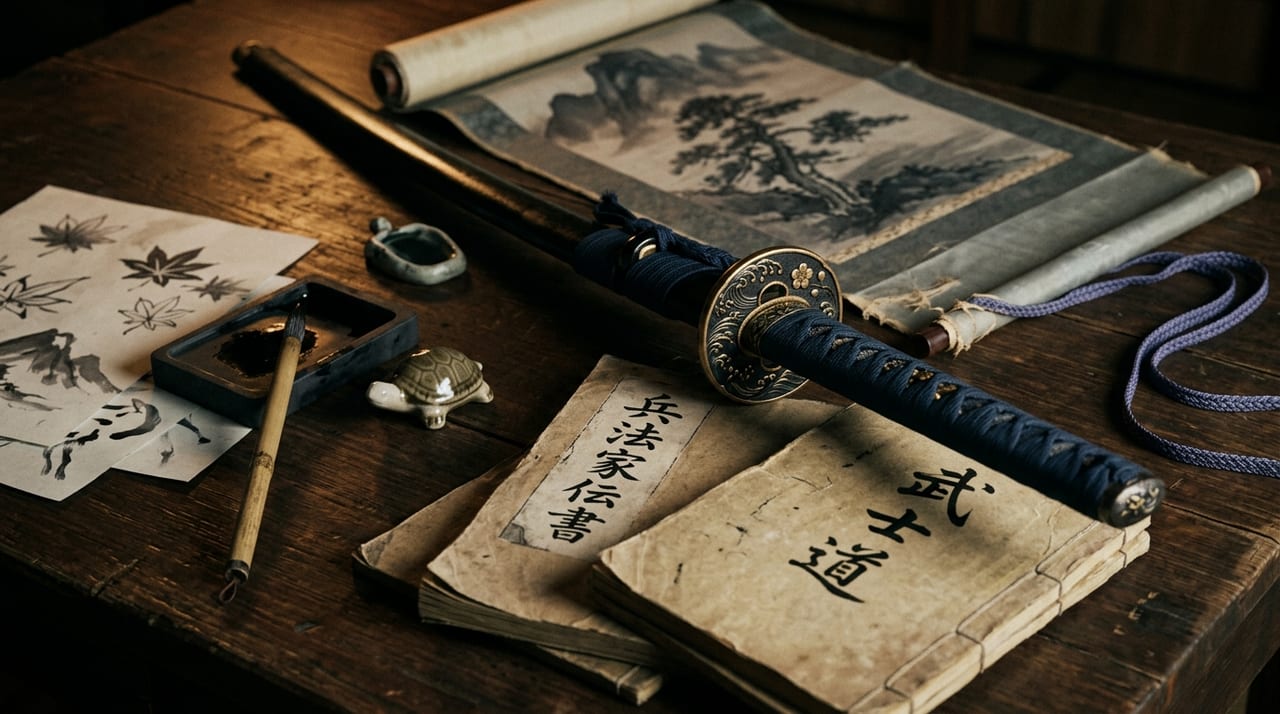
 * Image is for illustrative purposes only.
Taiga Drama: Furinkazan (Wind, Forest, Fire, Mountain)
大河ドラマ 風林火山
The 46th NHK Taiga Drama, Fūrinkazan, broadcast in 2007 (written by Ōmori Sumio, starring Uchino Masaaki). It depicts the life of Yamamoto Kansuke, military strategist to Takeda Shingen. Shingen's strategy and military power, embodying the Fūrinkazan banner, run through the entire work, with the Battles of Kawanakajima (five engagements between 1553 and 1564) as its greatest highlight, depicting the fierce clash between the Takeda and Uesugi armies. Ichikawa Kamejirō played Takeda Shingen, and GACKT played Uesugi Kenshin. Average viewership rating of 18.7% (Kanto region).
Description
NHK Taiga Drama Fūrinkazan—Yamamoto Kansuke and the Sword Culture of the Takeda as Embodied by the "Fūrinkazan" Banner
Fūrinkazan (2007, NHK Taiga Drama, 46th installment; screenplay: Ōmori Sumio; starring: Uchino Masaaki) is a Taiga drama that centers on the life of Yamamoto Kansuke, the legendary strategist of Takeda Shingen, and depicts the Takeda family's rise during the Sengoku period through to the fierce battles of Kawanakajima. This work bears the name "Fūrinkazan," the war banner of Takeda Shingen derived from Sunzi's Art of War ("Swift as the wind, silent as the forest, fierce as fire, immovable as the mountain"), one of the most renowned mottos in Japanese samurai culture. Strategy, martial force, and the aesthetics of the sword form the foundation of the entire work.
Yamamoto Kansuke—The Relationship Between the Strategist and the Sword
Yamamoto Kansuke (birth and death years unknown; died in battle at Kawanakajima in 1561) is known as a legendary strategist who served Takeda Shingen. Although the historical existence of Kansuke was once debated, it was confirmed by a letter from Takeda Shingen in the Ichikawa family documents, discovered in 1969, in which he is named "Yamamoto Kansuke" (the letter spells the name with a different character for "kan"). Kansuke is known for the legendary appearance of being elderly, one-eyed, and disabled. The combination of his talent as a strategist and his martial prowess forms the core of the drama's protagonist setting.
As battle-used swords of the Sengoku period, the works of the Bizen Osafune swordsmith group are representative. Osafune produced more swords than any other group from the Muromachi through the Sengoku periods.
Takeda Shingen's Favored Swords and Sword Culture
The drama's lord, Takeda Shingen (1521–1573), was known as "the Tiger of Kai." He was one of the strongest daimyō of the Sengoku period and also a warlord with deep knowledge of swords. The following are known as swords said to have been owned or dedicated by Shingen.
The tachi inscribed "Namu Yakushi Rurikō Nyorai, Bizen no Kuni Osafune-jū Kagemitsu" is said to have been dedicated by Shingen to Fujisan Hongū Sengen Taisha (Fujinomiya, Shizuoka Prefecture). It is a work of the Bizen Osafune smith Kagemitsu, and it is still held by the shrine as a National Important Cultural Property. The tachi inscribed "Rai Kuninaga" is said to have been Shingen's personal sword. In Hōei 2 (1705), at the 133rd memorial of Shingen, Yanagisawa Yoshiyasu dedicated it to Erin-ji. It is still held at Erin-ji in Yamanashi, Shingen's family temple, as a National Important Cultural Property. A sword associated with Shingen's father, Takeda Nobutora, is the Sōsan Samonji. Miyoshi Masanaga presented it to Nobutora. It passed from Nobutora to Imagawa Yoshimoto and became Nobunaga's spoil of war at the Battle of Okehazama (1560). The history of this sword, which passed through the Takeda family, is a typical example of the Japanese sword culture in which "swords bear witness to the rise and fall of warlords."
The Battles of Kawanakajima—The Last "Single Combat" Where Swords Clash in Battle
The Battles of Kawanakajima (the fourth engagement, 1561), the greatest highlight of Fūrinkazan, are known for the legendary "single combat" episode in which Takeda Shingen and Uesugi Kenshin directly crossed swords. The anecdote that "Kenshin struck at Shingen from horseback, and Shingen blocked it with his gunbai (war fan)" is one of the most famous direct encounters between warlords in Japanese history. It has been passed down as a symbolic moment in sword culture, where "the sword of a warlord meets the command implement (gunbai)." The drama's Kawanakajima climax recreates this legend on screen, and viewers remember it deeply as a celebrated scene of the Taiga drama.
"Swift as the Wind, Silent as the Forest, Fierce as Fire, Immovable as the Mountain"—The Movement of the Sword and the Philosophy of Sunzi
The Takeda army's banner "Fūrinkazan" derives from the "Military Maneuvering" chapter of Sunzi's Art of War. It embodies four tactical principles: speed (wind), stillness (forest), intensity (fire), and weight (mountain). These four principles also deeply resonate with the philosophy of "the movement of the sword" in Japanese swordsmanship. "Swift as the wind" (speed) is the lightning-fast draw of iai-nuki. "Silent as the forest" (stillness) is the stillness of the stance and the swordsman's "immovable mind." "Fierce as fire" (intensity) is a fiery slash that cuts cleanly in a single stroke. "Immovable as the mountain" (weight) is the weight of the long sword and the stability of a single blow.
The philosophy of "Fūrinkazan" can be understood as a crystallization of Japanese culture, in which the point where Takeda Shingen, a warlord, and Japanese sword culture intersect raises the aesthetics of the sword into a strategic philosophy.
Uesugi Kenshin's Sword Culture
Uesugi Kenshin (1530–1578), the arch-rival in Fūrinkazan, was called "the Dragon of Echigo" and "the God of War," and his sword culture is also recorded as being of high standing. Among the swords said to have been owned by Kenshin is the Azuki Nagamitsu, a tachi by Nagamitsu that has been passed down in the Uesugi family. From the perspective of the "confrontation of sword cultures" between the two great warlords Takeda and Uesugi, Fūrinkazan is a notable Taiga drama that deeply explores the historical and cultural aspects of the Japanese sword.
A Perspective for Sword Collectors
The Taiga drama Fūrinkazan holds an important place as a work that lets Japanese sword collectors and enthusiasts experience the core of Sengoku-period sword culture in visual and narrative form, from four perspectives: "the relationship between Takeda Shingen and Uesugi Kenshin, the two greatest warlords of the Sengoku period, and famous swords," "the culture of the legendary strategist Yamamoto Kansuke and the battle-used swords of the Sengoku period," "the Battles of Kawanakajima, the greatest symbolic scene of the battle use of Japanese swords," and "the resonance between the philosophy of Fūrinkazan and the aesthetics of swordsmanship."
Real Swords Featured
Tachi inscribed 'Namu Yakushi Rurikō Nyorai, Bizen no Kuni Osafune-jū Kagemitsu'
A tachi said to have been dedicated by Takeda Shingen to Fujisan Hongū Sengen Taisha. Made by Kagemitsu of Bizen Osafune. National Important Cultural Property.
Rai Kuninaga
A Japanese sword said to have been used by Takeda Shingen. Held at Erin-ji (Shingen's family temple) in Yamanashi. Designated a National Important Cultural Property.
See authentic Japanese swords
See authentic Japanese swordsThis page is intended to introduce Japanese sword culture and is not affiliated with any of the works mentioned.