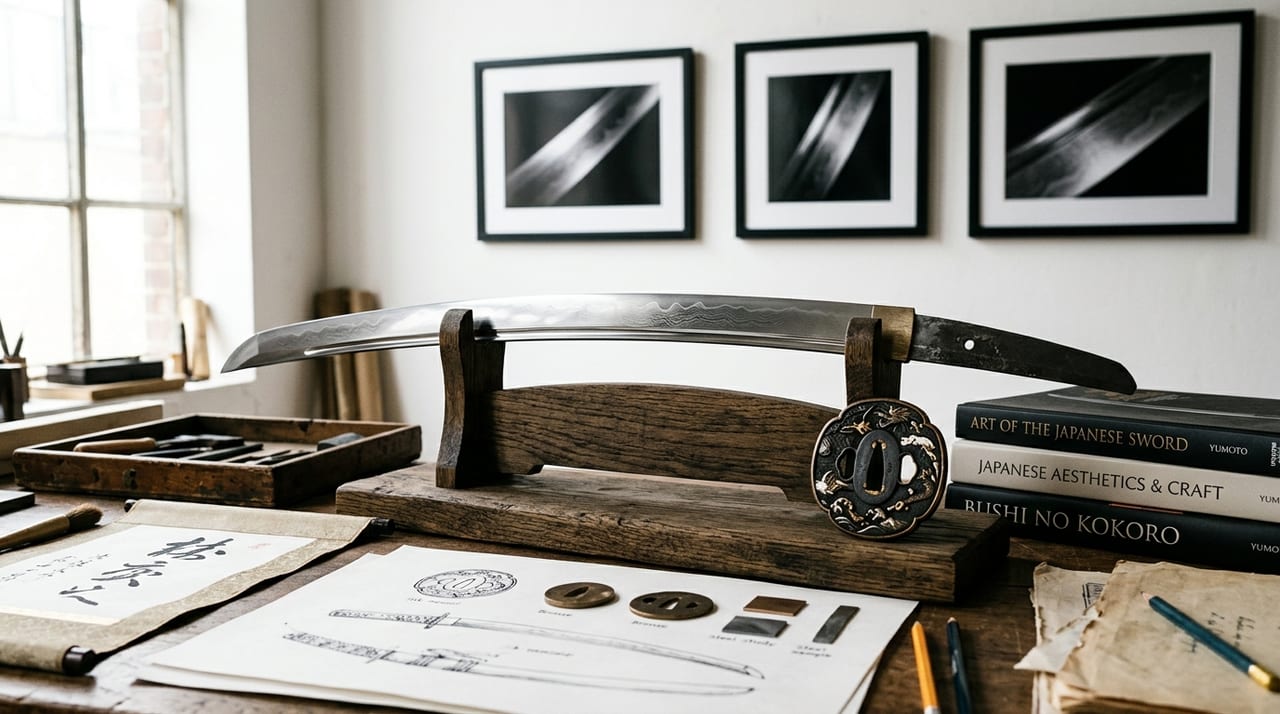
 * Image is for illustrative purposes only.
Japanese Swords × Contemporary Art
日本刀×現代アート
A new frontier where traditional Japanese swords intersect with contemporary art, reinterpreting blade aesthetics in modern contexts.
Description
Intersections with Contemporary Art
In recent years, Japanese swords have moved beyond the framework of traditional crafts and found new areas of expression at the intersection with contemporary art. This movement reinterprets the artistic value that Japanese swords have cultivated over more than a thousand years within a contemporary context and presents it to the world.
The Creativity of Contemporary Swordsmiths
While contemporary swordsmiths rigorously uphold traditional techniques, they pursue innovative beauty in the expression of hamon and jigane. Swordsmiths certified as Living National Treasures (holders of Important Intangible Cultural Properties) have received high acclaim at home and abroad, with their works regarded as art rather than mere craft objects. Miyairi Yukihira studies the swords of Shizu Kaneuji from the Kamakura period and of his fellow native Yamaura Kiyomaro, while Gassan Sadakazu II is known for ayasugi-hada, a distinctive surface pattern of jigane characteristic of the Gassan school. Ayasugi-hada is neither itame nor mokume; it is a regular, wavy pattern resembling the growth rings of a cedar tree, produced by the forging method transmitted by the Gassan school. Works by such contemporary swordsmiths are increasingly exhibited at art exhibitions and galleries, contributing to an international movement that reappraises Japanese swords as “moving sculpture”—three-dimensional art whose appearance changes endlessly with the angle of light.
Photography and Art Exhibitions
Art-oriented photography and exhibition projects featuring Japanese swords, created by photographers and designers, are being held around the world. Photographic works capturing the subtle shifts of light and shadow reflected on blades demonstrate that the beauty of Japanese swords can be fully expressed even in still images, and they are broadening interest in Japanese swords among art enthusiasts who differ from traditional sword fans. The fact that major museums worldwide, such as the Metropolitan Museum of Art and the Victoria and Albert Museum, hold Japanese swords in their collections is also evidence that the artistic value of Japanese swords is recognized internationally.
Sword Fittings and Contemporary Beauty
The world of sword fittings (tōsōgu) is likewise deepening its connections with contemporary art. Sword fittings such as the tsuba, menuki, fuchi-kashira, kozuka, and kōgai originally possessed a high artistic quality as miniature sculpture. The Gotō family, a prestigious lineage of metalworkers active from the Muromachi through the Edo period, began with the Ashikaga shogunate and then served the successive rulers Oda, Toyotomi, and Tokugawa; the line continued for seventeen generations, and the family mastered exquisite high-relief metalwork. The designs of dragons, lions, and plants and flowers applied to the menuki and fuchi of the Gotō family condense astonishing expressive power into a space only a few centimeters across, and they are regarded as the pinnacle of miniature sculpture. Tsuba makers such as the Shōami school, Nobuie, and Kaneie likewise developed distinctive artistic worlds through openwork carving on iron grounds, painterly high relief, and inlay.
Culture of Collecting
Collecting sword fittings has a long history as an independent pursuit separate from the swords themselves, and tsuba collecting in particular has enthusiasts around the world. Deciphering the design and technique embodied in a single tsuba is an intellectual pursuit requiring a deep understanding of Japanese aesthetic sensibility and history, and it resonates with the theme of “a universe within small things” in the context of contemporary art.
Real Swords Featured
Tsuba
A round or oval metal plate fitted between the hilt and the blade; the centerpiece of sword fittings, combining a protective function with decorative quality. Materials are diverse, including iron, shakudō, brass, and gold and silver, and a wide range of metalworking techniques are employed, such as openwork carving, high relief, inlay, and irogane. The Shōami school is known for a style of bold openwork carving on iron grounds, and Nobuie, a master of rugged iron tsuba, was beloved by Sengoku-period warlords. Kaneie, whose style involves painterly high-relief depictions of landscapes and figures on iron grounds, is called the “founder of painterly tsuba,” and Higo metalworkers established a plain, substantial aesthetic under the patronage of the Hosokawa family, lords of Higo. Tsuba collecting has enthusiasts around the world, and appreciating a single tsuba by reading its era, school, patron’s tastes, and metalworking techniques is an intellectual pursuit requiring a deep understanding of Japanese aesthetic sensibility.
Menuki
Small metal ornaments fitted to the front and back of a sword hilt. Originally practical parts that concealed the mekugi peg, they were gradually given exquisite chasing over time and elevated into works of art that may be called the very height of miniature sculpture. Menuki made by the Gotō family as official craftsmen to the shogunal household carve designs of dragons, lions, carp, hawks, warriors, and plants and flowers with astonishing precision in a space of only three to four centimeters, and they demonstrate the highest standard of Edo-period metalworking. Many of the Gotō family’s menuki are splendid pieces in kinmuku (solid gold) with iroe decoration, and they were prized as gifts to daimyo households. Even today, Gotō family menuki are traded at high prices as works of art.
Metalwork of the Gotō family
Beginning with the first generation, Gotō Yūjō, active in the mid-Muromachi period, the family served as official craftsmen to the shogunal household for about four centuries, through the seventeenth generation in the late Edo period, making it the most distinguished of all metalworking houses. The Gotō family’s works are called iebori and are characterized by dignified designs of gold iroe on shakudō grounds. Their subjects are mostly auspicious motifs such as dragons, lions, peonies, and pine, bamboo, and plum, and they possess the dignity and refinement befitting the shogunal house. The Gotō family’s works center on the mitokoromono: kozuka, kōgai, and menuki. This indicates that, in producing sword fittings bearing on the prestige of the shogunal house, the Gotō family was a group of specialist craftsmen focused on a particular field. Metalworkers outside the Gotō family are called machibori and developed freer and more varied styles.
Gendaitō
A general term for Japanese swords forged from the Shōwa era onward. After World War II, production of Japanese swords was temporarily banned by the GHQ sword hunt, but in 1953 the making of “Japanese swords as art objects” was again permitted under the Law for the Protection of Cultural Properties. Since then, contemporary swordsmiths have pursued their own artistry while inheriting traditional techniques, and they have also produced master craftsmen certified as Living National Treasures (holders of Important Intangible Cultural Properties). Miyairi Yukihira studied the swords of Shizu Kaneuji and Yamaura Kiyomaro, and Gassan Sadakazu II inherited the ayasugi-hada of the Gassan tradition. Ōsumi Toshihira studied the suguha of the Aoe school of Bitchū and continued making suguha swords throughout his life, while Amata Akitsugu worked on research into homemade ironmaking and is known for various styles, including the Yamashiro, Sōshū, and Bizen traditions. Contemporary swords offer a different viewpoint for appreciation than kotō and shintō, and the joy of holding “a single blade born from the hands of a swordsmith living today” is especially distinctive among sword appreciation experiences.
See authentic Japanese swords
See authentic Japanese swordsThis page is intended to introduce Japanese sword culture and is not affiliated with any of the works mentioned.