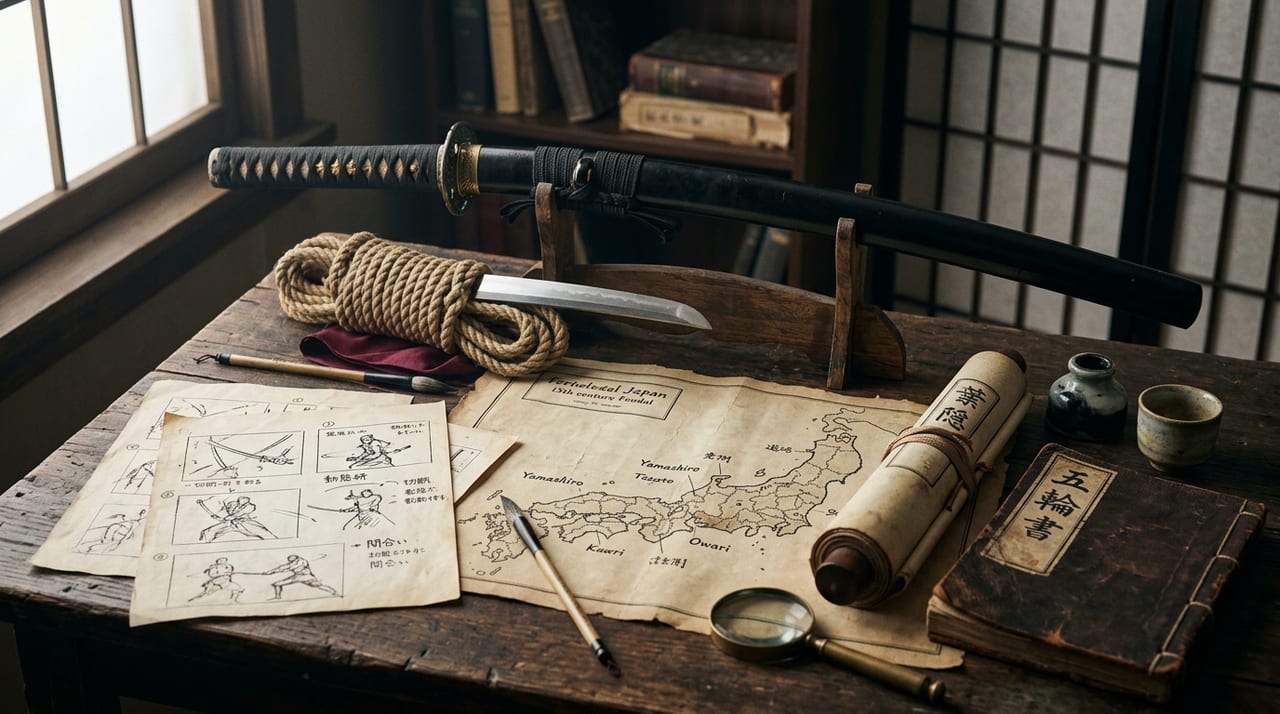
 * Image is for illustrative purposes only.
Sword of the Stranger
ストレンヂア 無皇刃譚
A theatrical animation film produced by Bones in 2007. Set in late Muromachi Japan, it depicts the encounter and escape of a nameless ronin called 'Nanashi' with a past and a boy named Kotarō. The sword-fighting scenes, which depict the movements of the Japanese sword with meticulous realism, are recognized as a masterpiece that endures in world animation history, and the film stands as a pinnacle of pure sword-fighting cinema, highly praised by international film critics.
Description
A Landmark of Swordplay Anime
Sword of the Stranger (Japanese title: Stranger: Mukō Hadan) is a theatrical animated film produced and released by Bones in 2007, and it is highly regarded worldwide as the peak of swordplay depiction in the history of Japanese animation. Andō Masahiro directed it, and Itō Yoshiyuki and Saitō Tsunenori served as animation directors. It is a work in which a strong determination to depict the movement of Japanese swords realistically and dynamically comes through the screen. The story is set in late Muromachi-period Japan. It is a tale of flight and growth that begins when the mysterious rōnin “Nanashi,” who refuses to give his name, meets the boy Kotarō and his dog Tobimaru, who are being pursued by Rarō (Luo-Lang), a blond, blue-eyed swordsman serving the Ming dynasty.
Realism in Swordsmanship Depiction
The greatest reason this film receives overwhelming support from animation fans around the world lies in the astonishing realism of its swordsmanship and sword-fighting scenes. Swordplay in conventional anime is often built on exaggerated staging and a string of superhuman techniques, whereas the swordplay in Sword of the Stranger squarely depicts the physical realities of gravity, inertia, fatigue, and bleeding, based on the movements of actual Japanese swordsmanship. In particular, the climactic duel between Nanashi and Rarō unfolds while deliberately contrasting the differences in bodily technique between Japanese swordsmanship and Chinese martial arts, and it vividly depicts the physical weight and length of the sword as a weapon and the kinematics of its cutting strokes.
Period Research of the Late Muromachi Era
The late Muromachi period (the late 15th to early 16th century), the setting of the story, was an age in Japanese history when gekokujō and warfare swirled. It was a time when Kyoto was devastated by the Ōnin War (1467–1477) and sengoku daimyō began to rise across the provinces, and the collapse of social order and the struggle for survival by force were fierce. The film's depictions of devastated villages, traces of war, and displaced people whose status system had collapsed faithfully reflect this historical background. The setting in which a military commander of the Ming dynasty (China) appears is also grounded in the historical facts of the Japan–Ming trade, piracy, and cultural exchange with the continent that actually took place in the Muromachi period, and it builds the complex relations of East Asia at the time into the film's scale. In terms of swords, the blades of the late Muromachi to early Sengoku period fall in a transitional phase from imposing tachi with bold proportions to the more maneuverable uchigatana, and the sword styles that appear in the film are shaped with awareness of this period research.
Rōnin and the Philosophy of the Sword
The setting in which the protagonist, “Nanashi,” refuses to give his name and keeps avoiding drawing the sword he has bound to its scabbard is a visual embodiment of the bushidō philosophy that “the sword is the last resort.” In Japanese swordsmanship there is the saying saya no uchi (victory within the scabbard), and there is a philosophy that holds the state of subduing an opponent without drawing the sword as the highest attainment. Nanashi binds his sword as an expression of fear of his own ability and of self-reproach, the certainty that if he draws it he will kill. This setting deeply embodies the paradox that the Japanese sword is a “tool for killing” and yet can also become a “symbol of the will not to kill.” The sense of release in the final scene, the moment he cuts the rope and draws the sword, is an emotion that rests on this context, and it is passed down as one of the scenes that most eloquently puts the philosophical dimension of the Japanese sword on screen.
Influence on the World
Sword of the Stranger was screened at film festivals in Europe and the United States and received high praise from both critics and general fans. It holds a special place especially for anime and film fans in North America and Europe as a work that showed them “how Japanese swords actually move,” and a great many overseas fans became interested in Japanese swords and Japanese swordsmanship because of this film.
Real Swords Featured
uchigatana — battlefield swords of the late Muromachi period
From the late Muromachi period into the Sengoku period, the mainstream of swords shifted from the tachi, worn hanging from the waist, to the uchigatana, worn thrust through the belt. Compared with the tachi, the uchigatana is shorter and lighter and has the practical advantage of quicker drawing and sheathing. The sword used by Sword of the Stranger's protagonist is based on the uchigatana style of this period and forms the stylistic background of the film's realistic swordsmanship. The spread of the uchigatana was closely linked to the change in the form of battle in the late Muromachi period, from mounted warriors at the center to foot warriors at the center.
Bizen Osafune school (notable swords of the Muromachi period)
The center of Japanese sword production in the Muromachi period was Bizen Osafune (now Setouchi City, Okayama Prefecture), which produced master smiths such as Chōgi, Morimitsu, Yasumitsu, Motoshige, and Sukesada. Swords bearing the signature “Sukesada” are especially well known as practical blades that were mass-produced in the late Muromachi period and widely used on the battlefield, and they are the representative battlefield swords of the age of chaos that Sword of the Stranger depicts. Many Bizen Osafune school swords still survive today, and they are one of the most important bodies of work that convey Muromachi-period sword culture to the present day.
Sōshū-den swords (the Masamune and Sadamune lineage)
Sōshū-den, which developed centered on Sagami in Kanagawa from the Kamakura to the Muromachi periods, produced master smiths such as Masamune, Sadamune, Hiromitsu, and Akihiro, and enjoyed enormous popularity among samurai households with its bold jigane and hamon in which nie shines. Sōshū-den swords, which warlords active in the late Muromachi period sought as their beloved blades, are the representative group of real famous swords that adorned the warring age depicted in Sword of the Stranger. In particular, the flashy hamon with kinsuji and inazuma-like patterns, where nie deeply penetrates, embodies the aesthetic sensibility of the warriors who lived through the age of chaos.
See authentic Japanese swords
See authentic Japanese swordsThis page is intended to introduce Japanese sword culture and is not affiliated with any of the works mentioned.