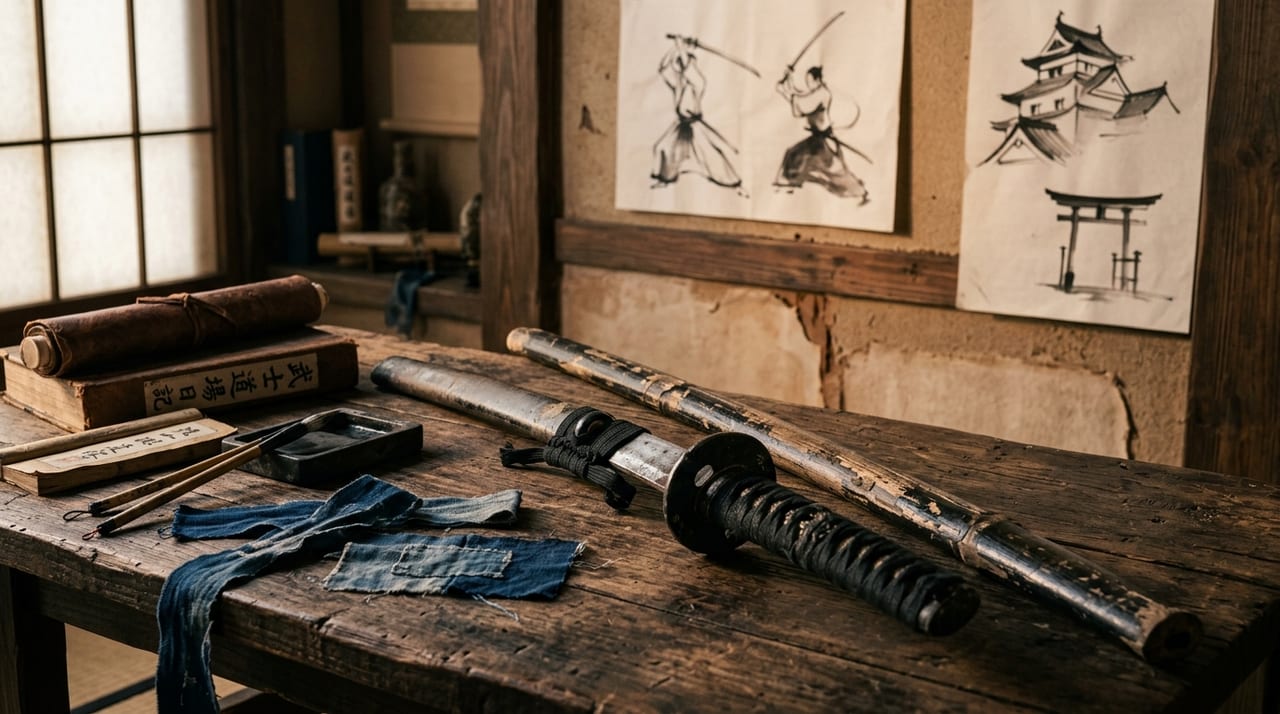
 * Image is for illustrative purposes only.
Noh Theatre & The Sword: Traditional Performance Arts
能・狂言・歌舞伎と日本刀
In Japanese traditional performing arts such as Noh, Kyogen, and Kabuki, the Japanese sword is both an essential prop and a profound symbol. Stage swords (butai-katana) represent the pinnacle of ornamental sword craftsmanship, and the movements of the sword are central to the performance itself.
Description
In the world of traditional performing arts such as Noh, Kyogen, Kabuki, and Nihon Buyo (Japanese classical dance), the Japanese sword functions not merely as a stage prop but as a symbol of character rank and spiritual depth. The mie pose in Kabuki—where the actor thrusts out a sword—and the kiri-gumi (combat sequences) in Noh represent the stylized beauty of the sword elevated to stage art. Stage swords and their mountings (koshirae) used in these arts demand an artistic refinement distinct from functional blades, and have been crafted by specialized sword artisans. Kabuki productions such as Kanjincho and Chushingura place the sword and the spirit of Bushido at their narrative core, serving to convey the cultural significance of Japanese swords to audiences. Even today, traditional performing arts continue to play a vital role in transmitting Japanese sword culture to future generations.
Real Swords Featured
Kabuki stage sword and koshirae
The sword mountings used on the Kabuki stage are works of art combining metalwork and lacquerware craftsmanship, meticulously crafted to suit each role. While the blade itself may be blunt or wooden for safety, the exterior ornamentation rivals that of genuine sword mountings.
Noh theatre "prop sword"
Swords used in Noh theater are specialized instruments with weight and length adjusted to match specific choreographed forms (kata). The sword handling performed by the shite actor in combat sequences represents a stylized formalization of real iaido and kenjutsu movements.
See authentic Japanese swords
See authentic Japanese swordsRelated Content
Nobunaga's Ambition
Game信長の野望
Japan's longest-running historical simulation game series by Koei Tecmo (1983–). Players control Sengoku warlords including Oda Nobunaga in a quest for national unification. The series systematically parameterizes warriors' swords and equipment, providing one of the most comprehensive frameworks for learning about Japanese sword history, distribution, and connections to historical figures.
Seven Samurai
Film七人の侍
Akira Kurosawa's timeless masterpiece that introduced the world to Sengoku-era warriors and swords, influencing all subsequent action cinema.
Legend & Butterfly (Film, 2023)
Filmレジェンド&バタフライ(映画・2023年)
Toei 70th Anniversary commemorative work (directed by Otomo Keishi, screenplay Furusawa Yoshita, released January 2023). Kimura Takuya portrays Oda Nobunaga and Ayase Haruka portrays his primary consort Nōhime (Kicho), depicting the unknown bond between Nobunaga and Nōhime. A large-scale historical film with a total production cost of 2 billion yen and cumulative attendance exceeding 1.8 million. Rooted in the historically documented famous swords of Nobunaga — Sozan Samonji (Yoshimoto Samonji) and Heshikiri Hasebe — this is an important work from the perspective of sword culture, in which Nobunaga's sword aesthetics under the banner of 'Tenka Fubu' (Rule the Realm Through Arms) intersect with Nōhime's strength.
Nioh 2
Video Game仁王2
A Sengoku-period action RPG released in 2020, developed by Team Ninja and published by Koei Tecmo Games. As a prequel to the earlier "Nioh," it stars a half-yokai protagonist with yokai blood, who crosses swords with demons while encountering real Sengoku-period warlords.
This page is intended to introduce Japanese sword culture and is not affiliated with any of the works mentioned.