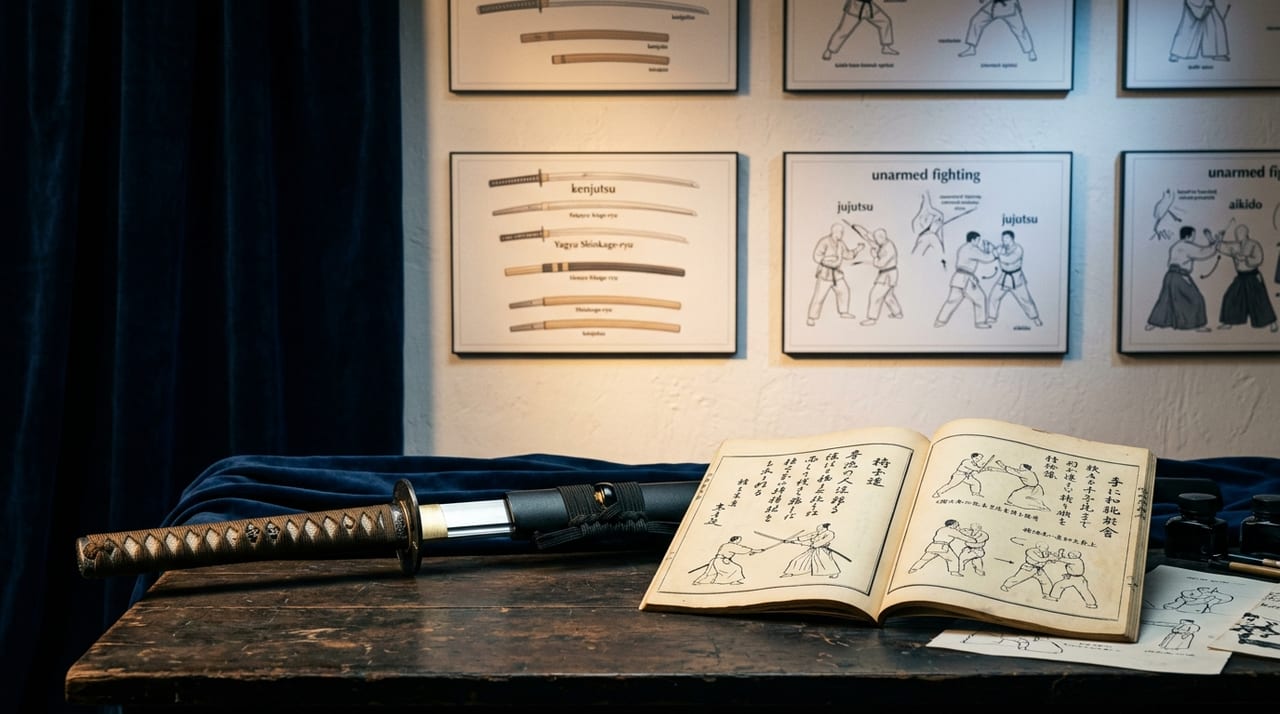
 * Image is for illustrative purposes only.
Shura no Mon (Gate of Hell)
修羅の門
A fighting manga by Kawahara Masatoshi (1987–1996, serialized in Monthly Shōnen Magazine). The story follows Mutsu Tsukumo, heir to the ancient martial art Mutsu Enmei-ryū, as he fights strong practitioners of various combat sports and martial arts. In the spin-off "Shura no Toki," past heirs of Mutsu Enmei-ryū fight historical swordsmen such as Miyamoto Musashi, Yagyū Jūbei, and Okita Sōji, and the work explores the "sword vs. unarmed" question: how an unarmed martial artist fights a swordsman.
Description
Shura no Mon — A Landmark Fighting Manga That Explores the Essential Question of "Sword vs. Unarmed"
Shura no Mon is a fighting manga by Kawahara Masatoshi (born 1960) that ran in Monthly Shōnen Magazine from 1987 to 1996. Including the spin-off "Shura no Toki" (1989 onward, published intermittently), it is regarded as one of the most important series in the history of Japanese fighting manga. The "Mutsu Enmei-ryū" inherited by the protagonist, Mutsu Tsukumo, is a fictional Japanese ancient martial art said to have more than a thousand years of history, depicted as "a complete combat system that can respond to any martial art or weapon." The reason this work matters to sword enthusiasts is that it brings the depiction of "combat against weapons" — in particular, the question of "how an unarmed fighter fights a swordsman who holds a blade" — to the highest level in manga history.
Mutsu Enmei-ryū's "Anti-Sword" Techniques — How It Fights an Opponent Armed With a Weapon
Mutsu Enmei-ryū is set up as a comprehensive martial art that also assumes combat against opponents armed with swords, spears, naginata, and other weapons. The core of the work's depiction of "combat against armed opponents" comes down to three principles: "distance that negates the weapon's reach (closing in close)," "disarming by attacking the arm and wrist that hold the weapon," and "reading the wind-up of a weapon's downward strike and moving in first."
This design philosophy is essentially consistent with the "maai (distance) theory" of actual old martial arts and swordsmanship. In swordsmanship, the concept that "whoever controls the maai wins," and in unarmed martial arts, the corresponding concept that "once you get inside the blade's reach, the sword is powerless," have been themes continually debated in real martial arts theory. Shura no Mon embodied this theoretical opposition at the highest level as manga storytelling.
Shura no Toki — Confrontations With Historical Swordsmen
The parallel series "Shura no Toki" depicts past heirs of Mutsu Enmei-ryū confronting historical swordsmen and warriors. The historical swordsmen who appear in the work include the following. Miyamoto Musashi (Niten Ichi-ryū): the bout with Musashi is one of the most important episodes in Shura no Toki, and it directly portrays the proposition of "strongest vs. strongest," pitting "the strongest swordsman in Japanese history" against "Mutsu Enmei-ryū." Yagyū Jūbei (Yagyū Shinkage-ryū): the confrontation with a swordsman of the Yagyū family, the martial instructors to the shogunal house, is depicted as an opposition between "the sword of power" and "the grassroots fighting art." Okita Sōji (Tennen Rishin-ryū): the confrontation with the Shinsengumi's genius swordsman depicts "the essence of practical swordsmanship."
Through these confrontations, Shura no Toki presents "the technical characteristics of each swordsmanship school," "the historical anecdotes and swords used by the swordsmen," and "actual swordsmanship theory (maai, sen, kuzushi)" within the manga as teaching material.
The Myth of "A Thousand Years Undefeated" — The Philosophy of Mutsu Enmei-ryū
The story unfolds on the premise that Mutsu Enmei-ryū "has never lost once in a thousand years." This concept of an "absolutely undefeated" martial art is the ultimate expression of the theme of "longing for the strongest school" in Japanese martial arts and swordsmanship culture. In the history of actual swordsmanship and martial arts as well, each school has made the claim that "our school is the strongest," and the design philosophy of this work is to look down on those real historical claims from the framework of the fictional Enmei-ryū.
A Perspective for Sword Collectors
Shura no Mon and Shura no Toki are works that let readers experience, in manga form and at the highest level, the essential question of swordsmanship: "how a Japanese sword functions in actual combat" and "how an unarmed martial artist responds to a swordsman who holds a blade." The technical characteristics of each swordsmanship school (Ittō-ryū, Shinkage-ryū, Tennen Rishin-ryū, Niten Ichi-ryū) are presented in the story as concrete fight scenes, making the work highly valuable as reference material for intuitively grasping "how differences between schools affect the way they actually fight." Through the confrontations with historical swordsmen, the types of swords each swordsman used, the characteristics of their schools, and actual historical anecdotes are woven into the story, making it one of the best fighting manga for deepening knowledge of sword culture through narrative.
See authentic Japanese swords
See authentic Japanese swordsThis page is intended to introduce Japanese sword culture and is not affiliated with any of the works mentioned.