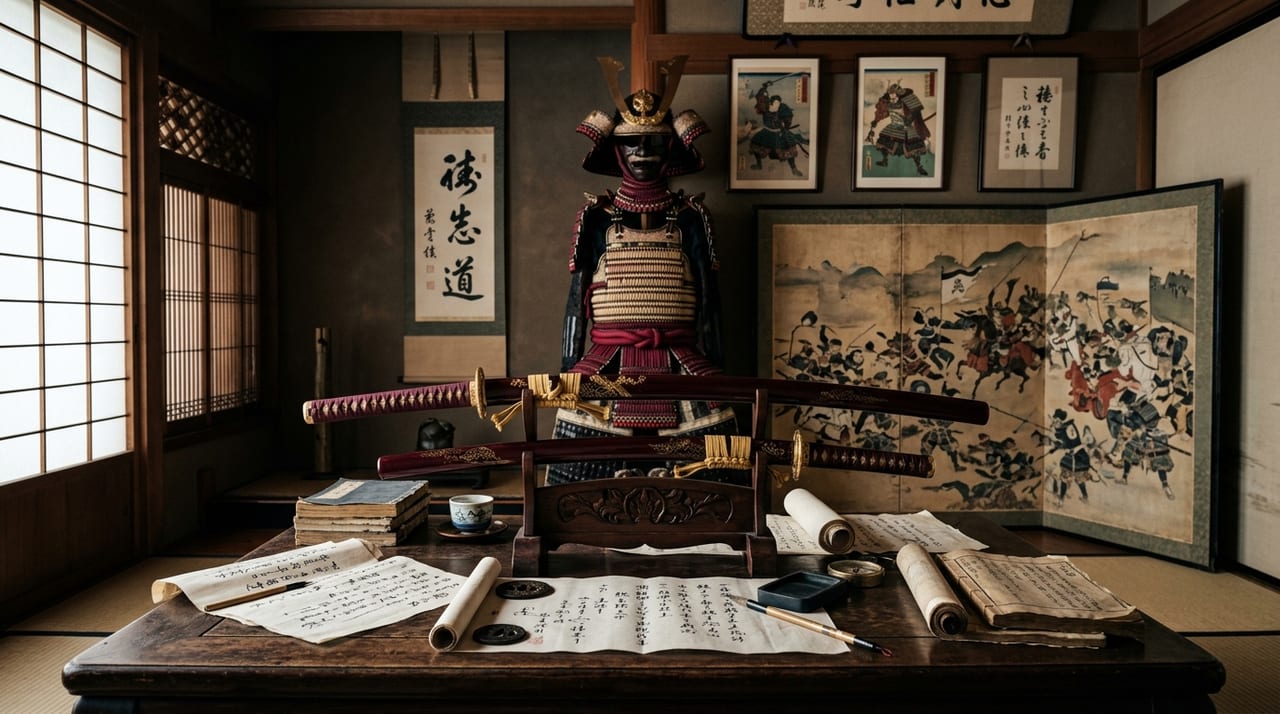
 * Image is for illustrative purposes only.
Sanada Maru
真田丸
A 2016 NHK Taiga Drama written by Kōki Mitani, depicting the life of Sanada Nobushige (Yukimura) from his youth through the Siege of Osaka. One of the most-watched Taiga dramas of the modern era.
Description
Overview of the Work
"Sanada Maru" was an annual Taiga drama broadcast by NHK in 2016. The screenplay was written by Kōki Mitani, and Masato Sakai starred as Sanada Nobushige. Centering on the complex family relationships with his father, Sanada Masayuki, and his elder brother, Sanada Nobuyuki, the drama depicts the life of Sanada Nobushige (Sanada Yukimura), who was active from the Sengoku period into the early Edo period. It recorded an average viewership rating of 16.6%, and it is a work that enjoyed especially high popularity among Taiga dramas of the 2010s.
Sanada Nobushige and the Sword of the Samurai
Sanada Nobushige is renowned as "the finest warrior in Japan" who pressed toward Tokugawa Ieyasu's headquarters in the Summer Siege of Osaka (1615). In this work, Nobushige's side as a strategist and diplomat comes to the fore, but his final resolve as a warrior and his decision with the sword form the catharsis of the work. The battlefield depiction of the fighting in the Sieges of Osaka, in which swords, spears, and firearms coexist, carefully recreates the actual combat style of the late Sengoku period, and embodies the complexity of an era in which the Japanese sword transitioned from the "soul of the samurai" to a "practical tool of the battlefield."
The Turning Point in Sword History from Sekigahara to the Sieges of Osaka
The period depicted in this work (1582–1615) is a decisive turning point for the history of the Japanese sword. After the Battle of Sekigahara (1600), opportunities for actual combat plummeted, and the Summer Siege of Osaka (1615) effectively closed the curtain on the last great war. Afterward, the sword changed its character to a symbol of the samurai, and its aspect as a work of art came to the fore. Sanada Maru is a work that depicts the last glow of that turning point, and it portrays the final era of swords that were actually wielded at the risk of life.
Screenplay by Kōki Mitani and Character Portrayal
The greatest feature of Kōki Mitani's screenplay is its viewpoint of depicting historical heroes as human beings at life-size. Through the group portrait of the three very different ways of living of Sanada Masayuki, Sanada Nobuyuki, and Sanada Nobushige, the aging and impatience of Toyotomi Hideyoshi, and the caution and tenacity of Tokugawa Ieyasu, the work portrays the aspects in which the meaning of carrying a sword becomes intertwined with politics, family, and pride. In answer to the question "Why do samurai wear swords?", the work embodies throughout its story the answer that "it is their proof of self."
Study of Armor and Sword Fittings
As is characteristic of Taiga dramas, the costumes, armor, and sword fittings of this work were also meticulously researched for period accuracy. The akazonae (red-lacquered armor) of the Sanada family is a famous military dress based on historical fact, and the swords worn beneath it are also set appropriately for the period, rank, and occasion. In the interior scenes of Osaka Castle, the handling of swords in ceremonial settings and daimyō processions, such as the taboos against drawing a sword and the manner of handing over swords, is depicted carefully. The work therefore also serves as reference material for learning the etiquette of swords in warrior society.
Real Swords Featured
Swords handed down in the Sanada family (held by the Sanada Treasure Museum)
The Sanada Treasure Museum in Matsushiro, Nagano City, Nagano Prefecture, holds many swords, armor, and arms handed down in the Sanada family. In particular, swords associated with Sanada Masayuki and Sanada Nobuyuki are highly valuable for research as typical practical uchigatana from around the time of the Battle of Sekigahara. Although few direct relics remain of Sanada Nobushige (Yukimura), who died in battle in the Sieges of Osaka, the Sanada family's overall collection of arms conveys to the present day the appearance of swords that warlords of the late Sengoku period actually used, and is a precious source.
Uchigatana of the Keichō–Genna period (practical swords of the very end of the Sengoku era)
The period around the 20th year of Keichō (1615), when the Sieges of Osaka were fought, was also a period of great change for swordsmiths. Official sword smiths of various domains, including Echizen Yasutsugu, who was associated with the Tokugawa family, were active, and many masterpieces were produced in the transitional period from practical swords of the Sengoku era to formal-status swords of the Edo period. Uchigatana of this era were the last generation required to balance responsiveness to actual combat with refinement as works of art. As swords that embody the historical background of the era of Sanada Maru, they hold special significance.
This page is intended to introduce Japanese sword culture and is not affiliated with any of the works mentioned.