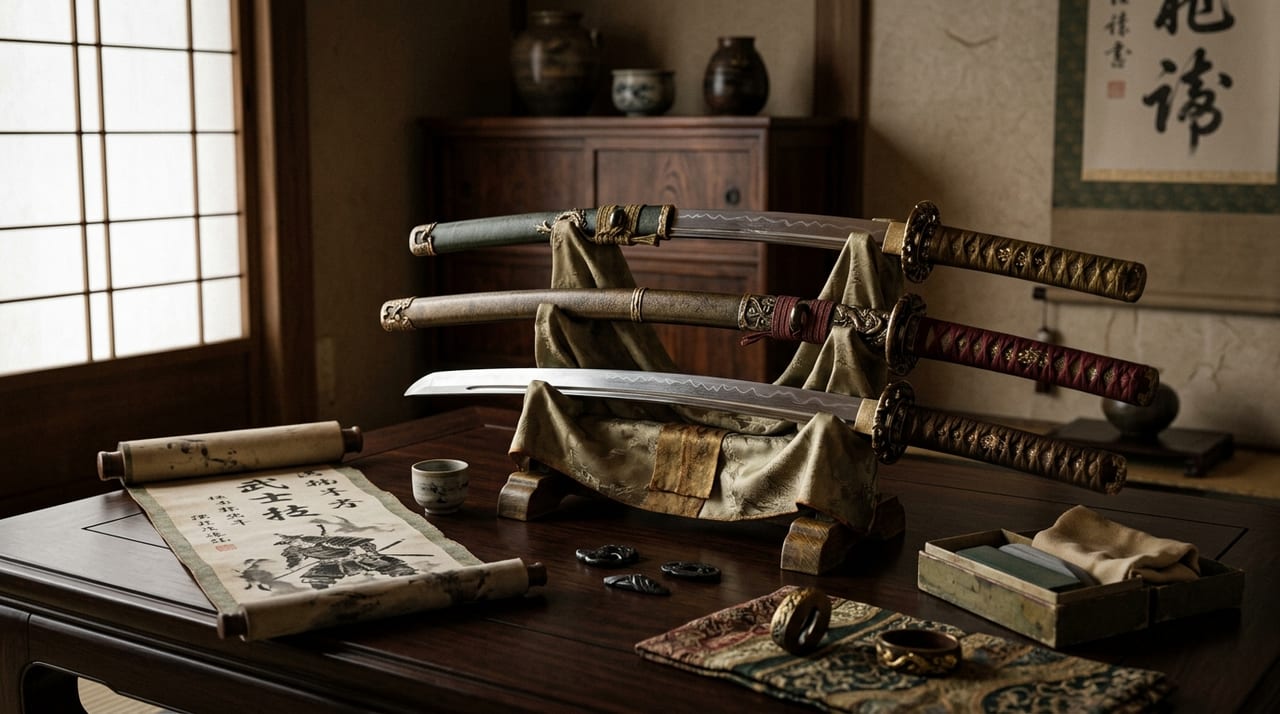
 * Image is for illustrative purposes only.
One Piece
ワンピース
A pirate manga by Eiichiro Oda with a cumulative circulation of over 500 million copies worldwide. Centered on Roronoa Zoro's Santōryū, it features a range of distinctive famous swords such as Wadō Ichimonji, Enma, Shūsui, and Kitetsu. The sword ranking (Saijō Ō Wazamono, Ō Wazamono, Ryō Wazamono, Wazamono) is based on the real grading system for Japanese swords. The Wano Country arc depicts the forging culture of Japanese swords in depth, conveying the profundity of Japanese swords to fans around the world.
Description
Global Influence
Eiichiro Oda's manga One Piece is a landmark work with over 500 million copies in circulation worldwide, and through the character Roronoa Zoro it has spread Japanese sword culture on a global scale. Zoro's unconventional swordsmanship of wielding three swords is entirely a creative invention, yet at its root flow the tradition of Japanese two-sword fighting and the essence of Japanese sword culture, which gives each blade a name and treats each one as unique and irreplaceable.
Setting of the Wazamono Iretsu
The blade ranking system in the story is based on the real Wazamono Iretsu (wazamono ranking). In the Edo period, the Yamada Asaemon family empirically tested blade sharpness through suemono-giri (cutting of fixed bodies) using criminals' bodies, and graded blades in four tiers: Saijō Ō Wazamono, Ō Wazamono, Ryō Wazamono, and Wazamono. This ranking was recorded in sword reference works such as the Kaihō Kenjaku, and it remains an important reference in the evaluation of Japanese swords today. One Piece skillfully adapts this real grading system to its story world, depicting swords as things that carry rank and narrative in themselves.
Naming of Blades
The naming of Zoro's beloved sword also reveals a deep familiarity with Japanese sword culture. Wadō Ichimonji is a name that evokes the Bizen Ichimonji school of the Kamakura period. The Ichimonji school, known as Fukuoka Ichimonji and Yoshioka Ichimonji, is a group of smiths that shines with its flamboyant chōji-midare hamon (temper line) and holds an enduring place in the history of Japanese swords. In particular, the splendid jūka-chōji hamon is the true essence of the Ichimonji school, and there are many masterpieces designated as National Treasures and Important Cultural Properties. Enma derives from Enma Daiō, the judge of the underworld in Buddhism, and reflects the Japanese tradition of giving swords religious and spiritual names. Among actual Japanese swords there are countless famous blades with titles related to supernatural beings, such as Onimaru, Dōjigiri, Onikiri, and Kumokiri. Shūsui means 'autumn water,' that is, the beauty of a blade as clear as a pure stream, and is a poetic name that symbolizes the aesthetic sense of Japanese swords. Kitetsu means 'piercing through demons' and strongly reflects the legends of cursed blades represented by Muramasa.
Depiction in the Wano Country Arc
In the Wano Country arc, the culture of blacksmiths and the closed samurai society are depicted in detail, and the history and sword culture of Japan are adapted in a way that is easy for overseas readers to understand.
Real Swords Featured
Bizen Ichimonji school
A school of smiths representing Bizen Province (present-day Okayama Prefecture) in the Kamakura period, and one of the schools that produced the most flamboyant hamon in the history of Japanese swords. Its founder is said to be Norimune, and it flourished across multiple lineages including the Fukuoka Ichimonji, Yoshioka Ichimonji, and Katayama Ichimonji. Its greatest feature is the splendid chōji-midare called jūka-chōji, in which ashi and yō appear abundantly within the hamon, showing a refined style that is flamboyant yet never loses dignity. The National Treasure 'Sanchōmō' is renowned as one of the finest masterpieces of the Ichimonji school. Setouchi City, where the Bizen Osafune Japanese Sword Museum is located, purchased it and preserves it as a treasure of the region. The influence of the Ichimonji school extended widely to later Bizen smiths, establishing the concept of hana (flamboyance) in Japanese swords.
Wazamono Iretsu (wazamono ranking)
A ranking system for swords established in the Edo period, based on sharpness. The Yamada Asaemon family, serving as official sword tester to the shogunate, empirically tested the sharpness of each smith's blades through suemono-giri using criminals' bodies, and graded them in four tiers: Saijō Ō Wazamono, Ō Wazamono, Ryō Wazamono, and Wazamono. The ranking was recorded in sword reference works such as the Kaihō Kenjaku and the Kokon Kaji Bikō, and it remains an important reference in sword evaluation today. Saijō Ō Wazamono includes Osafune Kanemitsu, Nagasone Kotetsu, and Tatara Nagayuki, and these blades still receive the highest valuations in the sword market today.
Bizen-den
The tradition of Bizen Province (present-day Okayama Prefecture), one of the Gokaden (five traditions) and the largest sword-producing region in the history of Japanese swords. Blessed with good iron sand and water, Bizen produced an enormous number of famous blades over a thousand years, from the Heian period through the Edo period. Its main characteristic is nioi-deki, and it is known for hamon with rich variation such as chōji-midare and gunome-midare. Many schools arose, including Ko-Bizen, Ichimonji, Osafune, Hatakeda, and Yoshii, and in both quality and quantity it overwhelmed other traditions. Bizen-mono is the foundation of appreciating Japanese swords, and many sword enthusiasts acquire a Bizen blade as their first.
Legends of cursed swords (yōtō)
The legend that a sword brings misfortune to its owner is one aspect of sword culture widely found across Japan. The most famous legend of cursed blades, that of Muramasa, originates in its feud with the Tokugawa family. There are also many famous blades with spiritual traditions, such as Onimaru Kunitsuna and Nikkari Aoe, which are said to have cut demons and spirits. These legends reflect the spirituality of the Japanese, who attributed supernatural power to swords, and show that swords were revered as spiritual beings rather than mere tools. The setting in which Kitetsu chooses its owner in One Piece incorporates precisely the essence of this cursed-blade legend into the story.
See authentic Japanese swords
See authentic Japanese swordsThis page is intended to introduce Japanese sword culture and is not affiliated with any of the works mentioned.