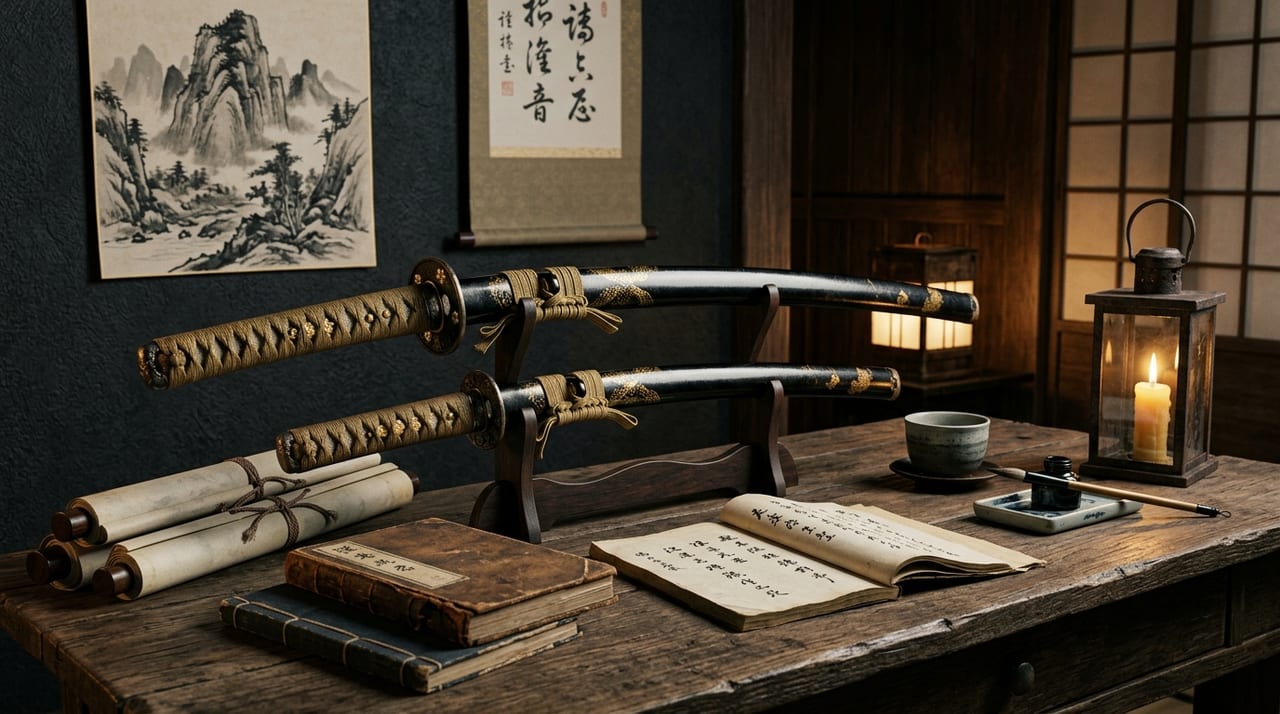
 * Image is for illustrative purposes only.
The Last Samurai
ラストサムライ
Hollywood epic directed by Edward Zwick in 2003. It depicts, from a Western perspective, the end of the samurai way of the Meiji Restoration with solemn grandeur. Its story, modeled on Saigō Takamori and the Seinan War, portrays the last brilliance of the samurai and the Japanese sword as they are swallowed by the tide of modernization.
Description
The Twilight of Bushidō
Edward Zwick’s The Last Samurai (2003) is an epic work that depicts the twilight of bushidō in the Meiji Restoration from a Western point of view. It is a film that impressed upon the world the last era in which the Japanese sword was used in actual combat. The samurai whom Captain Algren, played by Tom Cruise, encounters are modeled on Saigō Takamori, one of the Three Heroes of the Restoration, and on Satsuma domain samurai. The Seinan War of 1877, in which a modern conscript army suppressed a rebellion of the former samurai class, is recorded in history as the last large-scale use of the Japanese sword in organized combat.
Sword Culture of the Late Tokugawa Period
The Satsuma shizoku who served as models for the story had a culture of Satsuma-goshirae, the mountings style unique to the Satsuma domain. Satsuma-goshirae were guided by plain simplicity and sturdiness. They are characterized by a practical, combat-oriented construction without showy ornamentation, and their hilts are longer than common ones, with cowhide often used in place of sharkskin.
Swordsmiths of Satsuma Province
Satsuma Province was home to distinctive groups of swordsmiths, led by the Naminohira school. The Naminohira school traces its origin to a swordsmith who moved from Yamato Province in the late Heian period, and it continued until the early Meiji period, making it the longest-lasting school of swordsmiths. Its style is characterized by deeply curved tachi forged with itame-hada grain and a hamon based on a straight sugu-ha temper line, conveying a rustic yet powerful dignity. In the late Edo period, master smiths such as Hōki-no-kami Masayuki and Oku Yamato-no-kami Motohira also appeared.
Iaidō and Sword Maintenance
In iaidō, practitioners train in a sequence of movements from seiza: drawing the sword, cutting, chiburi (shaking off blood), and noto (sheathing). In sword maintenance, the blade is cleaned with uchiko powder and treated with chōji oil to prevent rust. A Japanese sword is one that keeps its beauty for a long time only when it is carefully maintained.
The Path After the Haitōrei
The image of samurai and Japanese swords being swallowed by the tide of modernization corresponds precisely to the reality after the Haitōrei (Sword Abolition Edict) of 1876. But the film does not depict only the end. Even after ceasing to serve as weapons, Japanese swords acquired new value as works of art and cultural properties, and they continue to captivate people around the world to this day. What The Last Samurai conveys is a story not of the “end” of the Japanese sword, but of its “transformation.”
Real Swords Featured
Satsuma-tō
A general term for swords forged in Satsuma Province (present-day Kagoshima Prefecture). The Naminohira school is the oldest and most representative, continuing from the late Heian period to the early Meiji period. Its style is characterized by itame-hada grain, a hamon based on sugu-ha temper lines, and deeply curved tachi profiles, embodying in the blade the plain, sturdy spirit of Satsuma samurai. In the Edo period, master smiths such as Mondo-no-shō Masakiyo, Hōki-no-kami Masayuki, and Oku Yamato-no-kami Motohira were active. Together with the distinctive mountings known as Satsuma-goshirae, Satsuma blades have a unique presence that sets them apart at a glance.
Seinan War
In 1877 (Meiji 10), Satsuma shizoku led by the Restoration hero Saigō Takamori waged Japan’s last civil war against the Meiji government. Facing a government army armed with modern weapons, the Satsuma forces repeatedly launched charges with drawn blades, and at the Battle of Tabaruzaka both sides drew their swords and fought fierce close combat. This battle is recorded in history as the last large-scale use of the Japanese sword in organized military action.
Satsuma-goshirae
A distinctive mountings style of the Satsuma domain that embodies, in its fittings, the spirit of Satsuma samurai, who valued plain simplicity and sturdiness. It rejects showy ornamentation and is characterized by hilts longer than common ones and by hilts using cowhide instead of sharkskin. In the Satsuma domain, Jigen-ryū was regarded as the official school, and some researchers argue that certain forms of Satsuma-goshirae were specified to suit Jigen-ryū and Yakumaru Jigen-ryū. This combat-oriented mountings culture is unique to Satsuma and rarely seen in other domains, and today it is prized by sword enthusiasts as a work of art.
Swords of Saigō Takamori
Saigō Takamori, one of the Three Heroes of the Restoration, symbolizes the sword culture of the Satsuma domain. Saigō is said to have owned several famous swords, the best known of which is a Muramasa dagger concealed in an iron fan inscribed with a kanshi (Chinese-style poem). Saigō’s persona, with his large frame, frugal life, and death in devotion to righteousness, overlaps with the spirit of plain sturdiness that Satsuma-tō embodies, and it continues to exert a strong influence on the Japanese spiritual archetype today. As the model for Katsumoto, played by Ken Watanabe in The Last Samurai, Saigō’s way of life also became known to the world.
This page is intended to introduce Japanese sword culture and is not affiliated with any of the works mentioned.