 * Image is for illustrative purposes only.
Lady Snowblood
修羅雪姫
A masterpiece of revenge drama, adapted in 1973 into a film directed by Toshiya Fujita and starring Meiko Kaji, based on the gekiga (graphic novel) originally published in 1972, written by Kazuo Koike and illustrated by Kazuo Kamimura. The protagonist is Kashima Yuki, a female swordswoman raised during the turbulent Meiji era as a 'tool of vengeance' to avenge her family. Its poetic visual beauty and stylish sword-fighting scenes had a major influence on Quentin Tarantino's later film Kill Bill.
Description
The Aesthetics of Revenge and the Birth of the Gekiga
Lady Snowblood is a masterpiece adapted from a gekiga (graphic novel) serialized in the gekiga magazine Weekly Playboy in 1972, written by Kazuo Koike and illustrated by Kazuo Kamimura, and made into a film by Toshiya Fujita the following year, in 1973. Kashima Yuki, played by Meiko Kaji, is a female swordswoman born in prison against the backdrop of the turbulent Meiji era, with the sole purpose of taking revenge on the bandits who killed her family. From childhood she is raised under strict sword training by the temple priest Dōkai. The purity and cruelty of the premise, a woman born as a tool of revenge, creates a sublime aesthetic that sets the work apart from other revenge dramas. The original author, Kazuo Koike, also repeatedly took Japanese swords and the melancholy of the samurai as his themes in works such as Kozure Ōkami and Goyōkiba, and through the gekiga genre he contributed greatly to the rediscovery of sword culture in postwar Japan. Through his body of work, Koike continued to raise social interest in Japanese swords by portraying them, in 1970s popular culture, not merely as weapons but as aesthetic and spiritual symbols.
Visual Beauty and Innovation in Swordplay
The most distinctive feature of the film is its poetic visual beauty, symbolized by the sword-fight scenes in the snowfield. The striking contrast of vivid red blood spraying across pure white snow, and the graceful iaido movements Meiko Kaji performs with a blade hidden in a janome-gasa (bull's-eye umbrella), are still talked about today as iconic scenes in the history of Japanese film. Fast camera pans combined with backlighting created a visual impact in which the trails of the swords seem burned into the viewer's retina. The sequel, Lady Snowblood: Love Song of Vengeance (1974), also starred Meiko Kaji in the same role, and together the series established the archetype of the female swordswoman in Japanese cinema. The theme song 'The Flower of Carnage' (Shura no Hana), sung by Meiko Kaji, is a masterpiece that carries the film's aesthetic sensibility directly into music.
Quentin Tarantino and the Influence on Kill Bill
Lady Snowblood's renewed international reputation was sparked by the explicit homage paid to it in Quentin Tarantino's Kill Bill (2003). The protagonist, The Bride, played by Uma Thurman, is said to have been inspired by Lady Snowblood, and 'The Flower of Carnage' by Meiko Kaji is also used in a scene that closely resembles the ending of Lady Snowblood. Tarantino has drawn enormous inspiration from Japanese films of the 1970s, including Lady Snowblood, and this connection dramatically raised the film's international profile. Its rediscovery at film festivals and in critical circles in Europe and America has sparked interest in Japanese 1970s gekiga and action films as a whole, and Lady Snowblood is now regarded as a world film heritage. The two works are inseparable within the lineage of the theme of 'Japanese swords and female swordswomen.'
The Meiji Sword Abolishment Edict and the Historical Background of Concealed Weapons
The Meiji era, the story's setting, was also a historical turning point in which the Haitōrei (Sword Abolishment Edict, Meiji 9 / 1876) dissolved the samurai class and ended the role of the Japanese sword as an official weapon. The concealed blade in the janome-gasa that Yuki uses belongs to a category of shikomi-mono (concealed-blade objects): everyday items such as canes, umbrellas, sensu fans, and kiseru pipes that hide a blade inside. This weapon form embodies the ingenuity and sorrow of an age in which swords could no longer be openly worn. This historical context layers the story with the melancholy and irony of its era, giving the work a weighty depth that goes beyond a simple action spectacle. In Meiji society immediately after the Sword Abolishment Edict, the sword was transformed from a symbol of power into a symbol of memory and resentment, and Lady Snowblood sharply captures this period of transformation.
Swordsmanship Schools and Practical Sword Culture
Although the film does not explicitly name the school of swordsmanship Yuki masters through training, the work strongly reflects the cultural background of sword dojo that actually existed across various regions in the Meiji period. Schools such as Tennen Rishin-ryū, Shintō Munen-ryū, and Yagyū Shinkage-ryū, which developed in the Edo period and continued to maintain dojo across the country after the Meiji era, survived as martial arts even after the Sword Abolishment Edict.
The Meiji Era and Japanese Sword Culture
The Meiji era depicted in Lady Snowblood is also the historical moment when the Japanese sword shifted its role from the soul of the samurai to cultural property and collectible. Uchigatana and wakizashi from the Bakumatsu and Restoration period, around the time of the Sword Abolishment Edict, are among the most historically valuable pieces in Japanese sword collections.
Real Swords Featured
Shikomi-gasa (concealed blade in a janome-gasa)
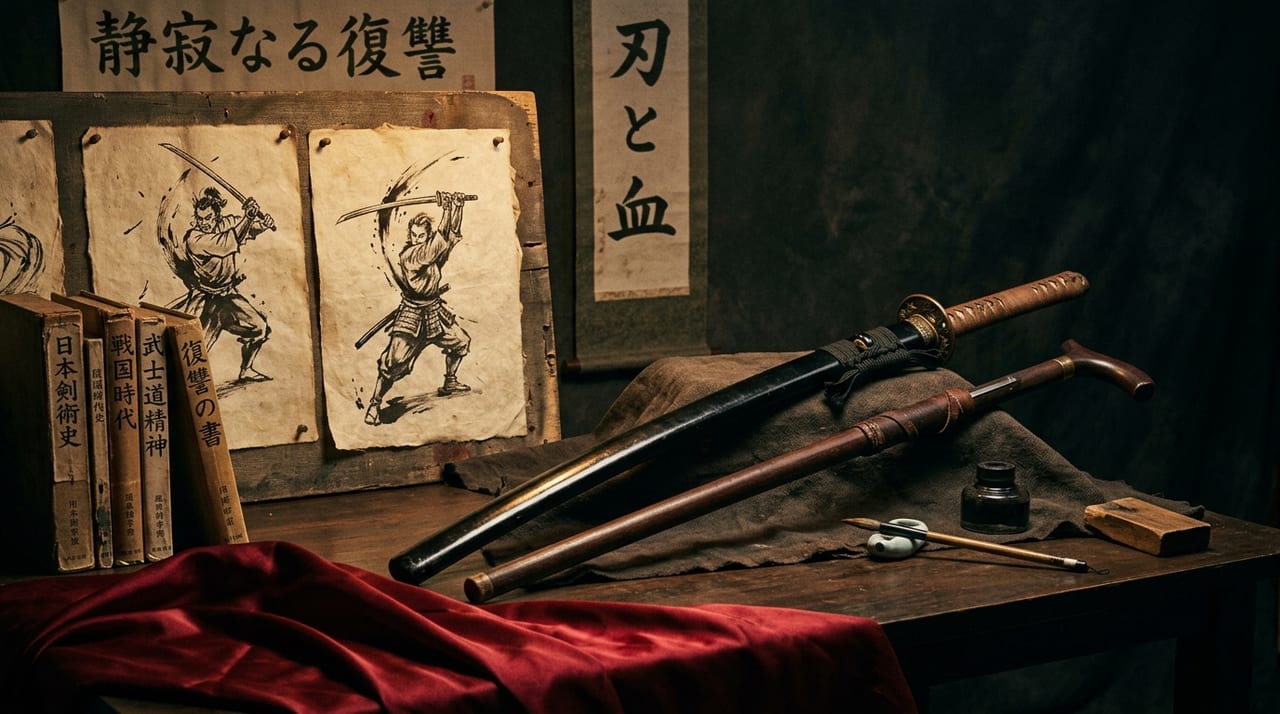
A shikomi-mono with a blade concealed in the handle of an umbrella. The weapon with which Yuki settles her mother's grudge is depicted as a blade hidden in the handle of a janome-gasa, creating an iconic scene in the film. Actual surviving shikomi-mono from the Bakumatsu and Meiji periods are prized among Japanese sword collectors, and they are highly valued as relics that tell the story of the Sword Abolishment Edict, a historical turning point.
This page is intended to introduce Japanese sword culture and is not affiliated with any of the works mentioned.