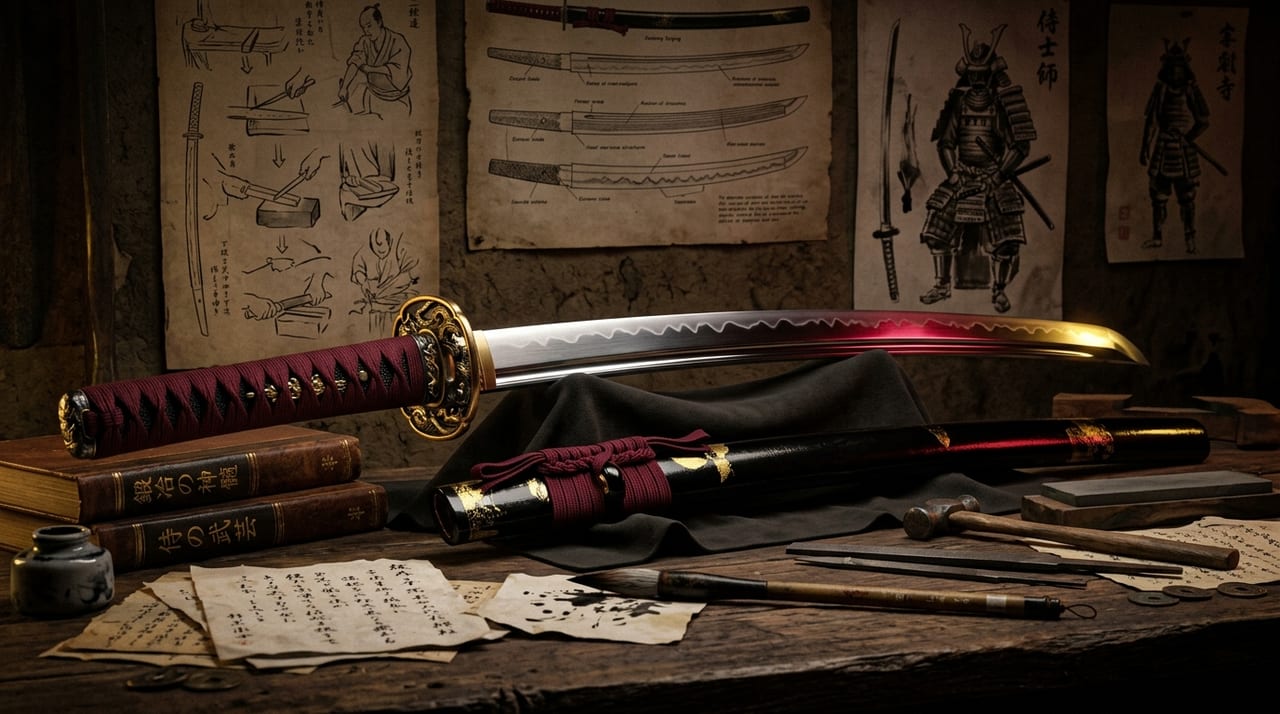
 * Image is for illustrative purposes only.
Kill Bill & Hollywood
キル・ビル & ハリウッド
A shocking work released in 2003 by director Quentin Tarantino. The ultimate sword forged by the fictional swordsmith Hattori Hanzō recalls the legends of the real Muramasa, the cursed blades of Kuwana in Ise Province, and Masamune, the treasure of the Kamakura period who perfected the Sōshū-den. This film pushed the Japanese sword into an icon of global pop culture and had a decisive influence on sword depictions in later Hollywood films.
Description
Global Impact
Director Quentin Tarantino's Kill Bill (2003) is a defining work that pushed the Japanese sword to the forefront of world pop culture. The story, in which Sonny Chiba plays a retired swordsmith, "Hattori Hanzō," who forges one final masterpiece, impressed audiences worldwide that making a Japanese sword is the ultimate handcraft, devoting all one's energy to a single blade, the opposite of mechanical mass production. The solemnity of the scene in which Hanzō takes out a Japanese sword hidden in the attic spread the recognition that the Japanese sword is not merely a weapon but a work of art infused with spirit.
Muramasa and the Cursed Blades
What comes to mind from Hattori Hanzō's sword are the Muramasa, the swordsmith lineage of Kuwana in Ise Province, and Masamune, the master of the late Kamakura period who perfected the Sōshū-den. Muramasa is known worldwide for the legend of the "cursed blades," but the core of this legend lies in its ties to the Tokugawa family. It is said that Tokugawa Ieyasu's grandfather, Kiyoyasu, was cut down by a retainer with a Muramasa blade, that his father, Hirotada, was stabbed with a Muramasa wakizashi, and that Ieyasu himself cut his hand on a Muramasa blade in childhood. Because of these ominous coincidences, the Tokugawa family is said to have shunned Muramasa, but in fact there are records that Ieyasu himself possessed Muramasa blades, and a complex gap exists between legend and historical fact. Muramasa's blades are well regarded for their cutting sharpness, and the smith earned very high acclaim as a master of practical swords. His hamon shows a distinctive appearance of continuous gunome, and the style of "omote-ura zoroi (matching hamon on both sides)," in which the front and back align precisely, is the greatest hallmark of the Muramasa school.
The Perfection of Masamune
Masamune, on the other hand, holds an unshakable reputation as the greatest swordsmith in the history of the Japanese sword. Active in the late Kamakura period, he perfected the Sōshū-den as a disciple of Shintōgo Kunimitsu. His gorgeous, powerful hamon centered on nie, the vigorous jigane with chikei, and the activity within the blade such as kinsuji and inazuma are considered the pinnacle of beauty in the Japanese sword. The "Masamune Juttetsu (Ten Disciples of Masamune)," said to be his disciples, are considered later attributions because the dates of their swordmaking do not match, but the Sōshū-den style spread to smiths across the country and supported the flourishing of Japanese sword culture in the Nanboku-chō period. Masamune's influence reached all of the Gokaden, and it is no exaggeration to say that it set the direction of the history of the Japanese sword itself.
Real Swords Featured
Muramasa
A swordsmith lineage based in Kuwana in Ise Province (present-day Kuwana, Mie Prefecture), active from the late Muromachi period to the Sengoku period. Continuing for six or more generations under the same name, it left behind fine blades of excellent practicality. Its greatest hallmark is the regular succession of gunome in the hamon and the "omote-ura zoroi (matching hamon on both sides)," in which the front and back of the blade align precisely, which is also an important point for identifying the Muramasa school. The legend of the "cursed blades" stems from its ties to the Tokugawa family, but in reality, as practical blades with excellent cutting ability, they were widely used by Mikawa samurai. In recent years, reappraisal has advanced under the influence of Touken Ranbu and various media, and in 2016 the Kuwana City Museum held the special exhibition "Muramasa: The Swordsmith of Kuwana in Ise."
Masamune
A swordsmith of the late Kamakura period, active in Sagami Province (present-day Kanagawa Prefecture) and regarded as the greatest peak in the history of the Japanese sword. Also known as Okazaki Gorō Nyūdō, he studied under Shintōgo Kunimitsu and brought the Sōshū-den to the level of perfection. His style is characterized by gorgeous, powerful hamon centered on nie, while chikei appears richly in the jigane and kinsuji and inazuma appear abundantly within the blade. Blades bearing his signature are extremely rare, and the authenticity debate over Masamune's works is one of the greatest issues in the history of Japanese sword research. The "Masamune Juttetsu (Ten Disciples of Masamune)" said to be his disciples, including Chōgi, Shizu Kaneuji, and Norishige, are considered later attributions because their dates of making do not match, but the Sōshū-den style spread to various regions and made the sword culture of the Nanboku-chō period flourish. The name Masamune has taken root in Japanese as a synonym for "famous blade," and its influence still forms the foundation of Japanese sword culture.
Sōshū-den (Sōshū tradition)
One of the Gokaden (Five Traditions) of the Japanese sword, the Sōshū-den developed centered on Kamakura. Against the background of demand for sturdy swords in preparation for the Mongol invasions, it combined the techniques of the Yamato-den and Yamashiro-den to establish its own forging method. Its greatest feature lies in its gorgeous, dynamic hamon centered on nie, and in the richness of the activity in the jigane and hamon, such as kinsuji, inazuma, and sunagashi. This tradition, whose foundations were laid by Shintōgo Kunimitsu, passed through Yukimitsu and was completed by Masamune, bringing a revolution to the aesthetic sense of the Japanese sword. From the Nanboku-chō period onward, the influence of the Sōshū-den spread throughout the country, and smiths in various regions came to make swords in the Sōshū style. Its aesthetics continue to be passed down vigorously to contemporary smiths.
Gokaden (Five Traditions)
A collective term for the five traditions that systematized Japanese sword forging techniques by region: the Yamato-den (Nara), Yamashiro-den (Kyoto), Bizen-den (Okayama), Sōshū-den (Kamakura), and Mino-den (Gifu). Each tradition has its own distinct methods of forging steel, quenching techniques, and hamon characteristics, and together they are the wellspring of the diversity of the Japanese sword.
See authentic Japanese swords
See authentic Japanese swordsThis page is intended to introduce Japanese sword culture and is not affiliated with any of the works mentioned.