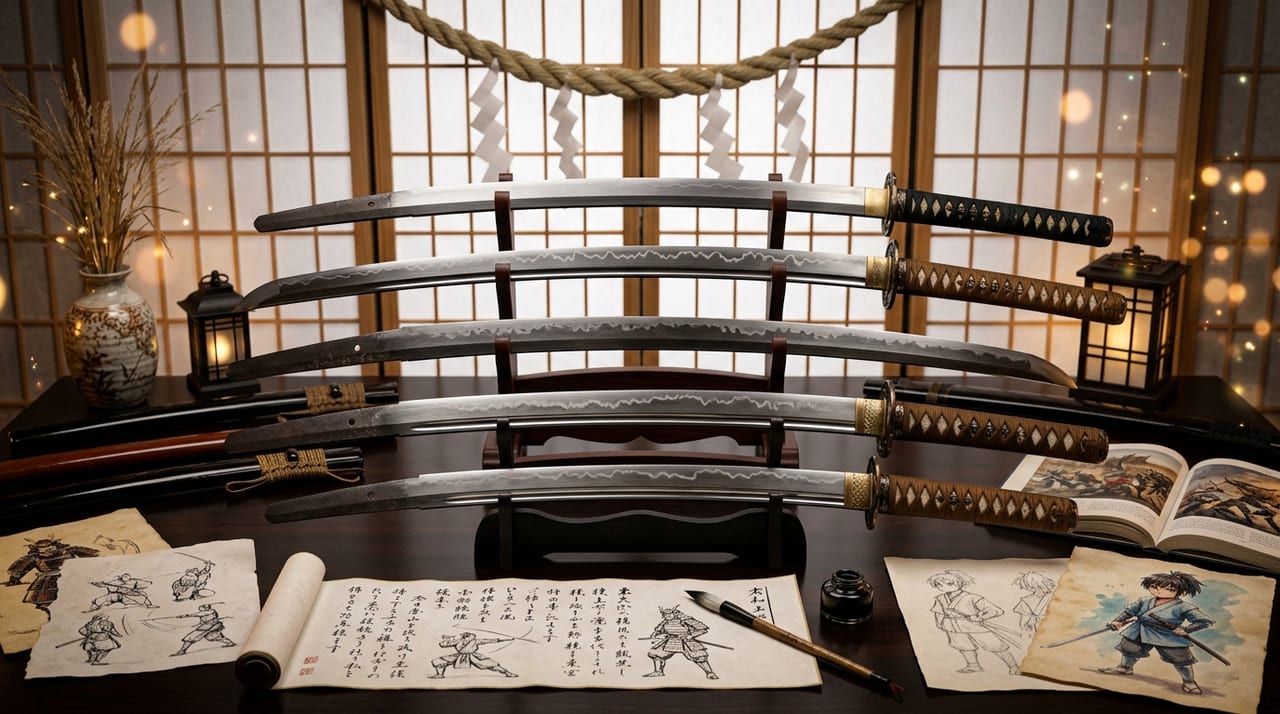
 * Image is for illustrative purposes only.
Kara no Kyoukai
空の境界
A theatrical anime film series (2007–2009, seven chapters) based on the original work by Nasu Kinoko and produced by ufotable. Ryōgi Shiki fights supernatural beings and curses with the Mystic Eyes of Death Perception, a knife, and the Japanese sword Kuji Kanesada, in a supernatural action work. The Kuji Kanesada that Shiki wields is depicted as a symbolic weapon that elevates the aesthetics of the Japanese sword into modern urban fantasy, making this work representative of TYPE-MOON's view of swords and weapons.
Description
Kara no Kyōkai (the Garden of sinners) — The Kuji Kanesada and the Aesthetics of the Japanese Sword in Modern Urban Fantasy
Kara no Kyōkai (the Garden of sinners) is a fantasy novel by Nasu Kinoko (TYPE-MOON). It was first published as a web novel in 1998 and released as a doujin publication in 2001. From 2007 to 2009, ufotable, the studio behind Demon Slayer and Fate/Zero, adapted it into a theatrical anime film series of seven chapters. The protagonist, Ryōgi Shiki, possesses the Mystic Eyes of Death Perception (chokushi no magan), the ability to see the lines of death in all things. Her weapons are mainly knives, but her original weapon is a Japanese sword, and in the story she wields an antique blade, the Kuji Kanesada.
Ryōgi Shiki's Kuji Kanesada — A Modern Fantasy Weapon in the Form of a Japanese Sword
The Kuji Kanesada that Shiki uses is set up as an antique blade made about 500 years ago by Izumi-no-kami Kanesada, and it has spiritual and magical properties that differ from ordinary Japanese swords. Combined with the Mystic Eyes of Death Perception, the Kuji Kanesada becomes a weapon with a supernatural function: it “materializes the lines of death and cuts through them.”
This setting can be understood as an adaptation, in modern urban fantasy, of the “spiritual and magical qualities” of the Japanese sword: the legends of demonic blades, divine swords, and demon-slaying swords. In Japanese sword culture, the idea that “a sword is not merely a weapon but a spiritual being and a vessel of spiritual power” has existed since ancient times. The divine sword traditions of the Kusanagi no Tsurugi and the Futsu no Mitama no Tsurugi are typical examples.
The Kuji Kanesada in Kara no Kyōkai is positioned as a weapon that embodies this Japanese notion of “the sword as a spiritual vessel” in the context of modern supernatural horror.
The Sword Aesthetics of TYPE-MOON — Continuity with the Fate Series
Kara no Kyōkai is the starting point of the TYPE-MOON worldview, which leads on to later works such as Fate/stay night (2004) and Fate/Zero (2011). In TYPE-MOON's works, Japanese swords, noble phantasms (hōgu), and holy swords have consistently held an important place as “symbolic weapons that carry spiritual power,” and the Kuji Kanesada in Kara no Kyōkai has historical significance in the series as its earliest expression of this.
TYPE-MOON's depictions of swords and weapons, such as the twin swords Kanshō and Bakuya of Archer (Mumei) in the Fate series, draw deeply on Japanese sword culture, and Kara no Kyōkai is positioned as their origin.
The Mystic Eyes of Death Perception and “the Principle of Things” — “The Metaphysics of Cutting”
The Mystic Eyes of Death Perception are “the ability to see the lines and points of death in every existence.” This ability can be understood as a visualization of metaphysical insight into the act of “cutting (giving death)”: “Why does this existence die, and what is the necessity of death?”
ufotable's Visual Beauty and “Movement of the Blade”
The ufotable-produced footage from 2007 to 2009 had the highest standard of animation and visual technology for theatrical anime at the time. Shiki's battle scenes were highly praised for their staging of “drawing the sword, slashes, afterimages, and sprays of blood.”
Perspective for Sword Collectors
As a work that lets readers experience the “spiritual and magical aspects of the Japanese sword” in the form of modern supernatural fantasy, Kara no Kyōkai offers sword collectors the perspective of “the spiritual meaning of the sword.” As the origin of TYPE-MOON's sword depictions and the starting point of the later Fate series (a treasure trove of famous swords and noble phantasms), it is an important reference point for exploring the intersection of sword culture and contemporary pop culture.
Real Swords Featured
Kusanagi Sword
Futsu no Mitama no Tsurugi
This page is intended to introduce Japanese sword culture and is not affiliated with any of the works mentioned.