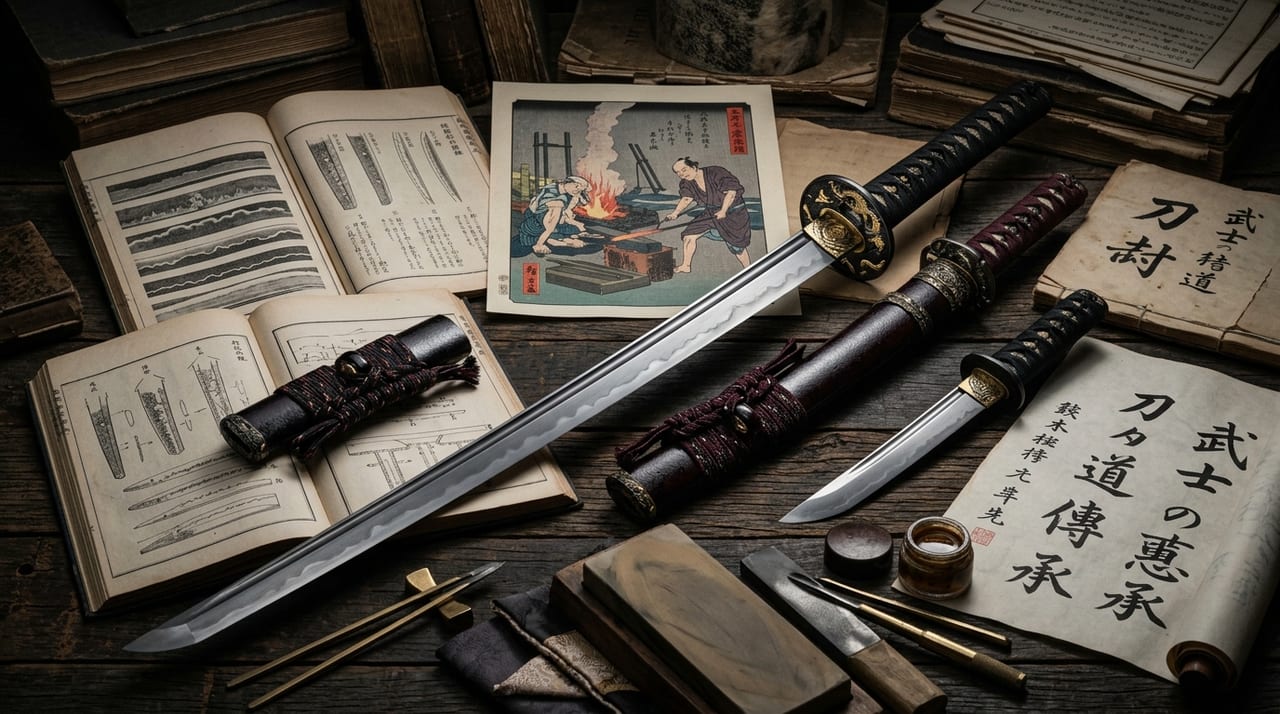
 * Image is for illustrative purposes only.
Hell's Paradise
地獄楽
A manga by Yuuji Kaku serialized in Weekly Shonen Jump+ (2018–2021) and anime adaptation (2023, produced by MAPPA). The story follows the beheading sword of executioner Yamada Asaemon Sagiri and death-row ninja Gabimaru, who explores Sengyoku Island to prove his innocence. The setting of the "beheading executioner" and "decapitation sword" directly portrays the Japanese sword's role as a tool of official state execution, embodying in contemporary manga the core theme of Japanese sword culture—the spiritual bond between sword and wielder. As a popular serialization in Weekly Shonen Jump+ read worldwide, it introduced contemporary fans to the historical aspect of the Japanese sword as an instrument of capital punishment.
Description
Hell's Paradise—The Fateful Relationship Between Sword and Wielder Embodied by the Execution Sword and the Executioner
Hell's Paradise (Koga Yuuji, 2018–2021) is a manga serialized in Weekly Shonen Jump+ and was adapted into an anime by MAPPA in 2023. The story follows Gabimaru, a ninja and death-row inmate of the shogunate, as he explores "Sengyoku Island" (a secret shogunate-sanctioned realm rumored to contain an elixir of immortality), accompanied and supervised by "Yamada Asaemon Sagiri"—the daughter of an official shogunate-appointed executioner family. The reason this work is significant to Japanese sword culture is that its depiction of the "execution sword" (斬首刀)—a specialized blade designed to sever human heads—directly portrays the katana's historical role as a tool of official state execution in contemporary manga form.
The "Execution Sword"—The Katana as an Instrument of Execution
The sword that Sagiri wields as an executioner is depicted as a blade used for the shogunate's method of capital punishment—decapitation. The concept of an "execution sword" is based on an actual concept that existed in Japanese sword history. The practical execution blade—the sword used for decapitation in the Edo period—required different characteristics than a standard uchigatana. To achieve "one-stroke decapitation" (一刀両断)—severing the head in a single blow—the blade required precise balance between sharpness and weight, combined with the blade's rigidity and adjusted length for maneuverability. Historical records document that official executioners employed by the shogunate used thick, heavy blades called dou-tanuki (胴田貫).
"The Sword and Its Wielder"—Sagiri's Blade Philosophy
The most significant sword theme in Hell's Paradise unfolds through the relationship between Sagiri and her blade: the spiritual bond between sword and wielder. Sagiri is depicted as a person who professionally wields a sword designed to sever heads, caught in conflict between viewing the blade purely as a tool of death and maintaining deep professional reverence toward it. This inner tension embodies a fundamental question in Japanese sword culture: "Is a sword merely a tool, or is it an extension of its wielder's spirit?" The philosophical dichotomy of the "life-giving sword" (活人剣, katsujinken) versus the "death-dealing sword" (殺人剣, setsujinken)—central to the Yagyu Shinkage-ryu tradition—echoes through the contrast between Sagiri's execution blade and Gabimaru's ninja sword.
The History of Capital Punishment—Edo-Period Justice and the Blade
During the Edo period, decapitation (uchi-kubi) was one of the principal methods of capital punishment in the shogunate and domain legal systems. Samurai-class criminals faced seppuku with kaishakunin assistance—a trusted attendant who would sever the condemned's head to hasten death—while commoner-class criminals were executed by decapitation. Executioners were typically drawn from the hinin, an outcast social class, embodying a profound social contradiction: they possessed the right to wield a sword while facing systematic discrimination. In Hell's Paradise, the Yamada Asaemon clan embodies this tension—the role of executioner combined with the samurai skills and pride required to carry it out.
Official Shogunate Swordsmiths—The Reality of Execution Blades
The Edo shogunate appointed official swordsmiths (goyou-kaji) to manufacture blades for the shogun and government. While it remains unclear whether specialized execution-sword smiths existed, tsujigiri—test-cutting practice on corpses to evaluate a new blade's edge—was an established historical practice during the Edo period, and the name "Yamada Asaemon" is drawn from the historical family of test-cutting masters. In Hell's Paradise, Sagiri Yamada Asaemon carries the clan name of this actual historical family of test-cutting practitioners and executioners, lending historical authenticity to the execution-blade concept.
MAPPA's Sword Action Direction
MAPPA's 2023 anime adaptation earned praise for its fluid, dynamic action sequences and sword choreography. The depiction of Sagiri's execution blade—emphasizing the distinctive "heavy, decisive stroke" and "pursuit of absolute precision"—visually captures the fundamental weight and gravity of the cutting motion in MAPPA's signature combat style. Particularly striking are scenes where Sagiri applies her execution techniques to actual combat, allowing viewers to experientially understand how an execution blade functions as a weapon in genuine swordplay.
A Collector's Perspective on Japanese Swords
Hell's Paradise stands as the most direct contemporary manga and anime treatment of the katana's historical role as an instrument of state execution, serving as crucial reference material for understanding the darker aspects of sword culture—the practical testing of blade performance, the methods of execution, and the social status of executioners. The use of the actual historical Yamada Asaemon family name—test-cutting masters—provides an entry point into tsujigiri culture and the historical practice of evaluating katana blade quality. The concept of the execution blade prompts modern enthusiasts to reconsider what "sharpness" and cutting performance fundamentally meant and the circumstances in which this cutting performance was historically tested.
Real Swords Featured
uchigatana
dou-tanuki
See authentic Japanese swords
See authentic Japanese swordsThis page is intended to introduce Japanese sword culture and is not affiliated with any of the works mentioned.