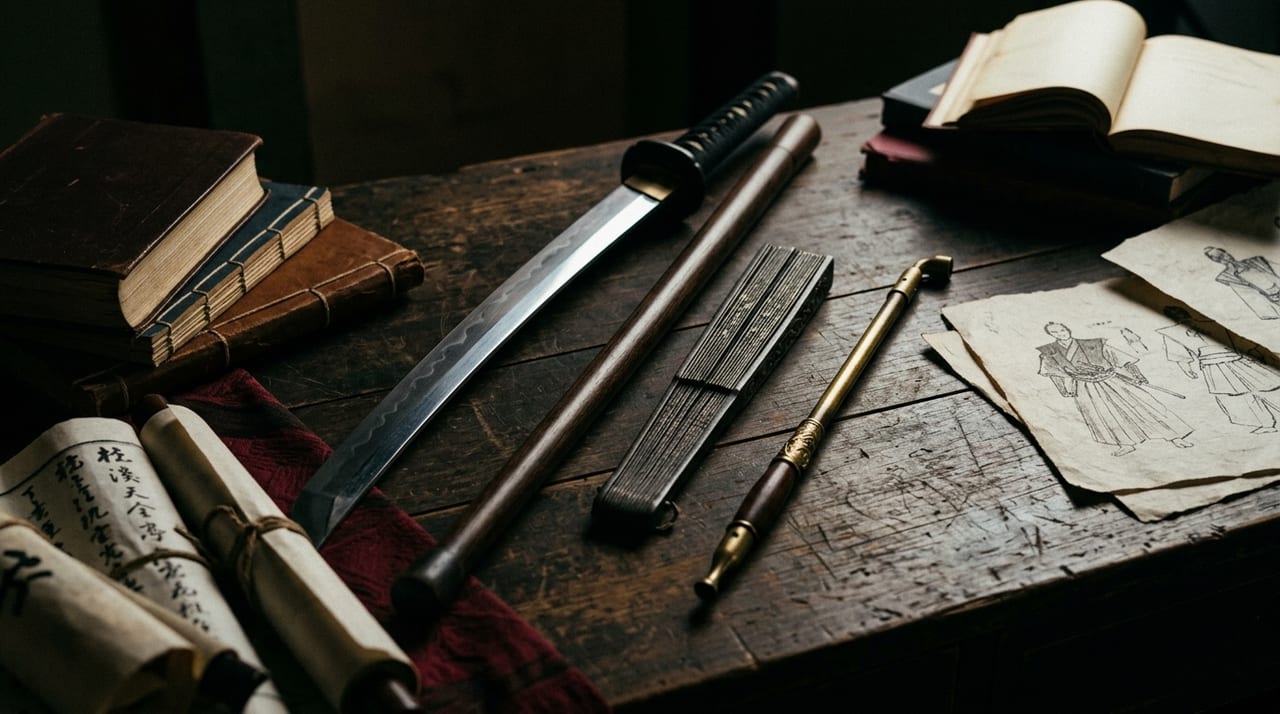
 * Image is for illustrative purposes only.
Hissatsu Shigotonin (Sure Death: The Assassins)
必殺仕事人
A period drama series first aired in 1979 on TV Asahi, produced by Asahi Broadcasting Corporation and Shochiku. It is a flagship of the Hissatsu series and still gets special editions in the 2020s. The story follows the 'shigotonin', a secret underground group who take down villains the law cannot reach, using their own hidden weapons and assassination techniques. Nakamura Mondo (Makoto Fujita), a dōshin, cuts and stabs villains with the daitō and wakizashi he carries as a constable. The series also features turning everyday objects into murder weapons, such as the broker Otowa's shikomi-jamisen (a shamisen with concealed blades) and Hide's kanzashi (ornamental hairpin).
Description
Hissatsu Shigotonin: Edo-Era Hidden-Weapon Culture Embodied in Concealed-Blade Swords
Hissatsu Shigotonin (1979 onward) is a flagship period drama produced by Asahi Broadcasting Corporation and Shochiku and aired on TV Asahi. It is the longest-running and most widely known work in the Hissatsu series. Its premise, in which 'shigotonin' who use their own assassination techniques and secret weapons take down villains the law cannot reach, embodies the dual-life culture of the Edo period: the 'omote no kao' (public face) and the 'ura no kagyō' (underground trade). The series is also one of the works that popularized the 'hidden weapon' motif in popular culture, including swords with blades concealed in their hilts and the shikomi-jamisen.
Shikomizue: Swords Hidden Inside Canes
The shikomizue is a 'hidden sword' in which a blade (a steel edge) is concealed inside what looks like an ordinary cane or bamboo walking stick. In the Edo period, before the Haitōrei edict (Meiji 9, 1876), samurai were officially permitted to wear swords, but people of other status were forbidden or restricted from carrying them. In response to this social restriction, a culture of hiding swords in everyday objects arose in Japan. The shikomizue is its most representative form, and the following historical examples survive: actual shikomizue said to have been used for self-defense by swordsmen of the late Edo period (preserved in museums in various regions), and shikomizue and shikomi-gasa (concealed-blade umbrellas) that spread after the Meiji period as self-defense for samurai after the sword ban.
Nakamura Mondo's Daitō and Wakizashi
Nakamura Mondo (Makoto Fujita), the protagonist of Hissatsu Shigotonin, leads a double life. By day he serves as a dōshin (a low-ranking constable) in the magistrate's office, and by night he works as a 'shigotonin' who takes down villains. Mondo's weapons are the daitō and wakizashi that he carries as a constable, and he strikes by cutting and stabbing when the opponent is off guard or open. In the first episode he disarms an opponent's trust by handing over a sword whose hilt is rigged to come off. This tactic became the origin of the variant technique in Hissatsu Shigotonin V, in which a blade concealed in the hilt strikes a vital point. Among his allies, the broker Otowa uses the shikomi-jamisen, which hides blades in the neck and tuning pegs, and the ornament craftsman Hide stabs villains in the nape of the neck with a kanzashi.
The Aesthetics of 'One Thrust': The Philosophy of the Signature Kill
The sword choreography (tate) of Hissatsu Shigotonin is defined by the aesthetics of 'ichigeki hissatsu' (a single blow that kills). The shigotonin's fights are not flashy sword duels. They finish an opponent with a minimal motion, a 'hitotsuki' (one thrust) or 'hitofuri' (one swing). This 'certain strike with minimal motion' is a dramatic embodiment of the Japanese sword philosophy of ichigeki hissatsu, which holds that 'a single perfect swordsmanship technique defeats the opponent.' Just as the kendō concept of 'ippon' embodies the value of one complete strike, the shigotonin's 'hitoshigoto' (one job) embodies the value of one complete assassination strike.
The Edo 'Underworld' and Hidden-Weapon Culture
The world of Hissatsu Shigotonin embodies the duality of the Edo 'public' and 'underground' societies. The premise that a magistrate's office official (public) is an assassin in secret (underground) dramatizes, as period drama, the cultural duality of 'tatemae' (public principle) and 'honne' (true feelings) in Edo society. This motif of 'hidden weapons' and 'hidden faces' reflects the practical dynamics of Edo society, which turned swords from 'public weapons' (samurai wearing swords) into 'underground weapons' (hidden blades). In the era after the sword ban, when swords could no longer be carried openly, the act of 'hiding a sword and continuing to carry it' carries the cultural meaning of resistance to the end of the age of the sword.
The Cultural Influence of the Hissatsu Series: Popularizing Concealed Weapons
From the Hissatsu series that began in 1972 to the present Hissatsu Shigotonin, the series has spread the concept of 'concealed weapons' through Japanese popular culture for more than fifty years. Its varied ideas of turning everyday objects into murder weapons, such as the shikomi-jamisen and the kanzashi, function as a cultural source for the 'hidden-weapon character' found in contemporary period drama, manga, and games.
A Perspective for Sword Collectors
Hissatsu Shigotonin is the most approachable entry point for understanding the 'concealed weapon', a special form of Japanese sword culture. It also serves as an entry point to the interest in 'shikomi-mono' (concealed-weapon objects), such as shikomizue and shikomi-kiseru (concealed-blade pipes), which actually circulate as collector items in today's sword market. By presenting, in the most accessible form of a period drama story, the social context of Edo-era sword regulation (the legal and social constraints on who could carry a sword, when, and where), the series contributes to understanding the historical and social context of sword culture.
Real Swords Featured
Uchigatana
Shikomi-katana (Hidden Sword)
Wakizashi
See authentic Japanese swords
See authentic Japanese swordsThis page is intended to introduce Japanese sword culture and is not affiliated with any of the works mentioned.