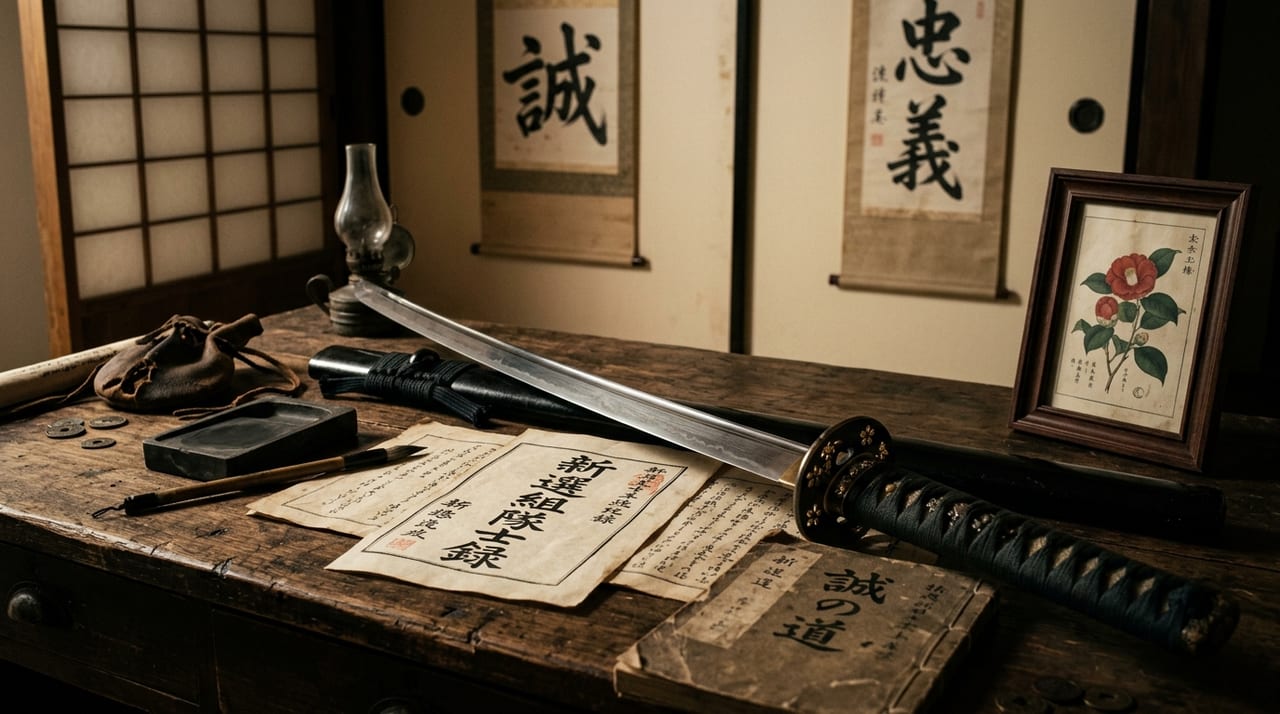
 * Image is for illustrative purposes only.
Hakuoki: Demon of the Fleeting Blossom
薄桜鬼
A multimedia franchise based on an otome game released by Idea Factory in 2008. Set in the late Edo period (bakumatsu), it centers on members of the Shinsengumi and depicts a world that fuses the blood of demons with the aesthetics of swordsmen. Its depiction of the sword culture used by the Shinsengumi and of bakumatsu swordsmanship is outstanding, making it a rare work that, beyond the otome game framework, is also supported by history fans and sword enthusiasts.
Description
Hakuoki and the World of Bakumatsu Swordsmen
Hakuoki originated as an otome game released by Idea Factory in 2008, and has grown into a work that has expanded across a wide range of media, including anime, stage plays, films, and novels. The setting is Kyoto in the bakumatsu period. The protagonist, Yukimura Chizuru, comes to serve within the Shinsengumi, and the story unfolds as she interacts with real Shinsengumi members, including Hijikata Toshizō, Okita Sōji, Saitō Hajime, Tōdō Heisuke, Nagakura Shinpachi, and Harada Sanosuke. Although it belongs to the otome game genre, a sincere commitment to bakumatsu history and to the depiction of swordsmanship runs throughout the entire work, and it is noteworthy that it is highly regarded by history lovers and sword enthusiasts as well.
Depicting the Shinsengumi and Tennen Rishin-ryū
What Hakuoki puts the most effort into is a faithful depiction of the Shinsengumi as an organization and of its swordsmanship culture. Tennen Rishin-ryū, whose sōke (headmastership) Kondō Isami inherited, is a practical swordsmanship school founded by Kondō Kuranosuke and spread to farming villages in the Tama region. Its training system prioritizes survival in actual combat over refined dojo swordsmanship. In Hakuoki, this Tennen Rishin-ryū style, both rough and rational, is reflected in each character's fighting style. Hijikata Toshizō's relentless swordsmanship as the “Demon Vice-Commander,” Okita Sōji's virtuosic “sandan-zuki” (three-stage thrust) as a genius's technique, and Saitō Hajime's silent, left-hand sword aimed at a one-blow kill are each depicted distinctively, based on the anecdotes passed down about them. Because the swordsmanship schools are deeply tied to the characters' individuality, Hakuoki is also a work of great interest from the perspective of the history of swordsmanship.
The Aesthetics of the Japanese Sword and Bakumatsu Sword Culture
The bakumatsu period holds special significance in the history of the Japanese sword as well. This era, immediately before samurai were prohibited from wearing swords under the Haitōrei (sword-abolition edict) of 1876 following the Meiji Restoration, was the last period in which Japanese swords were used as actual weapons. Hakuoki carefully depicts the sword culture of this era down to the finest details. The swords worn by the members function as props that show each person's individuality and rank, and depictions of everyday maintenance, such as cleaning, polishing, and checking the mekugi (blade-securing pegs), recur repeatedly, bringing out the everyday life of the people who used swords. Furthermore, the depiction of realistic constraints in battle scenes, such as the speed of drawing the sword, the weight of the blade, and the limits of its sharpness, emphasizes that the Japanese sword is not a tool with supernatural power but a practical weapon forged through rigorous craft.
The Boundary Between Demon and Human: The Spiritual Dimension of the Japanese Sword
Hakuoki's uniqueness lies in its worldview, which combines a supernatural element, the “blood of demons,” with depictions of the bakumatsu period based on historical record. Members called “rasetsu” who possess demonic power display swordsmanship beyond that of ordinary humans, but at the same time they live side by side with the danger of losing their human reason. This setting deeply resonates with an ancient Japanese idea about the spiritual aspect residing in the sword: that the sword is not merely a weapon but a sacred vessel that has a soul and holds spiritual power. The vision of “warriors in whom the sword and the blood of demons are fused” that Hakuoki portrays can be seen as a reinterpretation of this spiritual dimension of the Japanese sword as modern entertainment.
Cultural Influence
Through its meticulous depiction of the bakumatsu period and its appealing character design, Hakuoki attracted a broad fan base that went beyond the otome game framework, and it played a major role in raising interest in the Shinsengumi and bakumatsu history. Particularly among female fans, there are many cases of people who, prompted by Hakuoki, began visiting actual Shinsengumi history, swords, and historic sites in Kyoto.
Real Swords Featured
Izumi no Kami Kanesada (Hijikata Toshizō's beloved sword)
The Aizu swordsmith Izumi no Kami Kanesada (11th generation) is well known as the sword that Hijikata Toshizō, vice commander of the Shinsengumi, actually favored. In Hakuoki as well, Hijikata's character image is based on this historical fact, and Kanesada's magnificent overall form (taihai) and practical hamon (temper line) embody the appearance of a sword fitting for the vice commander of the Shinsengumi, the strongest band of swordsmen of the bakumatsu period.
Kashū Kiyomitsu (Okita Sōji's beloved sword)
Kashū Kiyomitsu, a swordsmith from Kaga (present-day Ishikawa Prefecture), is famous as the maker of the sword said to have been used by Okita Sōji, captain of the First Unit of the Shinsengumi. Okita's swordsmanship, said to have included the legendary “sandan-zuki” (three-stage thrust) as a genius swordsman, and Kiyomitsu's light and sharp style of sword-making are discussed as being deeply connected. Hakuoki's Okita Sōji is faithfully based on this historical swordsman, and Kiyomitsu's sword symbolizes the sword culture at the core of the Hakuoki world.
Nagasone Kotetsu (sword of Kondō Isami, commander of the Shinsengumi)
Nagasone Kotetsu was a renowned swordsmith of the early-to-mid Edo period, and his blades, for their extraordinary cutting ability, received the highest regard among the samurai class. He is famous for Shinsengumi commander Kondō Isami claiming to possess a genuine Kotetsu, but the authenticity of this claim has been historically debated. In Hakuoki as well, the relationship between Kondō Isami and the Kotetsu is an important motif, functioning as an embodiment of the admiration and pride for renowned swords within bakumatsu swordsmen culture.
This page is intended to introduce Japanese sword culture and is not affiliated with any of the works mentioned.