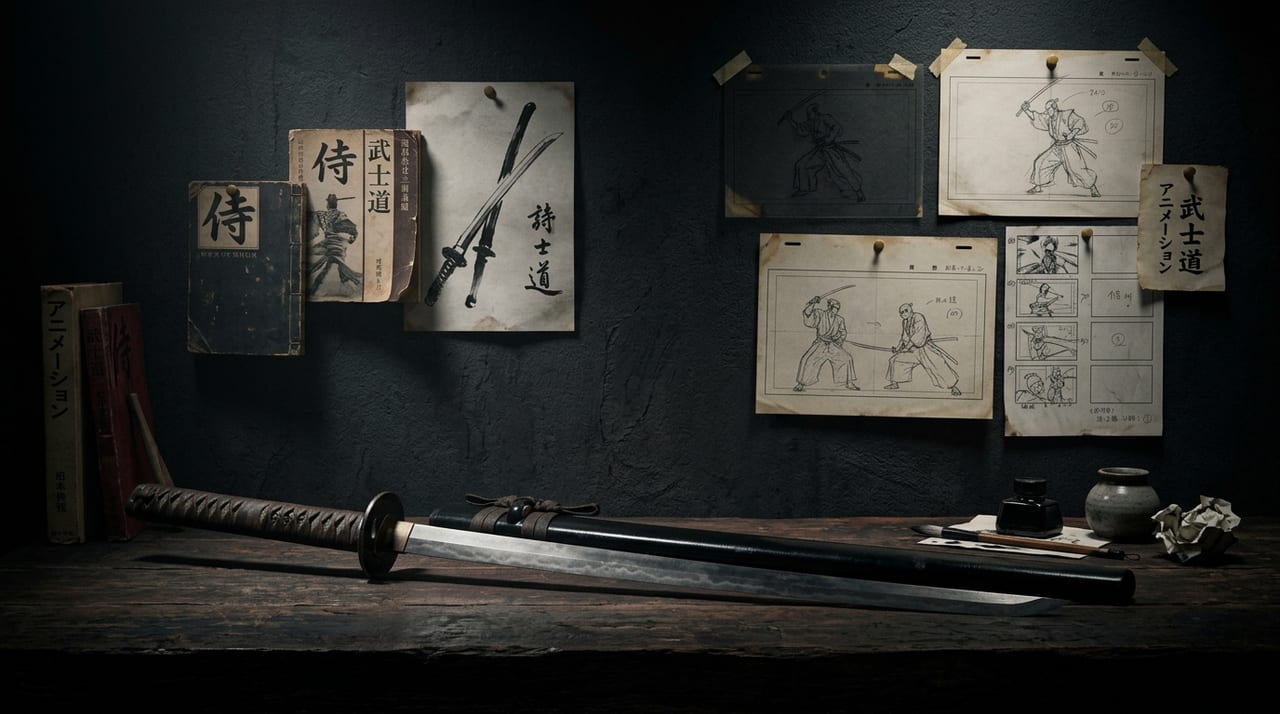
 * Image is for illustrative purposes only.
Final Fantasy VII
ファイナルファンタジーVII
A landmark RPG released by Square (now Square Enix) in 1997. The towering blade wielded by antagonist Sephiroth, named Masamune, is derived from the legendary Kamakura-era swordsmith Okazaki Masamune.
Description
Overview
Final Fantasy VII is a role-playing game released by Square (now Square Enix) for the PlayStation in 1997. The seventh mainline entry and the series' pivotal transition to full 3D graphics, it became a global phenomenon and remains the franchise's flagship title, spawning the Final Fantasy VII Remake (2020) and Final Fantasy VII Rebirth (2024) as part of a remake project that continues over a quarter-century later.
Sephiroth and the Masamune
The game's central antagonist, Sephiroth, wields Masamune, an oversized blade over two meters in length. Depicted in-game as a monumental odachi-style sword far beyond a standard uchigatana, it functions as a visual symbol of the character's overwhelming power.
The Real Swordsmith Okazaki Masamune
The name "Masamune" is drawn from a real swordsmith, Okazaki Gorō Nyūdō Masamune, believed to have worked in Sagami Province (present-day Kanagawa Prefecture) during the late Kamakura period (late 13th–14th century). He is credited with perfecting the Sōshū-den forging tradition, combining hard and soft steel to produce blades prized for both practicality and beauty. Few of his works survive and detailed primary sources on his life are limited, yet his name endures as a byword for the pinnacle of Japanese swordsmithing.
The Masamune–Muramasa River Legend
A well-known legend pits Masamune against another famed smith, Muramasa, in a contest where each smith's sword was set into a stream: Muramasa's blade is said to have cut everything that drifted near it, including leaves, while leaves parted around Masamune's blade untouched. From this tale arose the enduring contrast between Masamune as the maker of "life-affirming" blades and Muramasa as the maker of "bloodthirsty, cursed" ones — a legend understood today as later folklore rather than verified history, but one that remains emblematic of Japanese sword culture's ideals. Final Fantasy VII's choice to name Sephiroth's blade after Masamune draws directly on this legendary smith's prestige and narrative weight.
Cultural Impact
A quarter-century after release, Sephiroth and his Masamune blade remain beloved by gamers worldwide, endlessly reproduced as cosplay props, figures, and replica-sword motifs. For overseas players with little direct exposure to real Japanese swords, the name "Masamune" has served as a meaningful gateway into Japanese blade culture.
Real Swords Featured
Okazaki Masamune, Master of the Sōshū Tradition
A swordsmith believed to have worked in Sagami Province (present-day Kanagawa Prefecture) during the late Kamakura period. Credited with perfecting the Sōshū-den forging method, combining hard and soft steel to produce blades that balanced practicality with beauty, he is counted among the greatest swordsmiths in Japanese history. Few of his works survive and reliable primary sources on his biography are scarce, but his name became a lasting byword for the highest quality in Japanese blades.
The Masamune–Muramasa River Legend
A famous legend pitting Masamune against Muramasa, another renowned smith later associated with 'cursed' blades, tells of both swords being set upright in a stream: Muramasa's blade cut through everything that drifted near it, including leaves, while Masamune's blade was untouched as leaves parted around it. The tale cemented Masamune's reputation for 'life-affirming' blades against Muramasa's for 'bloodthirsty' ones. Understood today as later folklore rather than verified history, it nonetheless remains a story emblematic of the ideals prized in Japanese sword culture.
See authentic Japanese swords
See authentic Japanese swordsThis page is intended to introduce Japanese sword culture and is not affiliated with any of the works mentioned.