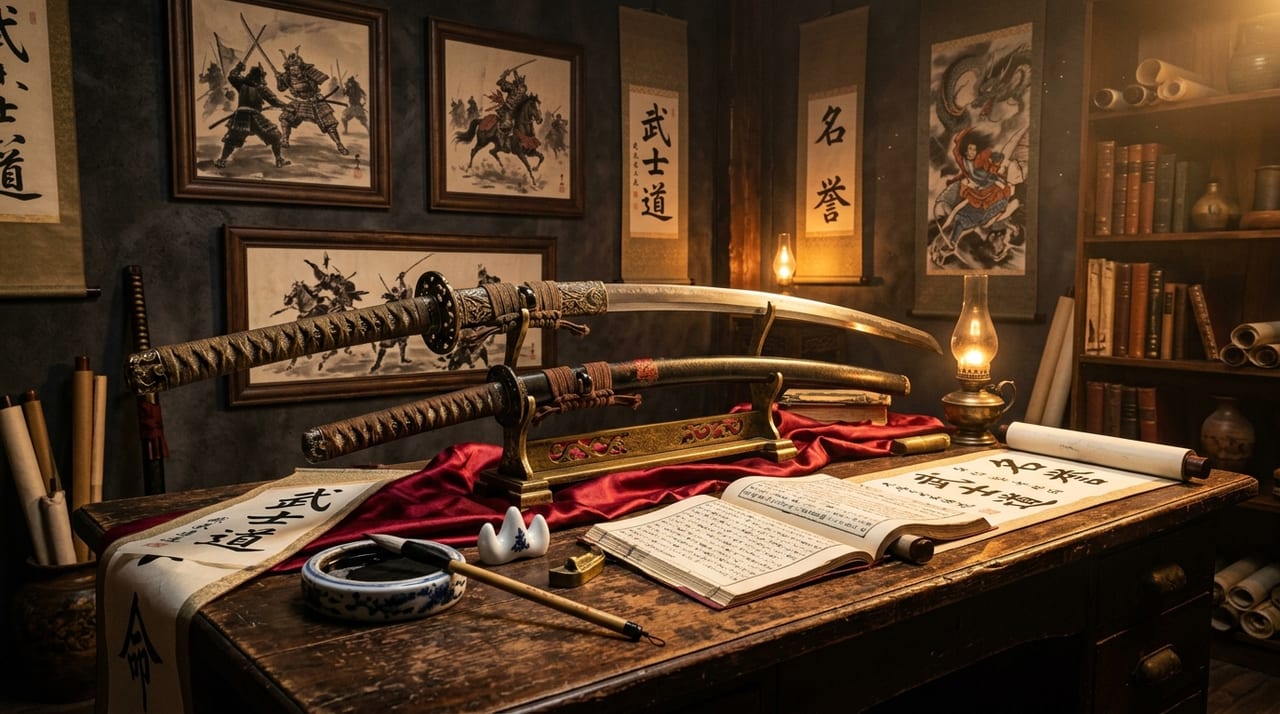
 * Image is for illustrative purposes only.
Fate/stay night
A large-scale media mix originating from the visual novel that TYPE-MOON released in 2004. Among the heroic spirits (Servants) summoned in the "Holy Grail War," several heroic spirits wield Japanese swords and Japanese-style weapons, and Japan's heroic legends and weapon culture are reinterpreted within the context of global pop culture.
Description
The Fate Series and Japanese Swords
Fate/stay night originated as a visual novel released by TYPE-MOON in 2004, and developed into a worldwide major franchise that includes anime, films, and a body of spin-off works. Under the concept of the "Holy Grail War," the setting in which heroes and heroic spirits from across all eras and regions are summoned into the modern day as Servants to fight one another functions as a device that arouses interest in the mythology, history, and legends of the world. With many Japanese heroes and swordsmen appearing, it contributes to the international dissemination of Japanese sword culture.
Sasaki Kojirō and Tsubame-gaeshi
The iconic Japanese sword in the Fate series is undoubtedly Sasaki Kojirō (Assassin class). Kojirō is depicted as a swordsman who wields a Bitchū Aoe long blade of a little over five shaku (called the Monohoshizao, or "clothes-drying pole") and possesses Tsubame-gaeshi, the ultimate sword technique.
The real Sasaki Kojirō was a swordsman of the early Edo period, whose name entered history through his duel with Miyamoto Musashi on Ganryū Island. The long nodachi (great sword) said to have been his weapon has a blade length exceeding that of an ordinary uchigatana (standard sword), which produces the absolute advantage of reach, while it demands outstanding skill to control its weight and length. The popularity of Fate's Sasaki Kojirō brought fans around the world the legend of the sword saint and interest in the diverse forms of Japanese swords.
Okita Sōji and Shinpiken (Mystic Sword)
Okita Sōji, who appears in Fate/Grand Order as a Saber-class figure, is the heroic spirit form of a gifted swordsman who left his name in history as captain of the First Unit of the Shinsengumi. Okita's sword technique, known as the triple thrust, and the legends surrounding his beloved sword, Kashū Kiyomitsu, were delivered to fans around the world throughout the Fate series. Although there are several theories about the actual swords Okita used, the connection with Kashū Kiyomitsu, a swordsmith from Ishikawa Prefecture, is the most widely known.
Heroic Spirits and the Metaphysics of Japanese Swords
One of the most philosophical questions the Fate series presents is the relationship between weapons and heroes. The weapon that a heroic spirit holds as its unique Noble Phantasm is depicted not as a mere tool, but as a conceptual entity inseparably bound to that heroic spirit's essence, legend, and soul.
This idea deeply resonates with the traditional Japanese view of swords, in which a sword is not merely an instrument for killing but a cultural symbol that embodies its owner's soul, dignity, and family line. The way famous blades have names, are handed down through distinguished families, and sit enshrined in museums as witnesses to history precisely overlaps with the Noble Phantasm-like ontology of Fate.
Global Spread and Japanese Sword Culture
Since its release in 2015, Fate/Grand Order has become one of the largest smartphone games in the world, distributed in Japan, China, South Korea, North America, and elsewhere, and has recorded tens of millions of downloads worldwide.
The Fate series, which treats Japanese heroes and swordsmen as heroic spirits, often serves as the first entry point for overseas fans to become interested in Japanese history, martial arts, and sword culture. It has made an immeasurable contribution to raising the international recognition of swordsmen such as Miyamoto Musashi, Sasaki Kojirō, Okita Sōji, and Hijikata Toshizō.
Real Swords Featured
Bizen Osafune Nagamitsu
The Edo-period biography Nitenki records that the blade Sasaki Kojirō used in the duel on Ganryū Island was a nodachi (great sword) with a blade length of over three shaku, known as "Bizen Nagamitsu." Nagamitsu, son of Mitsutada (founder of the Osafune school) and father of Kagemitsu, carried the golden age of Bizen blades. His works, with bold hamon (temper line) and fine jigane (steel base), demonstrate high practicality that meets the demands of master swordsmen. Many of his works are designated National Treasures or Important Cultural Properties, including the National Treasure "Taihannya Nagamitsu" (Tokyo National Museum).
Kashū Kiyomitsu (Okita Sōji's sword)
Kiyomitsu, a swordsmith of Kaga Province (present-day Ishikawa Prefecture), is most widely known as the maker of the beloved sword of Okita Sōji, captain of the First Unit of the Shinsengumi.
This page is intended to introduce Japanese sword culture and is not affiliated with any of the works mentioned.