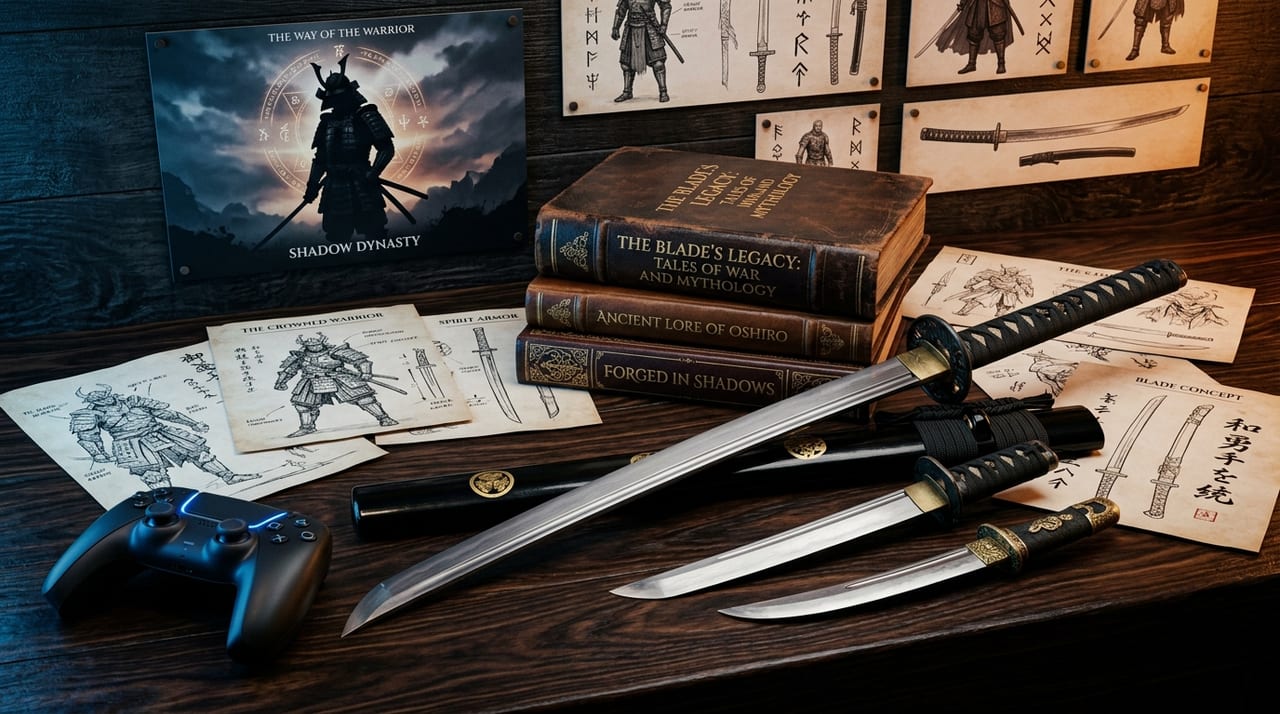
 * Image is for illustrative purposes only.
Elden Ring
エルデンリング
An open-world action RPG released in 2022 as a collaboration between FromSoftware and George R. R. Martin. It is a spiritual successor to the Dark Souls series and is set in an innovative new world, the Lands Between. The game features many swords and curved swords as weapons. Weapons modeled on Japanese swords, such as the renowned blade Moonveil, Rivers of Blood, and Nagakiba, were enormously popular with players around the world. It won Game of the Year in 2022 and is a groundbreaking title that spread Japanese sword aesthetics on a global scale.
Description
Elden Ring—The Gaming Masterpiece That Spread the Aesthetics of the Japanese Sword to the Modern World
Elden Ring (2022, FromSoftware) is an open-world action RPG directed by Miyazaki Hidetaka, with George R. R. Martin, author of A Song of Ice and Fire, participating in the construction of its world. It won numerous top awards, including Game of the Year at The Game Awards in 2022, and as the culmination of FromSoftware's "Souls series" (Demon's Souls, Dark Souls, Bloodborne, Sekiro), it sold over 25 million copies worldwide.
The reason Elden Ring deserves special mention from the perspective of Japanese sword culture is that many weapons from the Japanese sword, tachi, and curved sword (curved sword) categories appear in the game, and their aesthetics, performance, and lore have sparked explosive interest among the international player community.
Japanese Swords in the Game—Moonveil, Rivers of Blood, and Nagakiba
Elden Ring implements several Japanese-sword-style weapons as the "katana" category. The representative ones are as follows.
Moonveil is one of the most popular weapons in the katana category, and it is set up as a "sorcery-type tachi" that combines magic and physical attacks. Its weapon art, "Transient Moonlight"—a high-speed lunging slash resembling battōjutsu—evokes the battō draw of iaidō in its motion design, and it elevates the essence of Japanese iaidō culture into modern game action.
Rivers of Blood is set up as a demonic blade (yōtō) in the katana category, and its unique weapon art, "Corpse Piler," which combines the mysticism of controlling the flow of blood with blade strikes, enjoyed tremendous popularity. Its design can be read as a modern reinterpretation of the Japanese sword legend of the "bloodthirsty demon blade," such as the demon-blade legends of Muramasa.
Nagakiba is a weapon with a particularly long blade within the katana category, and its weapon art is "Unsheathe." Its long blade evokes the cultural image of the nodachi.
FromSoftware and the Japanese Sword—The Sword Aesthetics of the "Souls Series"
The game series developed by FromSoftware has consistently used Japanese sword culture as a core design resource. In Demon's Souls (2009), tachi and katana appeared as Japanese weapons, and in the Dark Souls series, the katana category was implemented independently as weapons of the "East." Sekiro (2019) made the sword culture of the Japanese Sengoku period itself the theme of the entire game.
Elden Ring is the culmination of this "lineage of Japanese sword aesthetics at FromSoftware." By positioning the sword category within the diverse weapon systems of the game in the open-world format, it has succeeded in translating "the characteristics of the sword as a weapon—speed, cutting sharpness, and the weight of a single strike" into the language of modern gameplay.
"The Wound of the Golden Order"—Elden Ring's Lore and the Philosophy of the Blade
In the "Lands Between," the world of Elden Ring, swords carry symbolic meaning beyond that of mere weapons. In a world where the Golden Order (Elden Ring) has been shattered, blades embody fragments of that broken order.
In particular, the sword-category weapon "Hand of Malenia" is depicted as a weapon embodying the contradiction between decay and purity, and it reinterprets, as modern fantasy, the concept of the "cursed famous blade (yōtō)" in Japanese sword culture—the spiritual power a blade holds and its bondage to its wielder.
Spreading the Sword Aesthetic to the World
The greatest contribution Elden Ring has made to Japanese sword culture is that it has let gamers around the world experience the "aesthetics of Japanese-sword-style weapons (speed, cutting sharpness, and the katana silhouette)"—especially players in Europe and the Americas, South America, and Southeast Asia, who previously had little opportunity to encounter Japanese swords.
As a modern cultural medium that can serve as an entry point to an interest in "from games to real Japanese swords," Elden Ring is also a work that draws attention for the international recognition of the Japanese sword.
A Perspective for Sword Collectors
The sword weapons appearing in Elden Ring can be read as translations of the Japanese blade classifications of tachi, uchigatana, and ōdachi into the context of modern games. The iaijutsu-like motion of Moonveil evokes the battō draw of iaidō, and the long blade of Nagakiba evokes the visual impact of the nodachi and ōdachi. These in-game weapons can also serve as a "modern entry point to the Japanese sword," where international players encounter the form, function, and aesthetics of the Japanese sword.
Real Swords Featured
tachi (the sword worn at the waist with its edge facing down, mainstream from the late Heian period to the mid-Muromachi period)
ōdachi and nodachi (large swords with a blade of three shaku, about 90 cm or more)
uchigatana (the standard sword worn in the Edo period)
This page is intended to introduce Japanese sword culture and is not affiliated with any of the works mentioned.